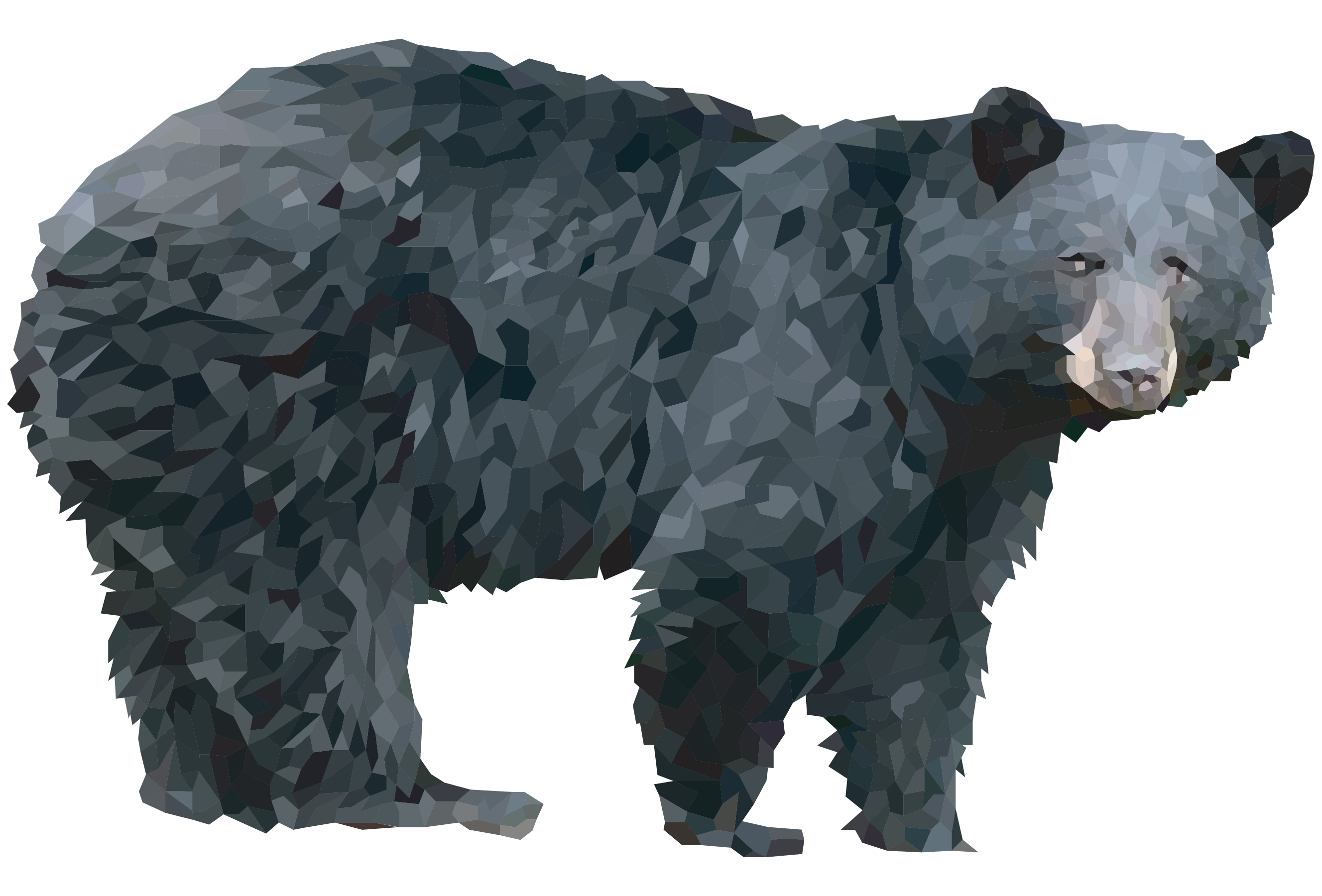
Ursus Americanus
The American Black Bear is a medium-sized bear native to North America. It is the continent’s smallest and most widely distributed bear species. American black bears are omnivores, with their diets varying greatly depending on season and location. They typically live in largely forested areas, but do leave forests in search of food. Sometimes they become attracted to human communities because of the immediate availability of food. The American black bear is the world’s most common bear species. Their fur is soft, with dense underfur and long, coarse, thick guard hairs. The fur is not as shaggy or coarse as that of brown bears. American black bear skins can be distinguished from those of Asian black bears by the lack of a white blaze on the chest and hairier footpads. The skulls of American black bears are broad, with narrow muzzles and large jaw hinges. Females tend to have slenderer and more pointed faces than males.
American black bears are highly dexterous, being capable of opening screw-top jars and manipulating door latches. They move in a rhythmic, sure-footed way and can run at speeds of 25 to 30 miles per hour. American black bears have good eyesight and have been proven experimentally to be able to learn visual color discrimination tasks faster than chimpanzees and just as fast as domestic dogs. American black bears have better eyesight and hearing than humans. Their keenest sense is their sense of smell, which is about seven times more sensitive than a domestic dog’s. American black bears are excellent and strong swimmers, swimming for pleasure and to feed. They regularly climb trees to feed, escape enemies and hibernate. American black bears may communicate with various vocal and non-vocal sounds. During times of fear or nervousness, bears may moan, huff or blow air. The average lifespan in the wild is 18 years, though it is quite possible for wild specimens to survive for more than 23 years.