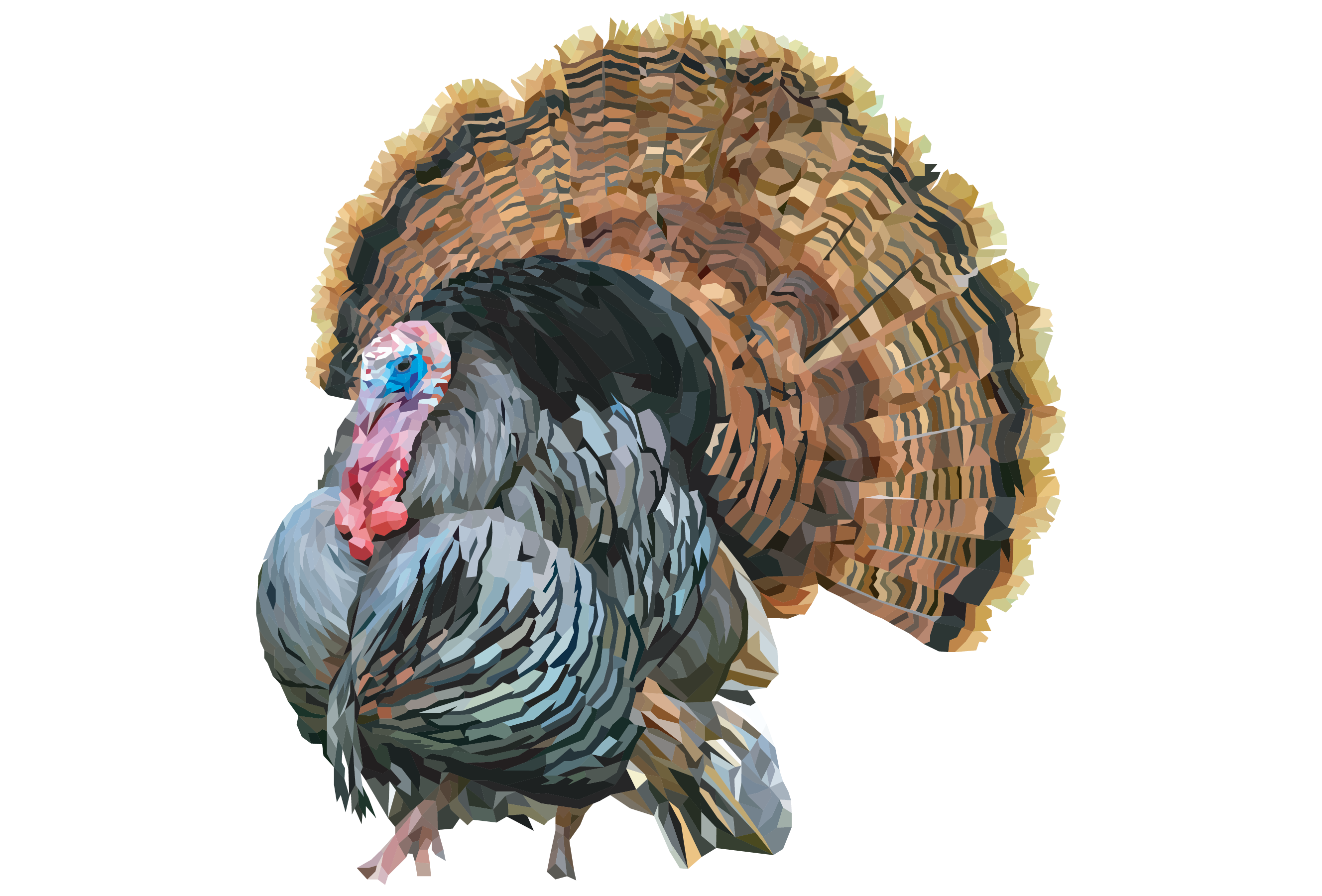
Meleagris Gallopavo
The Wild Turkey is an upland ground bird native to North America, one of two extant species of turkey, and the heaviest member of the diverse Galliformes. It is the same species as the domestic turkey, which was originally derived from a southern Mexican subspecies of wild turkey. Although native to North America, the turkey probably got its name from the domesticated variety being imported to Britain in ships coming from the Levant via Spain. Wild turkeys prefer hardwood and mixed conifer-hardwood forests with scattered openings such as pastures, fields, orchards and seasonal marshes. They seemingly can adapt to virtually any dense native plant community as long as coverage and openings are widely available. Open, mature forest with a variety of interspersion of tree species appear to be preferred.
Adult wild turkeys have long reddish-yellow to grayish-green legs. The body feathers are generally blackish and dark, sometimes grey brown overall with a coppery sheen that becomes more complex in adult males. Adult males, called toms or gobblers, have a large, featherless, reddish head, red throat, and red wattles on the throat and neck. The head has fleshy growths called caruncles. The long fleshy object over a male’s beak is called a snood. Each foot has three toes in front, with a shorter, rear-facing toe in back; males have a spur behind each of their lower legs. Male turkeys have a long, dark, fan-shaped tail and glossy bronze wings. As with many other species of the Galliformes, turkeys exhibit strong sexual dimorphism. The male is substantially larger than the female, and his feathers have areas of red, purple, green, copper, bronze, and gold iridescence. Females, called hens, have feathers that are duller overall, in shades of brown and gray. Parasites can dull coloration of both sexes; in males, coloration may serve as a signal of health. Turkeys have 5000 to 6000 feathers. Predators of adults include coyotes, gray wolves, bobcats, cougars, golden eagles and possibly American black bears, which also will eat the eggs if they find them.