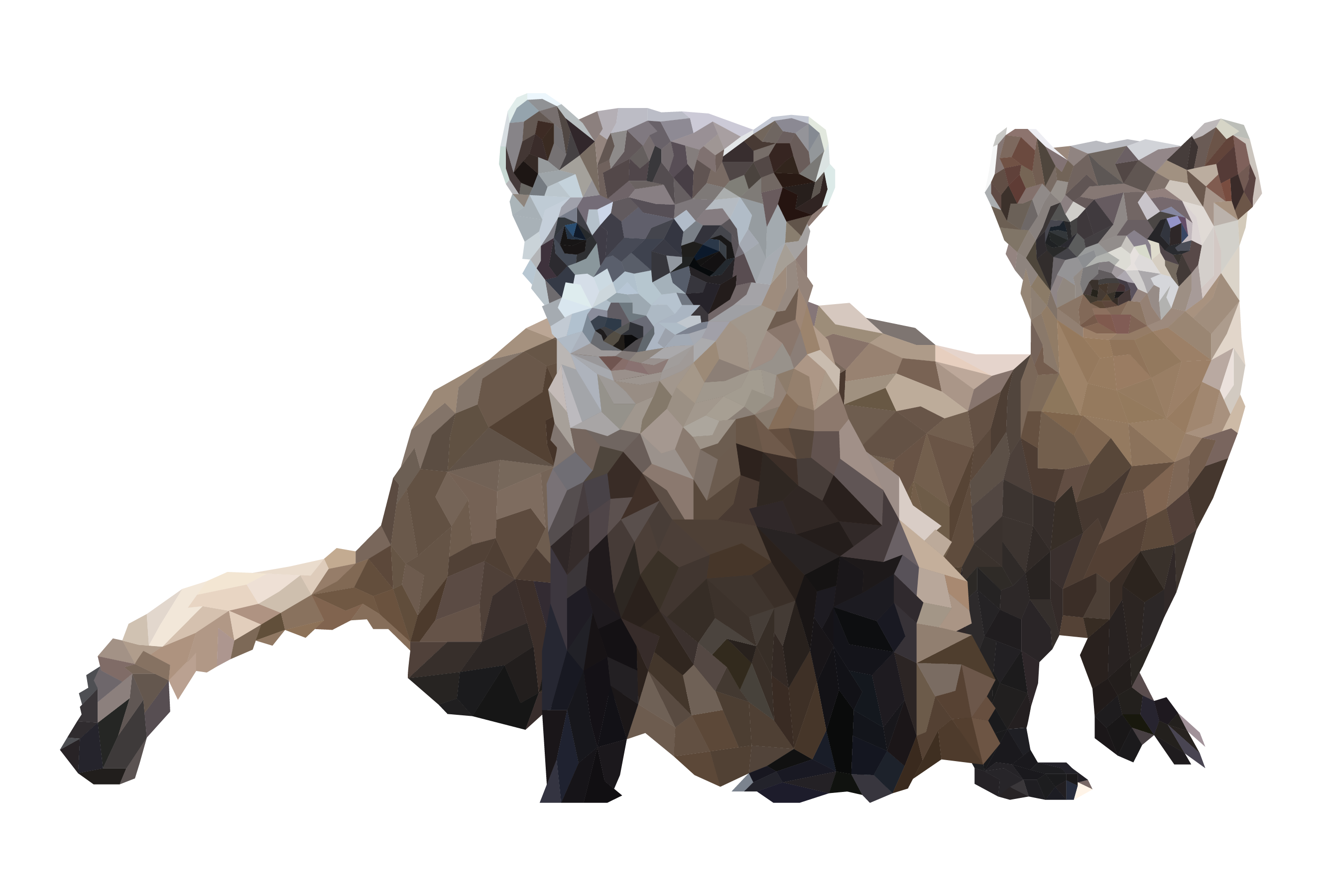
Mustela Nigripes
The Black-Footed Ferret, also known as the American polecat or prairie dog hunter, is a species of mustelid native to central North America. Historical habitats of the black-footed ferret included shortgrass prairie, mixed-grass prairie, desert grassland, shrub steppe, sagebrush steppe, mountain grassland, and semi-arid grassland. Black-footed ferrets use prairie dog burrows for raising young, avoiding predators, and thermal cover. The black-footed ferret has a long, slender body with black outlines such as the feet, ears, parts of the face and its tail. The forehead is arched and broad, and the muzzle is short. It has few whiskers, and its ears are triangular, short, erect and broad at the base. The neck is long and the legs short and stout. The toes are armed with sharp, very slightly arched claws. The feet on both surfaces are covered in hair, even to the soles, thus concealing the claws.
The black-footed ferret is solitary, except when breeding or raising litters. It is nocturnal and primarily hunts for sleeping prairie dogs in their burrows. Up to 91% of the black-footed ferret’s diet is composed of prairie dogs. It is most active above ground from dusk to midnight and 4 am to mid-morning. Aboveground activity is greatest during late summer and early autumn when juveniles become independent. Climate generally does not limit black-footed ferret activity, but it may remain inactive inside burrows for up to 6 days at a time during winter. It is listed as endangered by the IUCN, because of its very small and restricted populations. The species declined throughout the 20th century, primarily as a result of decreases in prairie dog populations and sylvatic plague. A captive-breeding program launched by the United States Fish and Wildlife Service resulted in its reintroduction into eight western US states, Canada, and Mexico from 1991 to 2009.