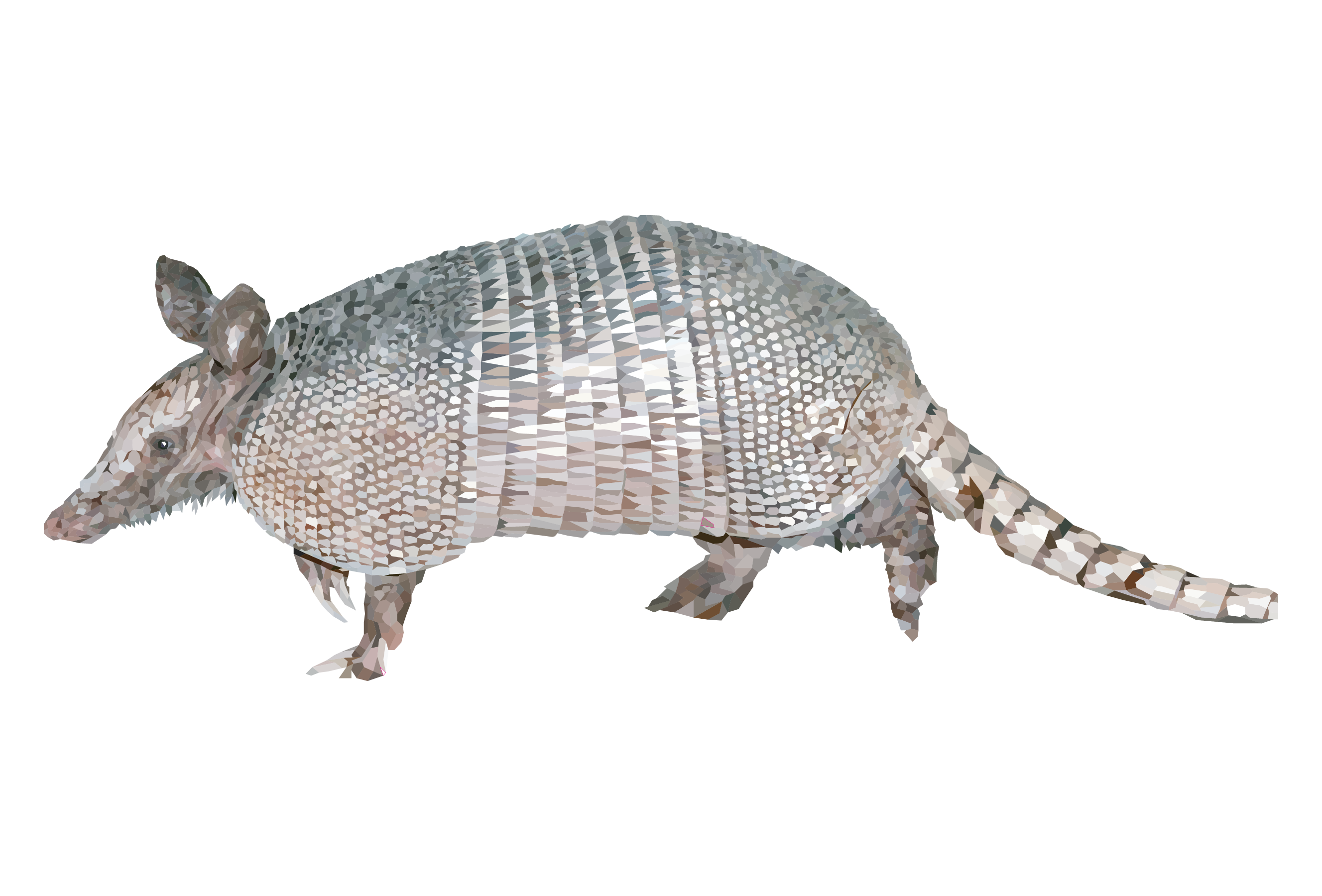
Dasypus Novemcinctus
The Nine-Banded Armadillo is a medium-sized mammal found in North, Central, and South America, making it the most widespread of the armadillos. Its ancestors originated in South America, and remained there until the formation of the Isthmus of Panama allowed them to enter North America as part of the Great American Interchange. They are found in many kinds of habitats, from mature and secondary rainforests to grassland and dry scrub.
Nine-banded armadillos are generally insectivores. They forage for meals by thrusting their snouts into loose soil and leaf litter and frantically digging in erratic patterns, stopping occasionally to dig up grubs, beetles, ants, termites, and worms, which their sensitive noses can detect through 8 in of soil. They then lap up the insects with their sticky tongues. Nine-banded armadillos have been observed to roll about on ant hills to dislodge and consume the resident ants. The outer shell is composed of ossified dermal scutes covered by nonoverlapping, keratinized epidermal scales, which are connected by flexible bands of skin. This armor covers the back, sides, head, tail, and outside surfaces of the legs. The underside of the body and the inner surfaces of the legs have no armored protection. Instead, they are covered by tough skin and a layer of coarse hair. The claws on the middle toes of the forefeet are elongated for digging, though not to the same degree as those of the much larger giant armadillo of South America. Nine-banded armadillos are solitary, largely nocturnal animals that come out to forage around dusk. They are extensive burrowers, with a single animal sometimes maintaining up to 12 burrows on its range. These burrows are roughly 8 in wide, 7 ft deep, and 25 ft long. If alarmed, nine-banded armadillos can flee with surprising speed. If the fleeing escape fails, an armadillo may quickly dig a shallow trench and lodge itself inside.