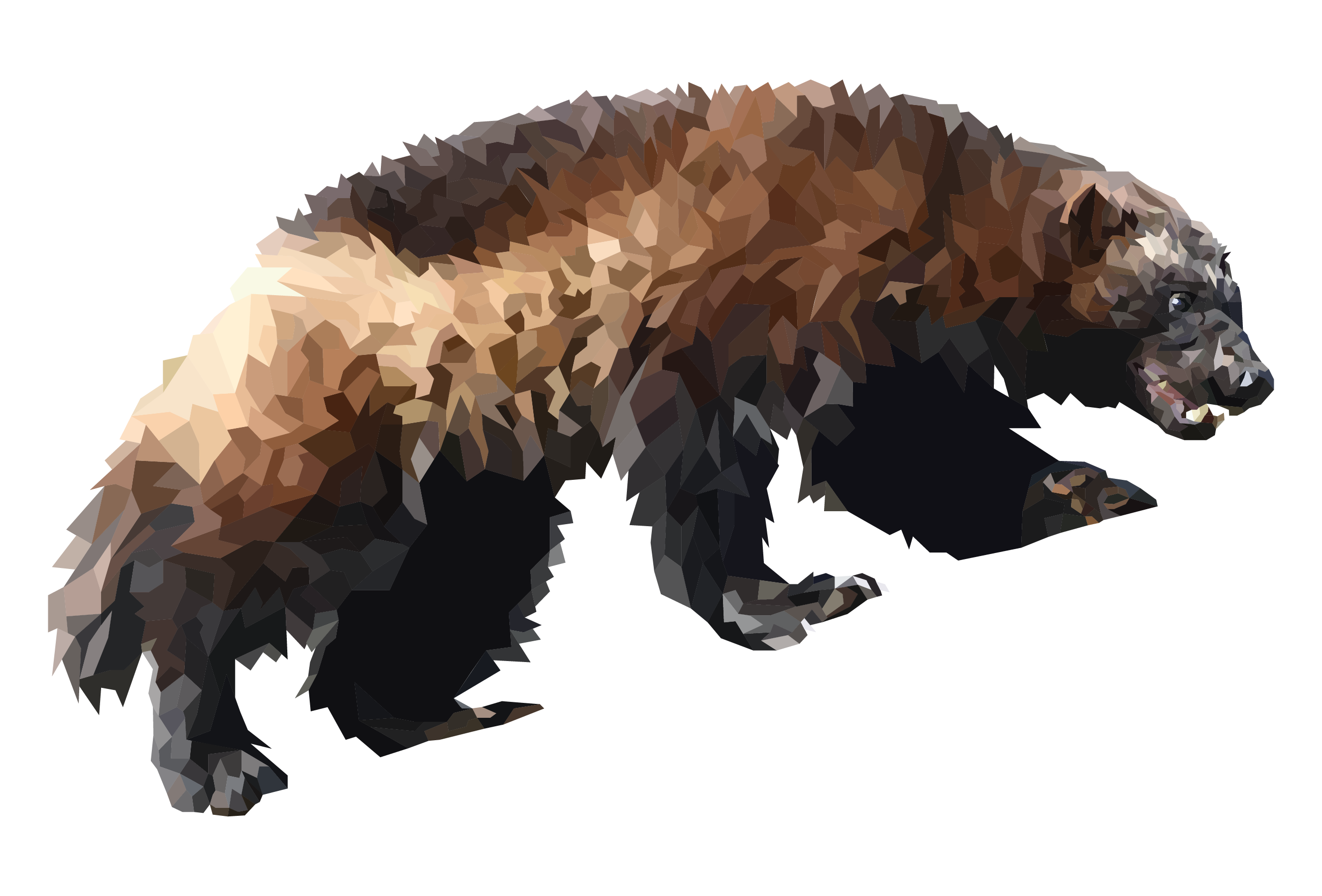
Gulo Gulo
The Wolverine, also referred to as the glutton, carcajou, skunk bear, or quickhatch, is the largest land-dwelling species of the family Mustelidae. It is a stocky and muscular carnivore, more closely resembling a small bear than other mustelids. The wolverine is found primarily in remote reaches of the Northern boreal forests and subarctic and alpine tundra of the Northern Hemisphere, with the greatest numbers in Northern Canada, the American state of Alaska. Though its legs are short, its large, five-toed paws with crampon-like claws and posture enable them to climb up and over steep cliffs, trees and snow-covered peaks with relative ease. The adult wolverine is about the size of a medium dog. The males are as much as 30% larger than the females and can be twice the females’ weight.
Wolverines have thick, dark, oily fur which is highly hydrophobic, making it resistant to frost. This has led to its traditional popularity among hunters and trappers as a lining in jackets and parkas in Arctic conditions. A light-silvery facial mask is distinct in some individuals, and a pale buff stripe runs laterally from the shoulders along the side and crossing the rump just above a bushy tail. Some display prominent white hair patches on their throats or chests. A solitary animal, it has a reputation for ferocity and strength out of proportion to its size, with the documented ability to kill prey many times larger than itself. Wolverines are considered to be primarily scavengers. A majority of the wolverine’s sustenance is derived from carrion, on which it depends almost exclusively in winter and early spring. The wolverine is also a powerful and versatile predator. Prey mainly consists of small to medium-sized mammals, but the wolverine has been recorded killing prey such as adult deer that are many times larger than itself. Wolves are thought to be the wolverine’s most important natural predator.