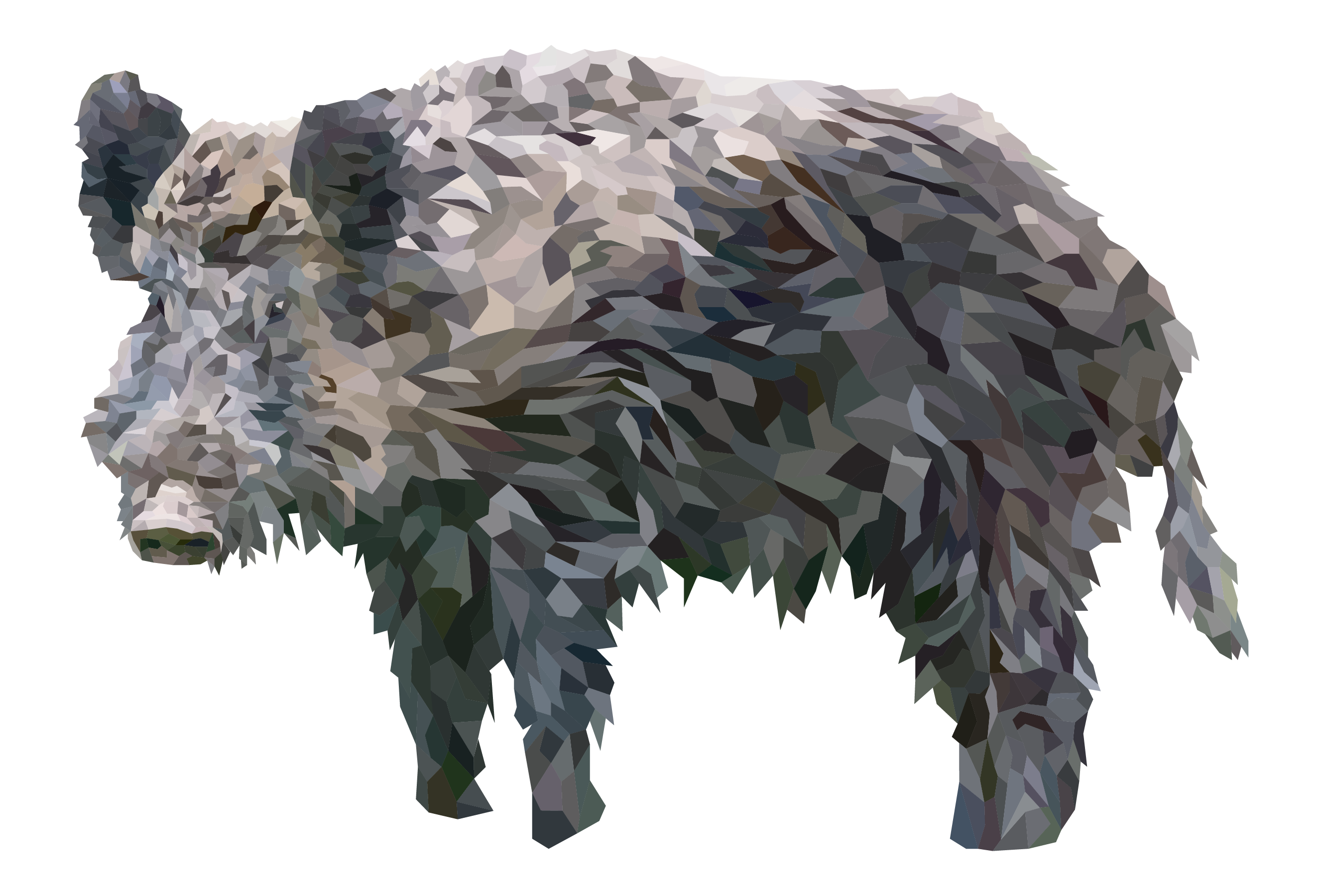
Sus Scrofa
The Wild Boar, also known as the “wild swine” or simply “wild pig”, is a suid native to much of the Palearctic, as well as being introduced in the Americas and Southeast Asia. Human intervention has spread it further, making the species one of the widest-ranging mammals in the world, as well as the most widespread suiform. The wild boar has a long history of association with humans, having been the ancestor of most domestic pig breeds and a big-game animal for millennia. Boars have also re-hybridized in recent decades with feral pigs; these boar–pig hybrids have become a serious pest wild animal in Australia, Canada, United States, and Mexico.
The wild boar is a bulky, massively built suid with short and relatively thin legs. The trunk is short and robust, while the hindquarters are comparatively underdeveloped. The region behind the shoulder blades rises into a hump and the neck is short and thick to the point of being nearly immobile. The animal’s head is very large, taking up to one-third of the body’s entire length. The structure of the head is well suited for digging. The head acts as a plough, while the powerful neck muscles allow the animal to upturn considerable amounts of soil. The wild boar is a highly versatile omnivore, whose diversity in choice of food is comparable to that of humans. A 110 lb boar needs around 4,000–4,500 calories of food per day, though this required amount increases during winter and pregnancy, with the majority of its diet consisting of food items dug from the ground, like underground plant material and burrowing animals. Sexual dimorphism is very pronounced in the species, with males being typically 5–10% larger and 20–30% heavier than females. Males also sport a mane running down the back, which is particularly apparent during autumn and winter. The winter coat consists of long, coarse bristles underlaid with short brown downy fur. The length of these bristles varies along the body, with the shortest being around the face and limbs.