♣ ♠ Interactive Timeline ♦ ♥
At Wanderer we strive to bring together entertainment, casual learning and design. This special interactive site does all three. Below are the 54 illustrations from the Airborne deck, every illustration below has a different plane or figure associated with the topic of aviation. To learn about more about each card simply click on one of the illustrations below to learn more. You can also use the navigation above to jump to specific times in history. This site aims to tell the story of each card that makes up this traditional 54 card playing deck. Throughout this site you will learn everything from the first time that a plane took to the sky to the time we went faster than the speed of sound. You will learn about the pioneers in the field of aviation and the famous faces who helped grow the field. Lets takeoff and learn about the great history of aviation!
1903
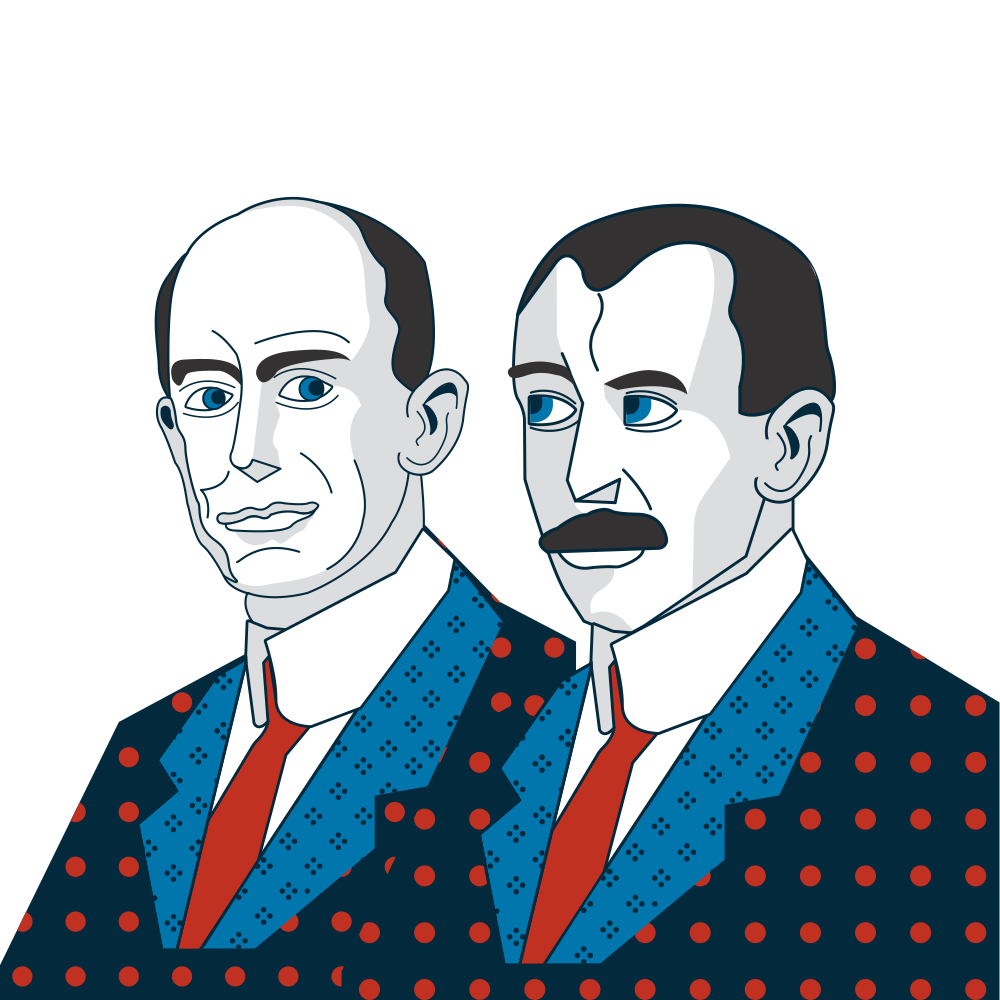
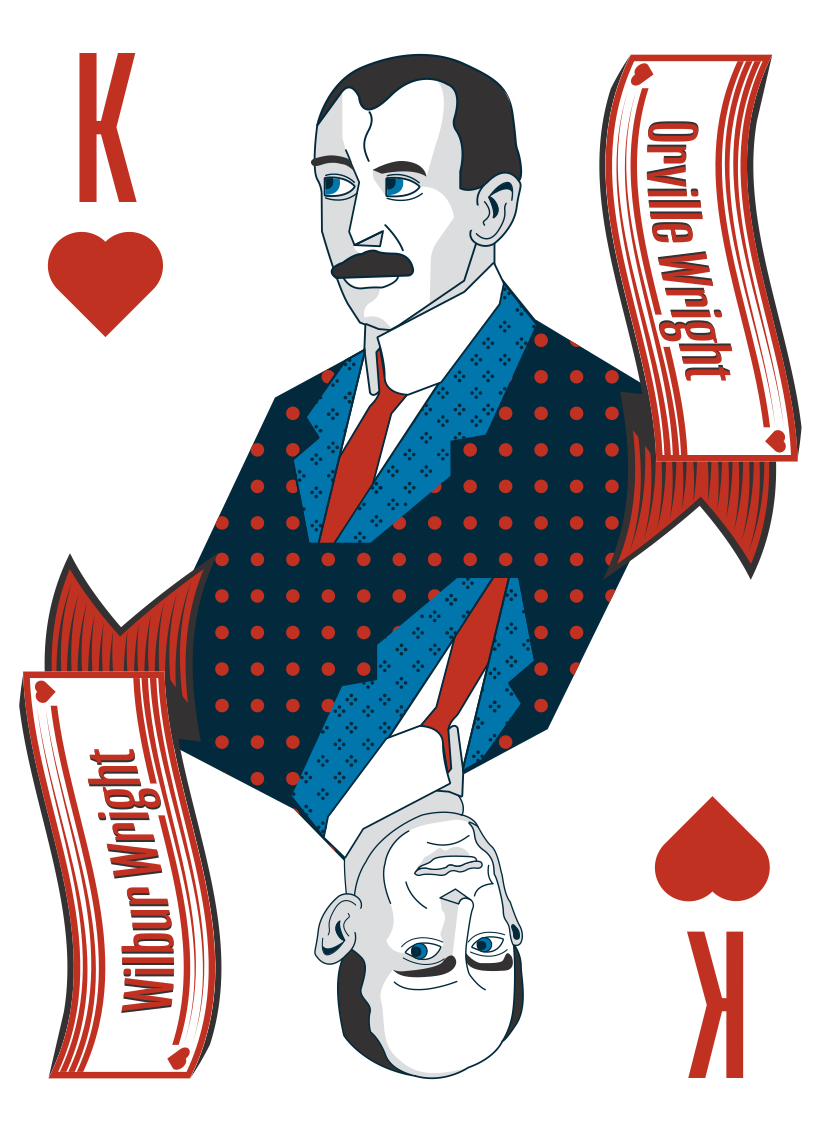
Wilbur Wright
- Born: April 16, 1867
- Death: May 30, 1912
Orvile Wright
- Born: August 19, 1871
- Death: January 30, 1948
Wright Brothers
The Wright brothers, Orville and Wilbur, were two American Aviators, engineers, inventors and Aviation Pioneers who are credited with inventing, building, and flying the world’s first successful airplane. Both brothers attended high school, but neither received diplomas. Capitalizing on the national bicycle craze, in December 1892 the brothers opened a repair and sales shop and in 1896 began manufacturing their own brand. They used this endeavor to fund their growing interest in flight. In July 1899 Wilbur put wing warping to the test by building and flying a biplane kite with a five-foot wingspan. The warping was controlled by four cords attached to the kite, which led to two sticks held by the kite flyer, which tilted them in opposite directions to twist the wings. They made the first controlled, sustained flight of a powered, heavier-than-air aircraft on December 17, 1903, four miles south of Kitty Hawk, North Carolina. In 1904–05 the brothers developed their flying machine into the first practical fixed-wing aircraft. Although not the first to build experimental aircraft, the Wright brothers were the first to invent aircraft controls that made fixed-wing powered flight possible. The brothers' fundamental breakthrough was their invention of three-axis control, which enabled the pilot to steer the aircraft effectively and to maintain its equilibrium. This method became and remains standard on fixed-wing aircraft of all kinds. Wilbur became ill from injuries he had suffered in a plane crash, diagnosed with typhoid fever, he died at age 45 on May 30th 1912 at the Wright family. Orville died on January 30, 1948, over 35 years after his brother, having lived from the horse-and-buggy age to the dawn of supersonic flight. John T. Daniels, the Coast Guardsman who took their famous first flight photo, died the day after Orville.
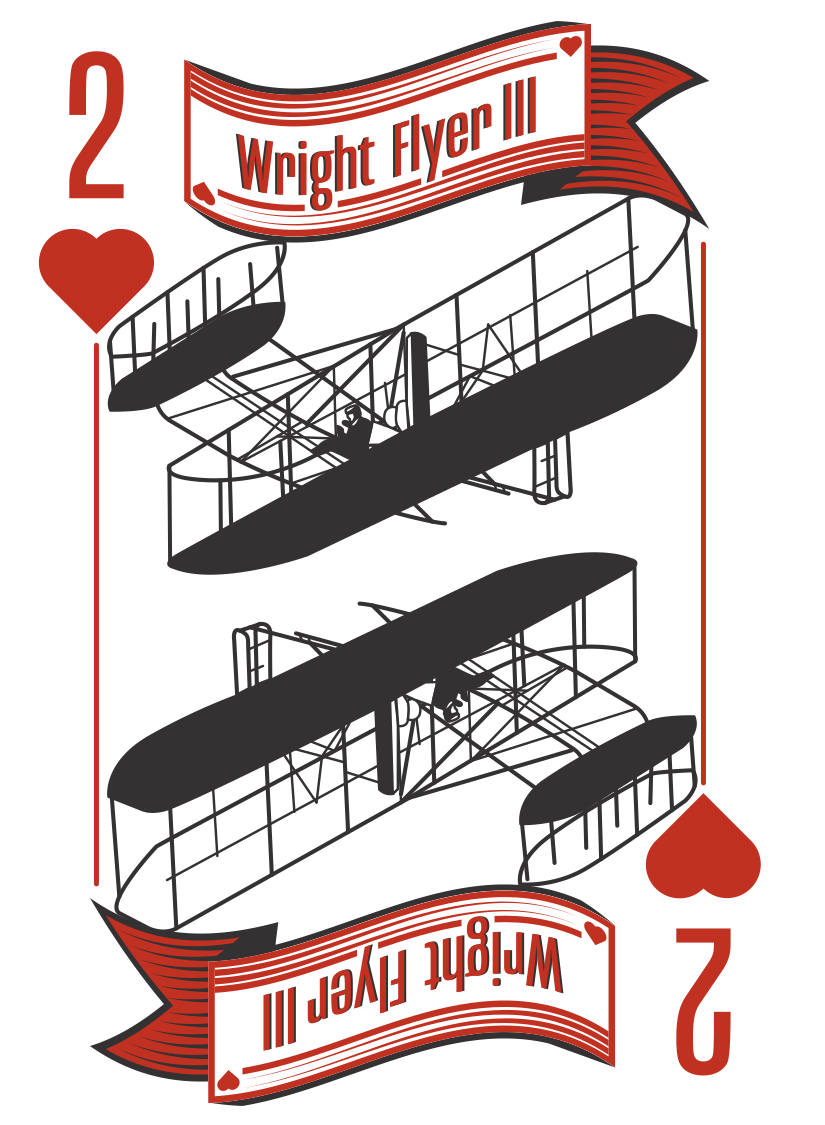
- Role: Experimental Airplane
- Manufacturer: Wright Company
- Designer: Wright Brothers
- First Flight: June 23, 1905
- Produced: 1904 - 1905
- Number Built: 1
- Unit Cost: $1,000 (1903)
- Top Speed: 35 mph
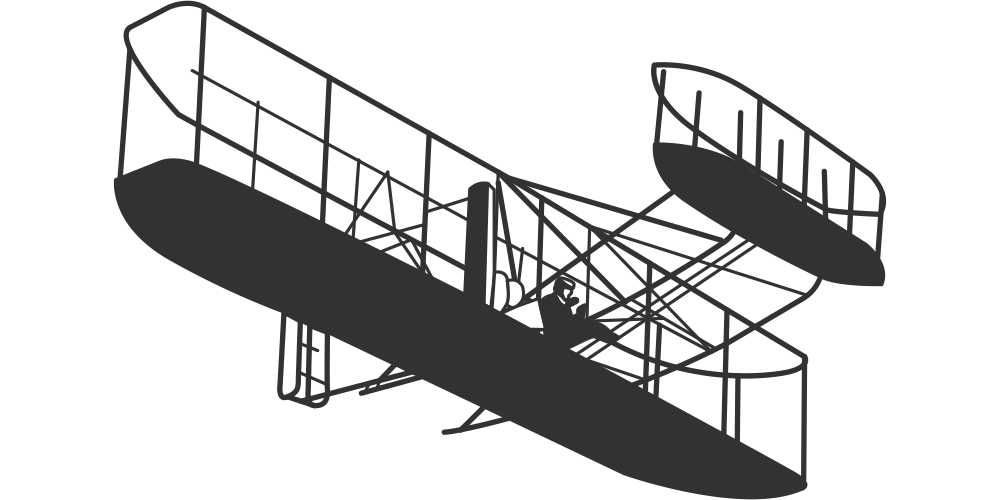
Wright Flyer III
The Wright Flyer was the first successful heavier-than-air powered aircraft. Designed and produced by the now world famous Wright brothers who funded their projects from their bicycle store. The flyer was based on the Wright’s experience testing gliders at Kitty Hawk between 1900 and 1902. The wrights built the aircraft in 1903 out of giant spruce wood. Since they could not find a suitable automobile engine to power it, they commissioned their employee Charlie Taylor to build a new design from scratch. The Flyer was a bicanard biplane configuration and the pilot flew lying on his stomach on the lower wing with his head toward the front of the craft in an effort to reduce drag. He steered by moving a cradle attached to his hips, the cradle pulled wires, which warped the wings and turned the rudder simultaneously. This design influenced the later Flyer II and III designs. Wilbur Wright became world famous overnight after a public showing at the flying field in LeMans, France, in 1908 before a very skeptical audience. This performance inspired an aviation revolution across Western Europe that would lead to rapid advancement in the understanding and development of powered flying machines. The Wright Flyer ushered in the beginning of the pioneer era of aviation.
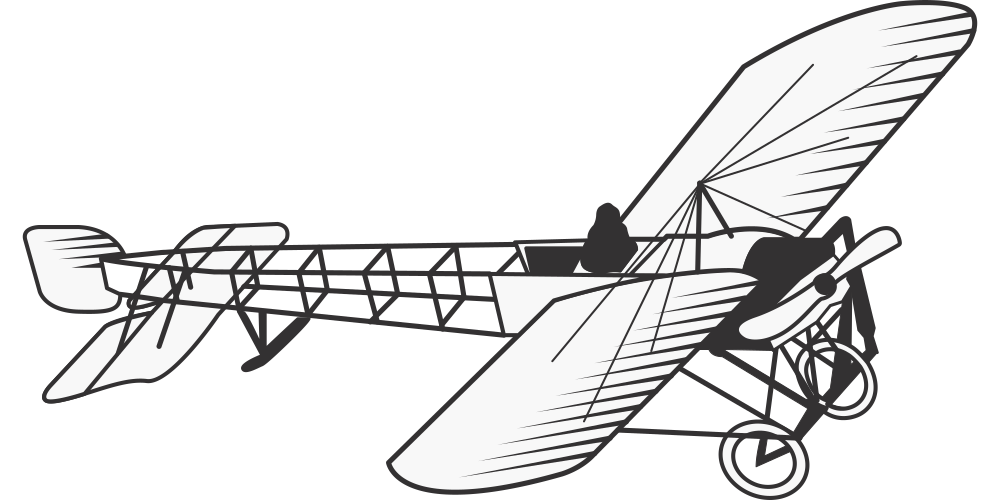
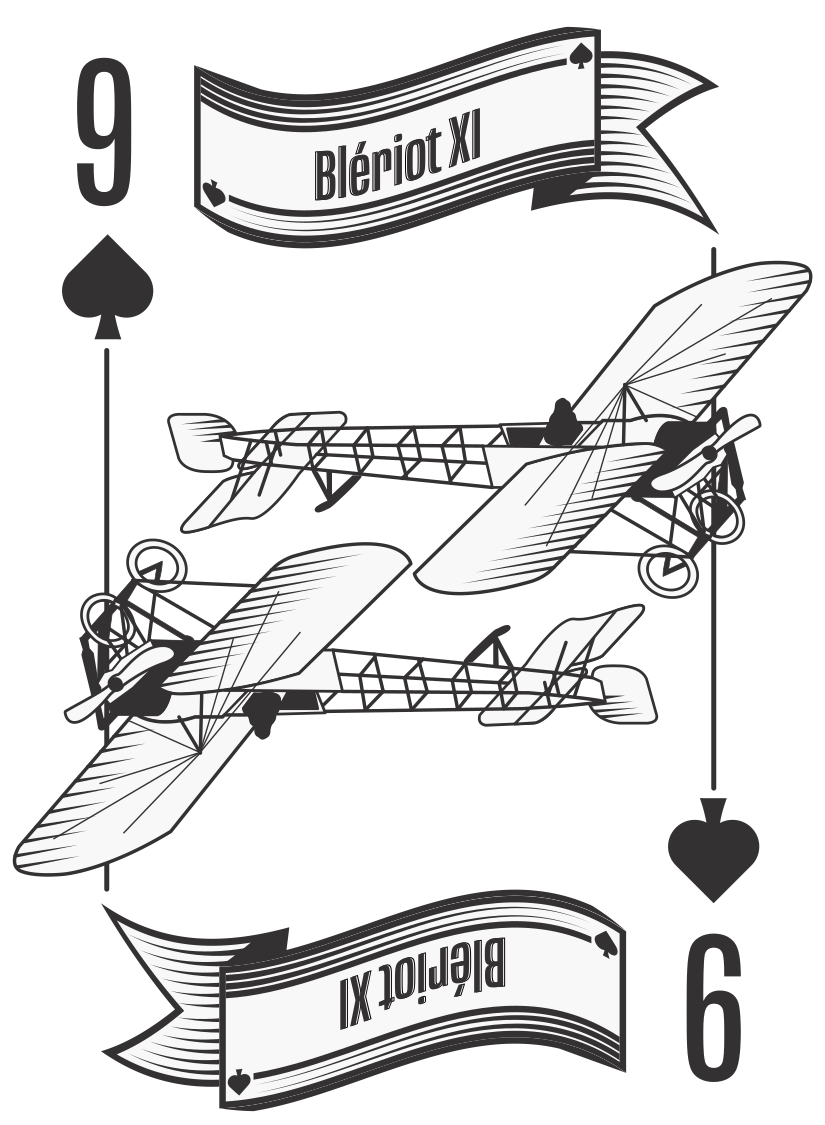
- Role: Civil Tourer / Trainer / Military
- Manufacturer: Louis Blériot
- Designer: Louis Blériot and Raymond Saulnier
- First Flight: January 23, 1909
- Produced: 1909 - Present
- Number Built: N/A
- Unit Cost: $11,995 (2011)
- Top Speed: 47 mph
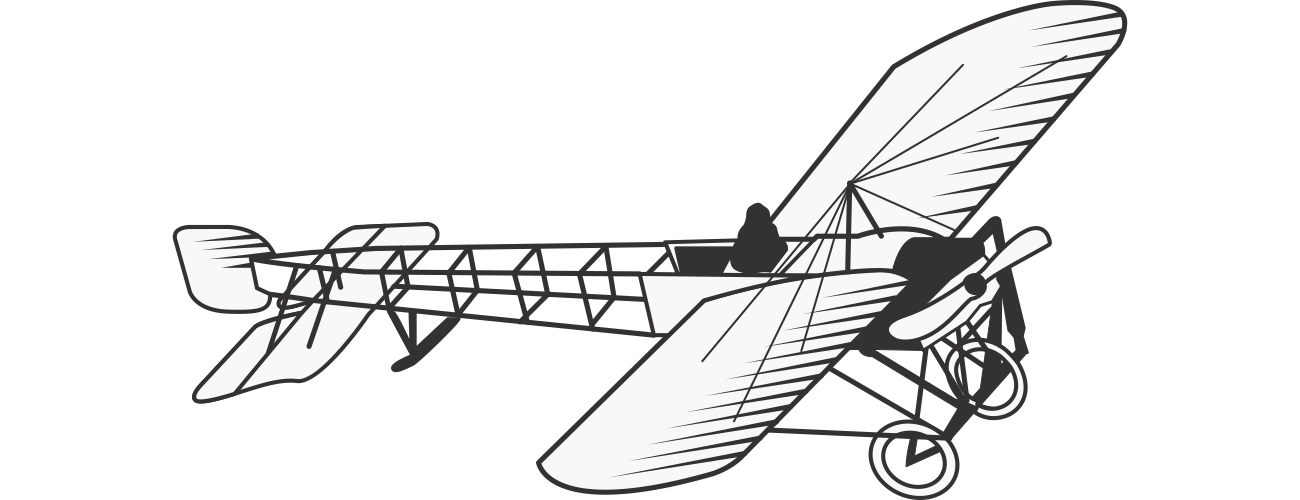
Bleriot XI
The Bleriot XI is a French aircraft of the pioneer era of aviation. Aviation pioneer Louis Blériot was so inspired by the Wright Brothers’ ability to use wing warping to fly an airplane that he modified his one-of-a-kind monoplane and set off to become the first person to cross the English Channel in a heavier-than-air aircraft. He became the first pilot to cross the English Channel on the 25th of July in 1909. This is one of the most famous accomplishments of the pioneer era of aviation, and not only won Blériot a lasting place in history but also assured the future of his aircraft manufacturing business. His success resulted in a cultural epiphany that aviation wasn’t simply a toy for rich playboys, but could be a valuable tool to shrink the world. Demand for his design exploded and many aviation pioneers of the day flew variations of his craft. That included Clyde Cessna, the founder of the Cessna Aircraft Corporation, the company that has sold more single-engine aircraft than any other company. The Blériot was soon produced in both single and two seat versions, powered by several different engines and was widely used for competition and training purposes. Military versions were also produced and bought by many countries for use during World War I.
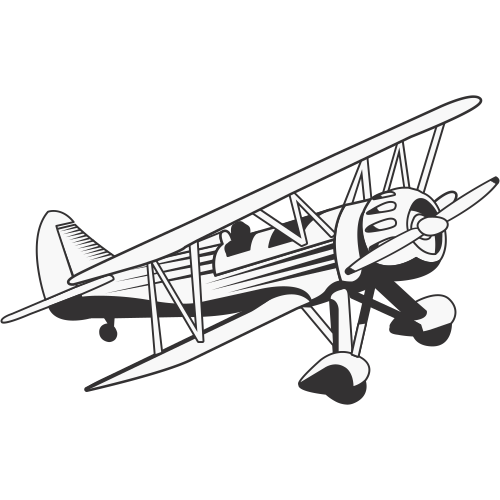
- Role: Fighter/ Recreation
- Manufacturer: N/A
- Designer: N/A
- First Flight: 1914
- Produced: 1914 - 1930s
- Number Built: N/A
- Unit Cost: N/A
- Top Speed: 150 mph
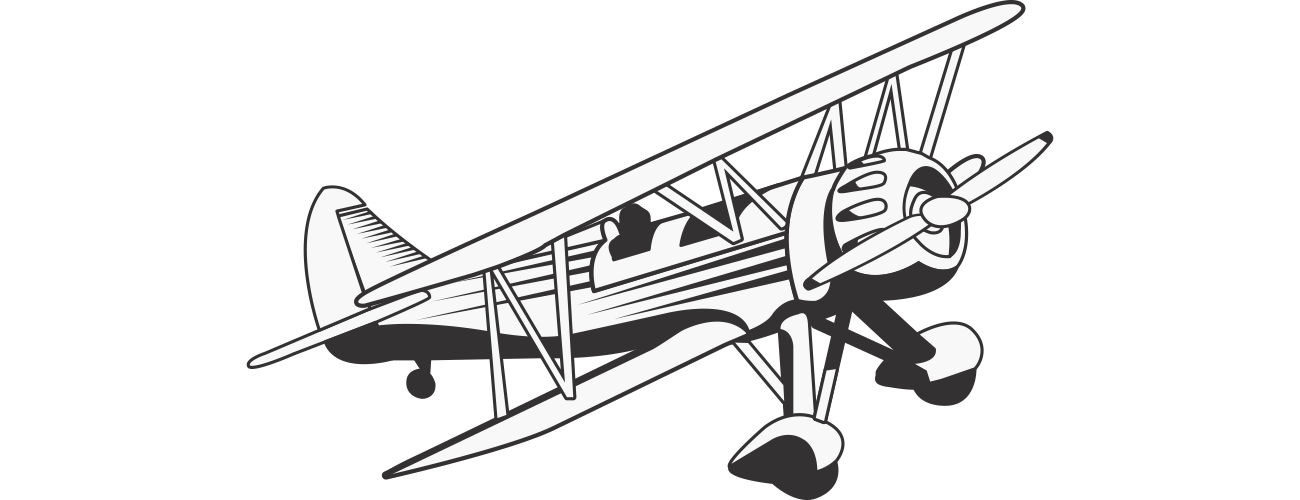
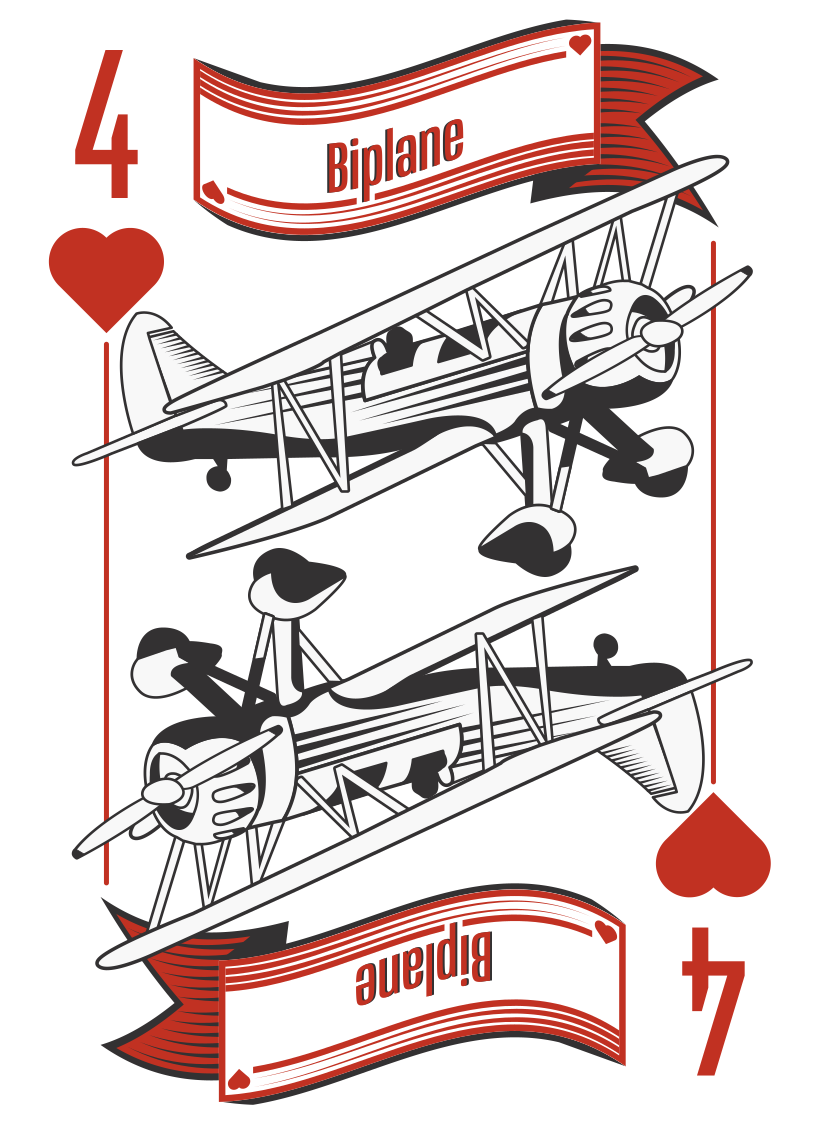
Biplane
The biplane is a fixed–wing aircraft with two main wings stacked above one another. The first powered, controlled aeroplane to fly, the wright flyer, used a biplane wing arrangement, as did many other aircrafts in the pioneer years of aviation. Biplanes have a structural advantage over monoplanes, but it produces more drag. Biplanes offer several advantages over conventional cantilever monoplane designs: they permit lighter wing structures, low wing loading and smaller span for a given wing area. Biplanes were originally designed with the wings positioned directly one above the other. Moving the upper wing forward relative to the lower one is called positive stagger or, more often, simply stagger. It can help increase lift and reduce drag by reducing the aerodynamic interference effects between the two wings. By the 1930s biplanes had reached their performance limits, and monoplanes were predominant, particularly in continental Europe where monoplanes had been common from the end of World War I. At the start of World War II, several air forces still had biplane combat aircraft in front line use but they were clearly noncompetitive, and most were used as training or shipboard operation, until shortly after the end of the war.


- Role: Fighter
- Manufacturer: Fokker-Flugzeugwerke
- Designer: Reinhold Platz
- First Flight: July 5, 1917
- Produced: 1917
- Number Built: 320
- Unit Cost: $32,000 (1998)
- Top Speed: 115 mph
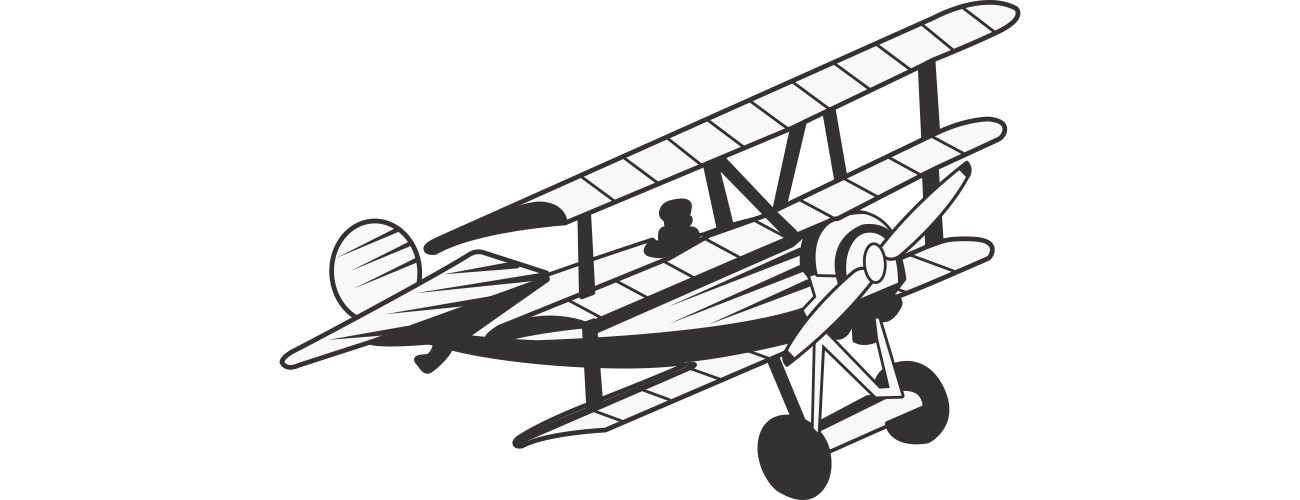
Triplane
The Fokker Dr.I, often known simply as the Fokker Triplane, was a World War I fighter aircraft built by Fokker-Flugzeugwerke. In February 1917, the Sopwith Triplane began to appear over the Western Front. Despite it’s single Vickers machine gun armament, the Triplane swiftly proved superior to the more heavily armed albatross fighters used by the German Air Force. Compared with the Albatros and Pfalz fighters, the Fokker offered exceptional maneuverability. Though the ailerons were not very effective, the rudder and elevator controls were light and powerful. Rapid turns, especially to the right, were facilitated by the triplane’s marked directional instability. The Fokker Dr.I saw widespread service in World War I in the spring of 1918. It became famous as the aircraft in which Manfred von Richthofen also known as “The Red Baron” gained his last 19 victories. The Red Baron is considered the ace-of aces of the war, being officially credited with 80 air combat victories. The Baron was shot down and killed near Vaux-sur-Somme on April 21, 1918. Considerable discussion and debate regarding aspects of his career, especially the circumstances of his death have taken place since. He remains one of the most widely known fighter pilots of all time.
According to the Smithsonian Institution and Fédération Aéronautique Internationale the Wrights made the first sustained, controlled, powered heavier-than-air manned flight at Kill Devil Hills, North Carolina, four miles south of Kitty Hawk, North Carolina on December 17, 1903. The first flight by Orville Wright, of 120 feet in 12 seconds, was recorded in a famous photograph. In the fourth flight of the same day, Wilbur Wright flew 852 feet in 59 seconds. The flights were witnessed by three coastal lifesaving crewmen, a local businessman, and a boy from the village, making these the first public flights and the first well-documented ones.
1920

- Born: February 4, 1902
- Death: August 26, 1974
- Known For: First non-stop flight from New York to Paris.
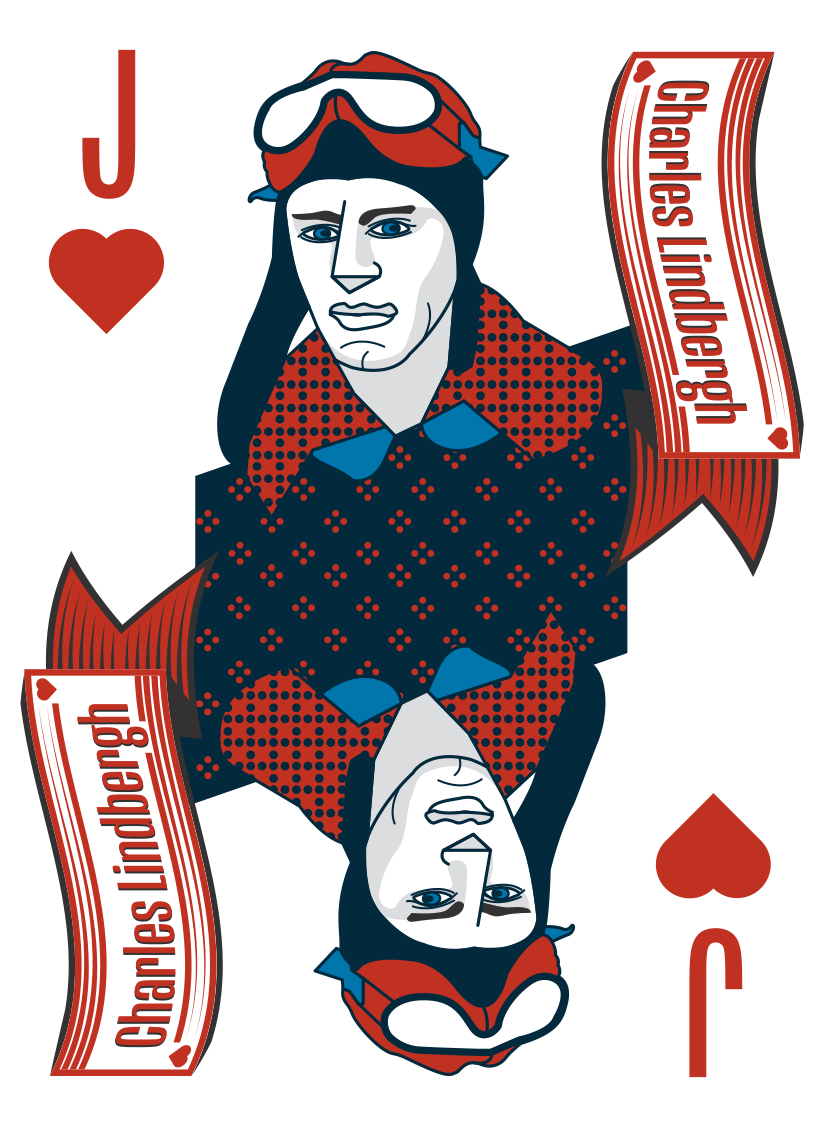
Charles Lindbergh
Charles Lindbergh was an American aviator, military officer, author, inventor, explorer and environmental activist. Born in Detroit, Michigan from an early age Lindbergh showed interest in flying through his experience with the mechanics of motorized vehicles his family owned. He started college as a mechanical engineering and became more fascinated with aviation. He quit college in February of 1922 and enrolled at the Nebraska Aircraft Corporation’s flying school. On April 9th he flew for the first time in a two-seat Tourabout biplane as a passenger. A few days later Lindbergh took his first formal flying lesson. To gain experience he traveled across the mid west barnstorming as a wing walker and parachutist. His first solo flight came in May 1923 at an army flight training field in Georgia, where he went to buy a surplus World War I Curtiss JN-4 “Jenny” Biplane. In 1925 he started military training with the United States Army Air Service and got his Army pilot’s wings. Because the Army didn’t need extra pilots he returned to civil aviation as a flight instructor and worked as an airmail pilot. His instantaneous fame came about from his winning of the Orteig Prize, achieved from flying from New York to Paris, non-stop. He flew the special made Spirit of St. Louis for 33 ½ hours, 3,600-statute-mile across the Atlantic for the first non-stop flight between North America and the European mainland. In winning the Orteig Prize, Lindbergh stirred the public’s imagination. He wrote: “I was astonished at the effect my successful landing in France had on the nations of the world. It was like a match lighting a bonfire.” Upon his arrival back to the U.S. he was awarded the Distinguished Flying Cross from president Calvin Coolidge. He was also the first Time Magazines “Man of the Year” in 1928 and remains the youngest Man of the Year ever.
- Role: Rotocraft
- Manufacturer: N/A
- Designer: Juan de la Cierva (First Designer)
- First Flight: January 9, 1923
- Produced: N/A
- Number Built: N/A
- Unit Cost: N/A
- Top Speed: 207.7 km/h
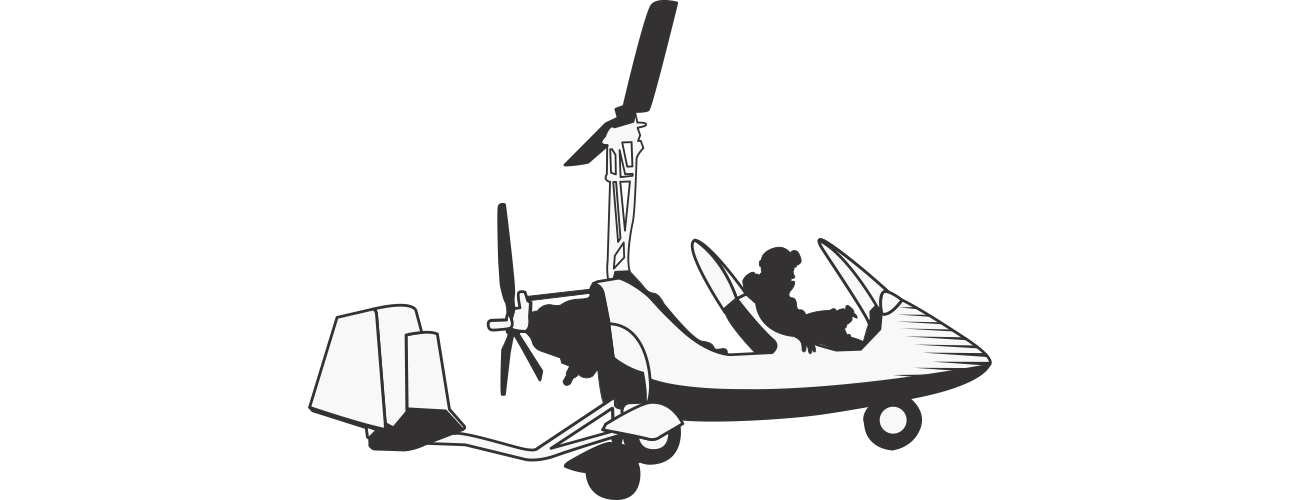
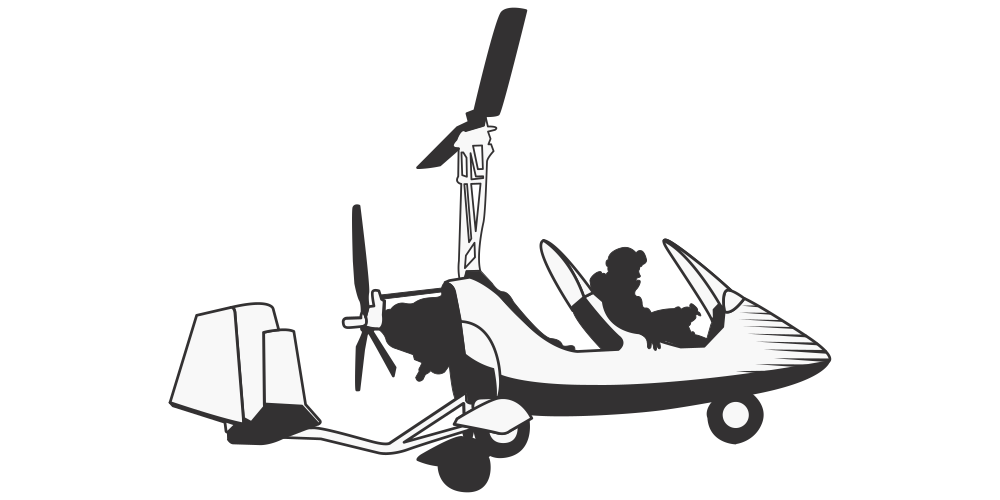
Autogyro
The autogyro, also known as a gyroplane or gyrocopter, is a type of rotorcraft that uses an unpowered rotor in free autorotation to develop lift. An engine-driven propeller provides forward thrust independently, typically. While similar to a helicopter rotor in appearance, the autogyro’s rotor must have air flowing across the rotor disc to generate rotation and the air flows upwards through the rotor disc rather than down. Spanish engineer Juan de la Cierva invented the first autogyro as an attempt to create an aircraft that could fly safely at low speeds. He first flew one on January 9th 1923 at Cuatro Vientos Airfield in Madrid. Many of the early autogyro designs featured a rear-mounted engine and propeller in a pusher configuration. Today the autogyro design is used in many facets; many law enforcements across the world use them as a cheaper and more cost effective alternative to a helicopter. In 2002, a Grosen Brothers Aviation’s Hawk 4 provided perimeter patrol for the Winter Olympics. Also of note, in 931 Amelia Earhart flew a Pitcairn PCA-2 autogyro to a women’s world altitude record of 18,415 feet. The autogyro however is one of the last remaining types of aircrafts that has not been used to circumnavigate the globe.
- Role: Long Range Aircraft
- Manufacturer: Ryan Airlines
- Designer: Donald A. Hall
- First Flight: April 28, 1927
- Produced: 1927
- Number Built: 1
- Unit Cost: $144,931 (2015)
- Top Speed: 133 mph
Spirit of St. Louis
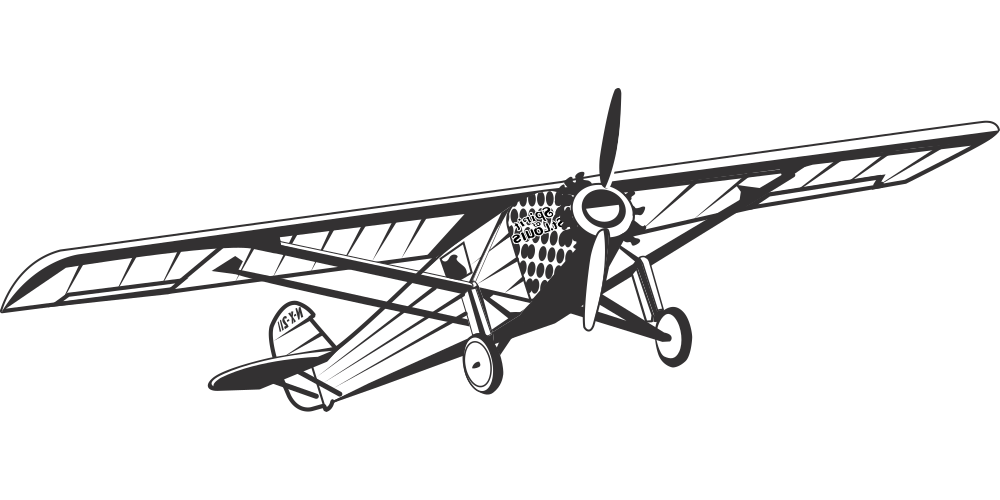
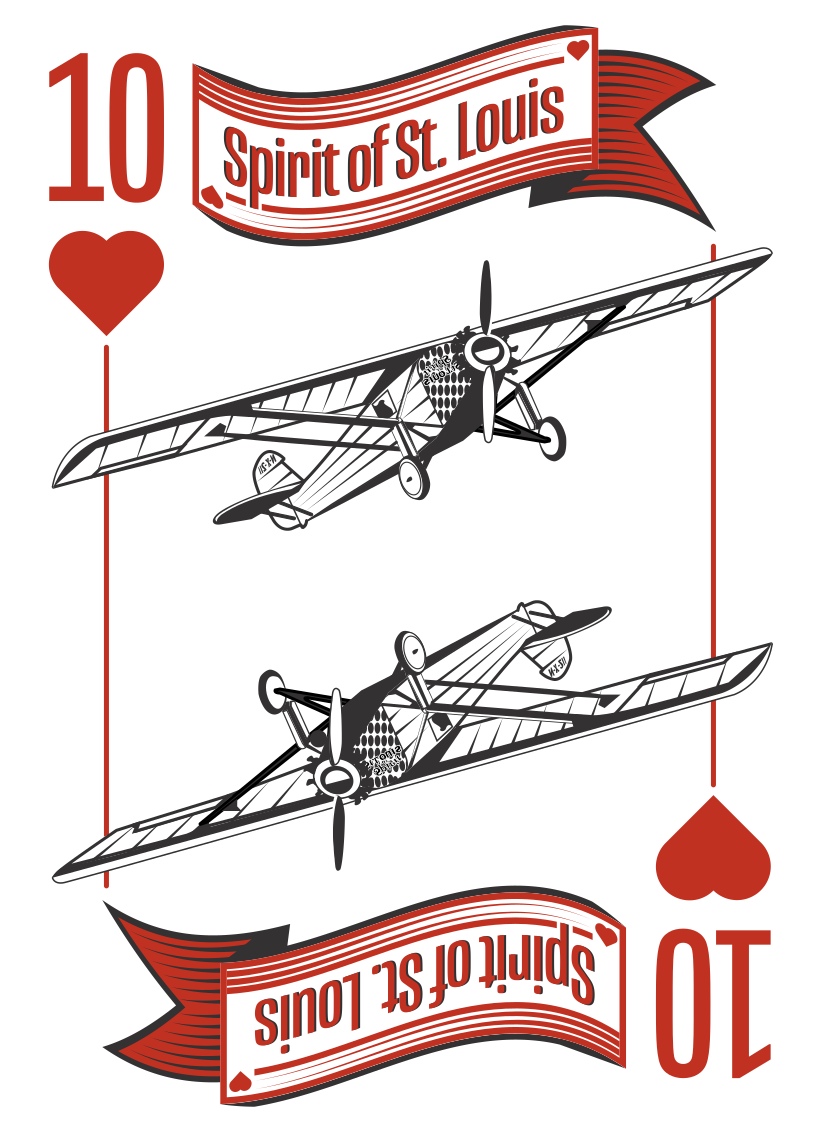
The Spirit of St. Louis is a custom-built, single engine, single-seat and high wing monoplane. This aircraft was designed by Donald A. Hall and produced by Ryan Airlines. Donald and his staff worked very closely with Charles Lindbergh to develop this plane. The Spirit of St. Louis is famous for the first solo nonstop transatlantic flight from long Island, New York to Paris, France. By doing this they won the $25,000 Orteig Prize for the first transatlantic flight. The aircraft piloted by Charles Lindbergh took off from Roosevelt Airfield, in New York on May 20th 1927 and landed 33 hours and 30 minutes later in Paris, France. The plane was officially known as the Ryan NYP for New York to Paris but later named the Spirit of St. Louis in honor of Lindbergh’s supporters from the St. Louis Raquette Club in his hometown of St. Louis, Missouri. To increase the fuel efficiency, the Spirit was also one of the most advanced and aerodynamically streamlined designs of its era. To achieve this flight Lindbergh insisted that unnecessary weight be eliminated, even going so far as to cut the top and bottom off of his flight map. He also carried no radio in order to save weight. Today the Spirit of St. Louis lives on display in the National Air and Space Museum.


- Born: January 26, 1892
- Death: April 30, 1926
- Nickname: “Queen Bees”
Bessie Coleman
Bessie Coleman was an American civil aviator and first woman of African-American descent to hold a pilot license. Coleman moved to Waxahachie, Texas with her large family at the age of two, where she stayed until the age of 23. Coleman began attending school in Waxahachie at the age of six. She had to walk four miles each day to her segregated, one room school, where she loved to read and excelled at math. In 1916 at the age of 24, she moved to Chicago, Illinois where she lived with her brothers. Working as a manicurist at the White Sox Barber Shop she overheard stories from pilots returning home from World War I and their experience flying in the war. She took a second job at a chili parlor to procure money faster to become a pilot. As American flight schools of the time admitted neither women nor blacks, Robert S. Abbott, founder and publisher of the Chicago Defender, encouraged her to study abroad. Coleman received financial backing from banker Jesse Binga and the Defender. Coleman took a French-language class at the Berlitz school in Chicago and then traveled to Paris on November 20, 1920 so she could earn her pilot license. She learned to fly in a Nieuport 82 biplane with “a steering system that consisted of a vertical stick the thickness of a baseball bat in front of the pilot and a rudder bar under the pilot’s feet”. On June 15, 1921, Coleman became the first woman of African-American and Native American descent to earn an aviation pilot’s license and the first person of African-American and Native American descent to earn an international aviation license from the Fédération Aéronautique Internationale. Determined to polish her skills, Coleman spent the next two months taking lessons from a French ace pilot near Paris and in September 1921 she sailed for New York. She became a media sensation when she returned to the United States. She soon became a successful air show pilot in the United States, and hoped to start a school for African-American fliers. She died in a plane crash in 1926 while testing her new aircraft. Her pioneering role was an inspiration to early pilots and to the African-American and Native American communities.
After World War I, experienced fighter pilots were eager to show off their skills. Many American pilots became barnstormers, flying into small towns across the country and showing off their flying abilities, as well as taking paying passengers for rides. Eventually the barnstormers grouped into more organized displays. Air shows sprang up around the country, with air races, acrobatic stunts, and feats of air superiority. Amelia Earhart was perhaps the most famous of those on the barnstorming / air shows circuit. She was also the first female pilot to achieve records such as crossing of the Atlantic and Pacific Oceans. In 1927 Charles Lindbergh took the Orteig Prize of $25,000 for the first solo non-stop crossing of the Atlantic.
1930


- Role: Airliner and Transport Aircraft
- Manufacturer: Douglas Aircraft Company
- Designer: Donald Douglas
- First Flight: December 17, 1935
- Produced: 1936–1942, 1950
- Number Built: 607
- Unit Cost: $1,419,036 (2017)
- Top Speed: 207 mph
Douglas DC-3
This airliner and transport aircraft is a fixed-wing propeller-driven airliner that revolutionized air transport in the 1930s and 1940s. The Douglas DC-3 has had a lasting impact on the airline industry and World War II making it one of the most significant transport aircraft ever produced. The DC stands for Douglas Commercial and was the culmination of a development effort that began after an inquiry from Transcontinental and Western Airlines to Donald Douglas. This was in an effort to rival the service of United Airlines. The Douglas DC-3 can carry up to 21 – 32 passengers or 6,000 lbs. of cargo and has a range of 1,500 miles. This plane is designed with a twin-engine and a tailwheel-type landing gear. The DC-3 is credited with popularizing air travel in the U.S., many eastbound transcontinental flights could cross the U.S. in about 15 hours with 3 refueling stops where as a few years earlier such a trip entailed short hops in slower and shorter-range aircrafts during the day and train travel overnight. Post-war, the DC-3 was made obsolete on main routes by more advanced types such as the Douglas DC-6 and Lockheed Constellation, but the design proved exceptionally adaptable and useful. Approximately 2,000 DC-3s and military derivatives were still flying, a testament to the durability of the design.

- Born: January 30, 1891
- Death: November 29, 1950
- Known For: Founding the Beech Aircraft Company
Walter Beech
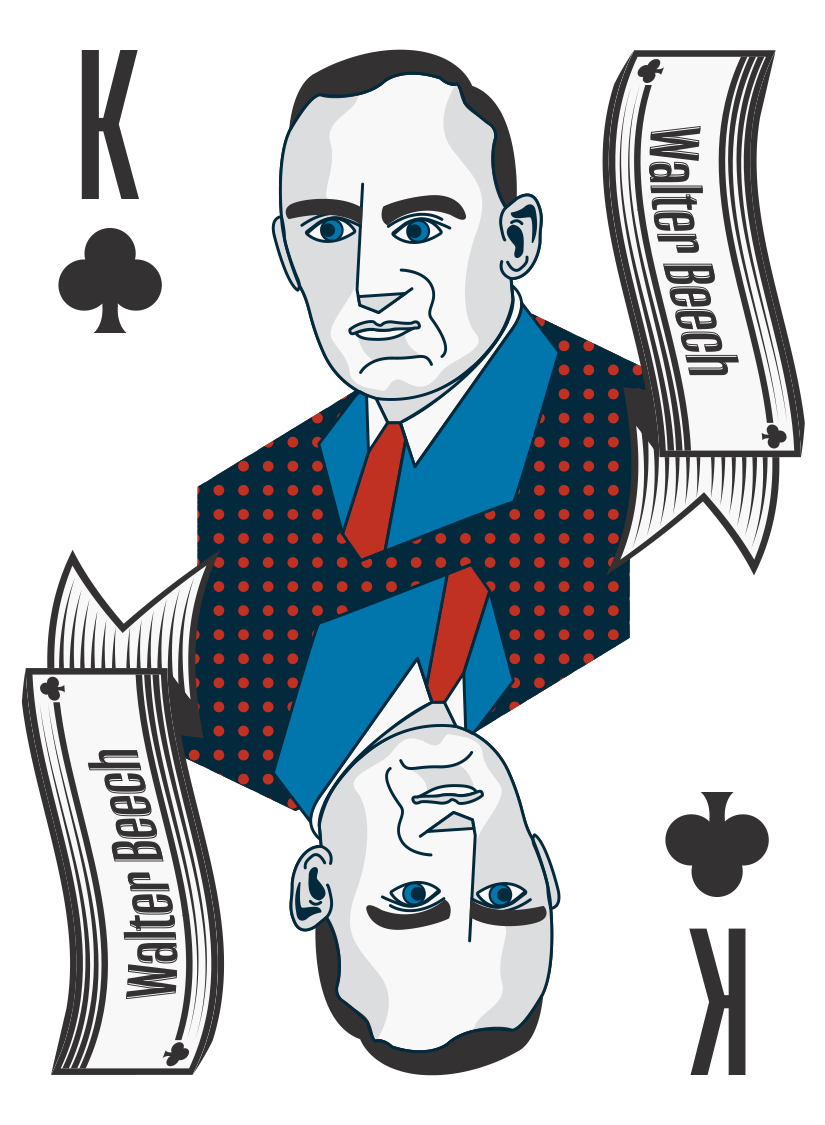
Walter Herschel Beech was an American aviator and aviation entrepreneur who co-founded the Beech Aircraft Company in 1932 with his wife, Olive Ann Beech, and a team of three others. Beech started flying in 1905, at age 14, when he built a glider of his own design. Then, after flying for the United States Army during World War I, he joined the Swallow Airplane Company as a test pilot. He later became general manager of the company. In 1924, he, Lloyd Stearman, and Clyde Cessna formed Travel Air Manufacturing Company. When the company merged with Curtiss-Wright, Beech became vice-president. In 1932, he and his wife, Olive Ann Beech, along with Ted Wells, K.K. Shaul, and investor C.G. Yankey, co-founded the Beech Aircraft Company in Wichita, Kansas. In 1937, Beech Aircraft introduced the Twin Beech which was adopted for use by the U.S. Army Air Corps and was also sold all over the world. Their early Beechcraft planes won the Bendix Trophy. During World War II, Beech Aircraft produced more than 7,400 military aircraft. The twin Beech AT-7/C-45 trained more than 90 percent of the U.S. Army Air Forces navigator/bombardiers and 50 percent of its multi-engine pilots. Beech died from a heart attack on November 29, 1950. He and his wife are buried at Old Mission Mausoleum in Wichita. Beech left a legacy not measured in dollars, but in the commitment of his former employees to build an aircraft that would meet his high standards for reliability, durability, and marketability. He died November 29, 1950. After his death, Olive Ann served as president and Beech Aircraft Corporation. She continued to grow the company from the foundation Walter had laid in to more than one million square feet of production space, consisting of 17 subsidiaries and 10 production plants that produced aircraft for personal, business, and military use. During her nearly 20 years at the helm, sales tripled.


- Born: September 25, 1903
- Death: July 6, 1993
- Nickname: “First Lady of Aviation”
Olive Ann Beech
In 1924 Olive Ann Beech, at the age of 21, took a job as an office secretary and bookkeeper for the newly formed Travel Air Manufacturing Company in Wichita. After learning the business she handled correspondence, kept the records, and conducted transactions. She was soon promoted to office manager and secretary to Walter Beech, one of the founders of Travel Air. Travel Air merged with the Curtiss-Wright Corporation in August 1929. Walter Beech assumed the presidency of Curtiss-Wright and moved to New York City. In 1932, Walter Beech quit Curtiss-Wright and started Beech Aircraft Company in Wichita, naming himself as president, Olive Ann as secretary. Olive Ann worked with the financial side of the business and played an important role in major company decisions. The first airplane the company designed and built was a biplane with negatively staggered wings, which became known as the Model 17 Staggerwing. Olive Ann suggested that to help increase sales of the aircraft that the company should sponsor a woman pilot flying the Staggerwing in the 1936 transcontinental Bendix Trophy Race. Beech sponsored pilot Louise Thaden, along with Blanche Noyes as co-pilot, won the race against some of the nation’s best male pilots. In 1940, Walter became ill with encephalitis and Olive Ann took over the leadership of the company at a time when retooling was required for military production of both the Staggerwing and the Twin Beech. Production was also started on the Beechcraft Bonanza for the civilian market. After Walter’s death in November 1950, Olive Ann assumed leadership of the company by being named president and chair of the board and was the first woman to head a major aircraft company. On December 12, 1980, the U.S. National Aeronautic Association awarded her the Wright Brothers Memorial Trophy, the highest honor the aviation fraternity bestows, for her contributions to the aviation industry. The following year, she was inducted into the National Aviation Hall of Fame. She earned more awards, honorary appointments, and special citations than any other woman in aviation history, and was often referred to as the nickname listed above: “First Lady of Aviation”.


- Born: July 24, 1897
- Disappeared: July 2, 1937 (aged 39)
- Known For: Many early aviation records.
Amelia Earhart
Amelia Earhart was an American aviation pioneer and author. Born in Atchison, Kansas, she was an adventurous child who liked to climb trees with her sister Pidge. She had a difficult childhood constantly moving around, but they finally landed in Chicago. Amelia wanted to go to a high school with a good science program, because of this she decided to not go to the nearest high school and instead deciding to go to Hyde Park High School. She graduated in 1917 and went to a junior college but didn’t complete the program. Earhart’s aviation career began when her and her father visited an airfield where Frank Hawks gave her a ride that would forever change Earhart’s life. “By the time I had got two or three hundred feet off the ground,” she said, “I knew I had to fly.” After that 10-minute flight she immediately determined to learn to fly. Working at a variety of jobs including photographer, truck driver, and stenographer at the local telephone company, she managed to save $1,000 for flying lessons. Earhart had her first lesson on January 3, 1921, at Kinner Field near Long Beach. Six months later, Earhart purchased a secondhand bright yellow Kinner Airster biplane she nicknamed “The Canary”. On October 22, 1922, Earhart flew the Airster to an altitude of 14,000 feet, setting a world record for female pilots. On May 15, 1923, Earhart became the 16th woman in the United States to be issued a pilot’s license. Earhart became the first woman to fly solo across the North American continent and back. She also became the first woman to fly non-stop across the Atlantic. Between 1930 and 1935 Earhart had set seven women’s speed and distance aviation records in a variety of aircrafts. She was also a member of the National Woman’s Party and an early supporter of the Equal Rights Amendment. Tragically during an attempt to make a circumnavigational flight of the globe in, Earhart and navigator Fred Noonan disappeared over the central Pacific Ocean.


- Role: Trainer / Light Aircraft
- Manufacturer: Piper Aircraft
- Designer: C. G. Taylor & Walter Jamouneau
- First Flight: 1938
- Produced: 1938 -1947
- Number Built: 20,000+
- Unit Cost: $995 – $2,461 (1947)
- Top Speed: 87 mph
Piper J-3 Cub
The Piper J-3 Cub is an American light aircraft that was built between 1937 and 1947 by Piper Aircraft. The J-3 Cub is known for its simple, lightweight design which gives it good low-speed handling properties and short field performance. The Cub is a high-wing, strut-braced monoplane with a large-area rectangular wing. It was originally intended to be a trainer aircraft and certainty had success in that role. It also found a role as a reconnaissance aircraft for the United States Military. By the end of the Second World War, 80 percent of all U.S. military pilots received their primary training in a J-3. The Cub is one of the most well known light aircrafts of all time because of its affordability and popularity. The aircraft came with a standard chrome yellow paint, which came to be known as Cub Yellow. After World War II the J-3 Cub became an icon of the era of American general aviation. The Piper’s simple construction, low cost, and docile handling made it one of the most popular light aircraft of all time. Due to increasing demand from bush pilots(pilots who operate in underdeveloped areas), the classic design has seen something of a modern renaissance. Manufacturers are adding onto the time-tested platform by adding modern conveniences like increased horsepower and electrical systems.

- Role: Fighter / Photo-reconnaissance Aircraft
- Manufacturer: Supermarine
- Designer: R. J. Mitchell
- First Flight: March 5, 1936
- Produced: 1938 - 1948
- Number Built: 20,351
- Unit Cost: £12,604 (1936)
- Top Speed: 363 mph
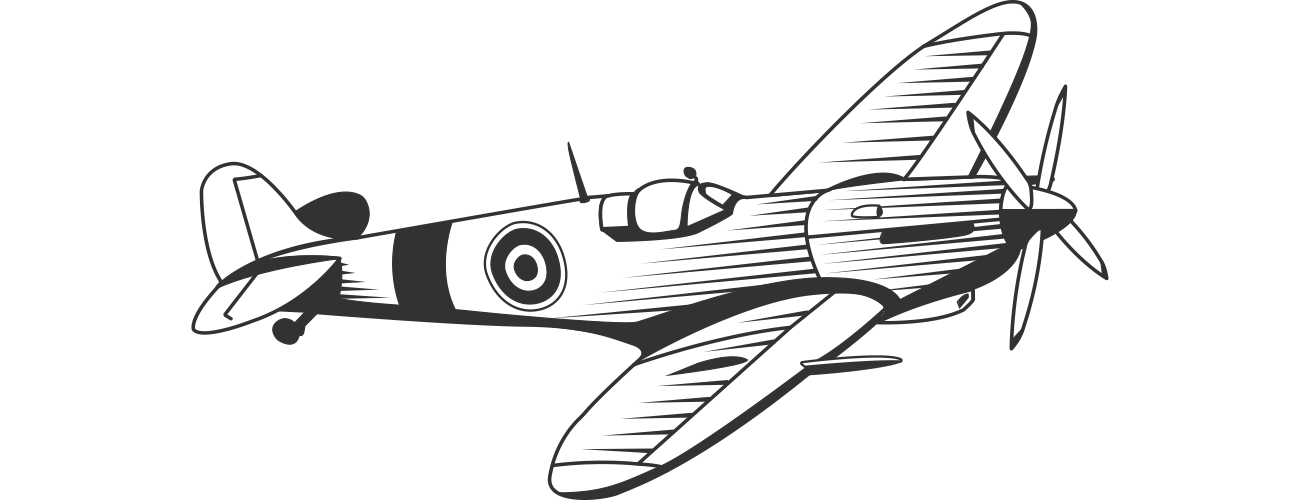
Supermarine Spitfire
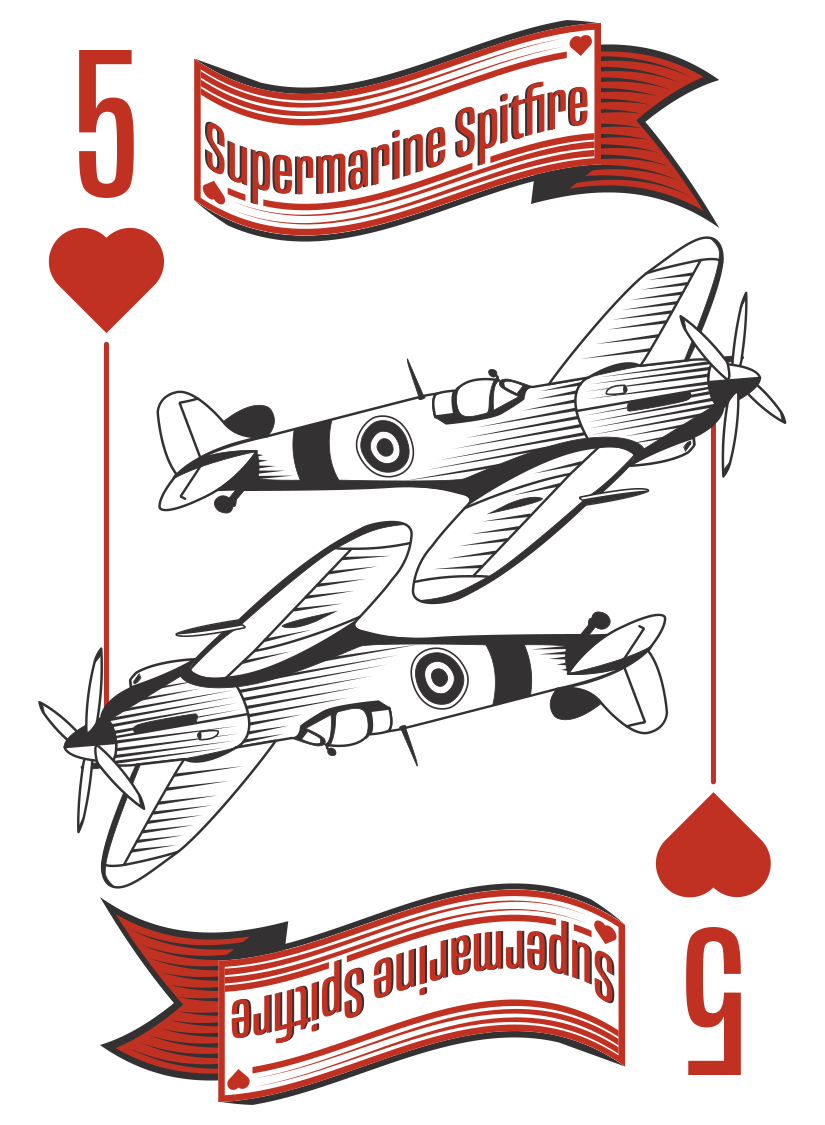
The Supermarine spitfire is a single seat British fighter aircraft designed by R.J. Mitchell. Much of the initial production of this aircraft took place after the mid 1930s. It saw frequent use by the Royal Air Force and other Allied countries World War II. This Aircraft was partly made famous for its role during the Battle of Britain. The Spitfire was designed to be a short-range, high-performance interceptor aircraft that could engage enemy Luftwaffe fighters. The Spitfire featured a unique elliptical wing design with an extremely thin cross section, which allowed it to achieve higher top speeds than it’s competitors. An elliptical design is the most efficient aerodynamic shape for an untwisted wing, leading to the lowest amount of drag. After Mitchell’s premature death in 1937 his colleague Joseph Smith took over as chief designer. Jeffrey Quill a famous Royal Air Force test pilot and 2nd pilot to fly a Spitfire noted: “If Mitchell was born to design the Spitfire, Joe Smith was born to defend and develop it.” Other variants of the Spitfire included the Seafire, a naval version adapted for use on aircraft carriers and the a version became the first high-speed photo-reconnaissance aircraft to be used by the Royal Air Force. The Iconic Spitfire was revered by its pilots and served in combat roles until the 1950s.
1940
World War II saw a great increase in the pace of development and production, not only of aircraft but also the associated flight-based weapon delivery systems. Air combat tactics and doctrines took advantage. Large-scale strategic bombing campaigns were launched, fighter escorts introduced and the more flexible aircraft and weapons allowed precise attacks on small targets with dive bombers, fighter-bombers, and ground-attack aircraft. New technologies like radar also allowed more coordinated and controlled deployment of air defense. In October 1947 Chuck Yeager took the rocket-powered Bell X-1 through the sound barrier. This was the first controlled, level flight to exceed the speed of sound. Further barriers of distance fell in 1948 and 1952 with the first jet crossing of the Atlantic and the first nonstop flight to Australia.
- Role: Fighter Aircraft / Fighter-Bomber
- Manufacturer: Messerschmitt
- Designer: Willy Messerschmitt
- First Flight: April 18, 1941
- Produced: 1941 - 1945
- Number Built: 1,430
- Unit Cost: N/A
- Top Speed: 559 mph
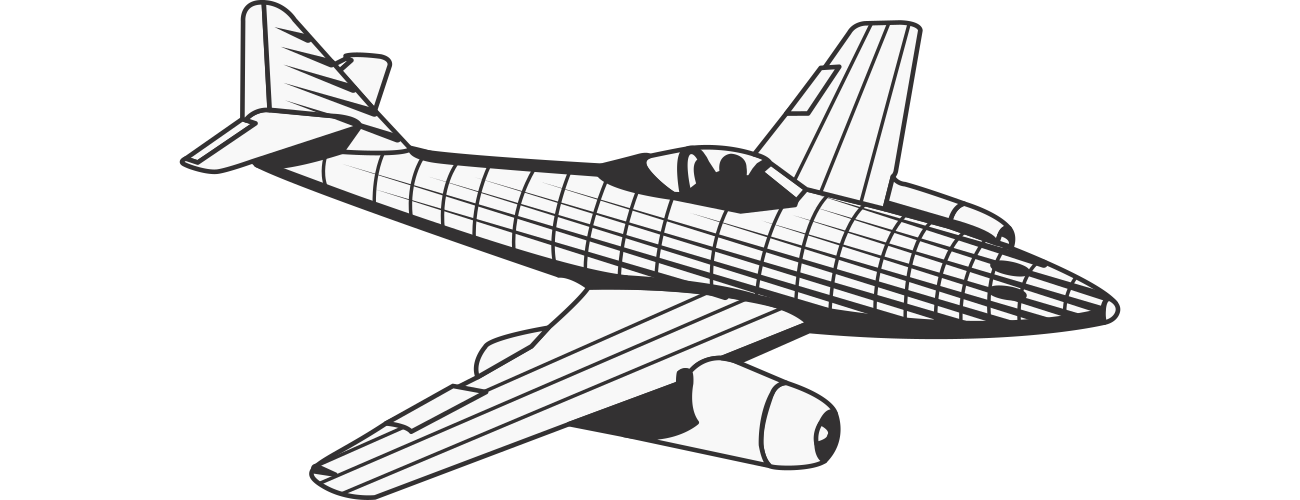
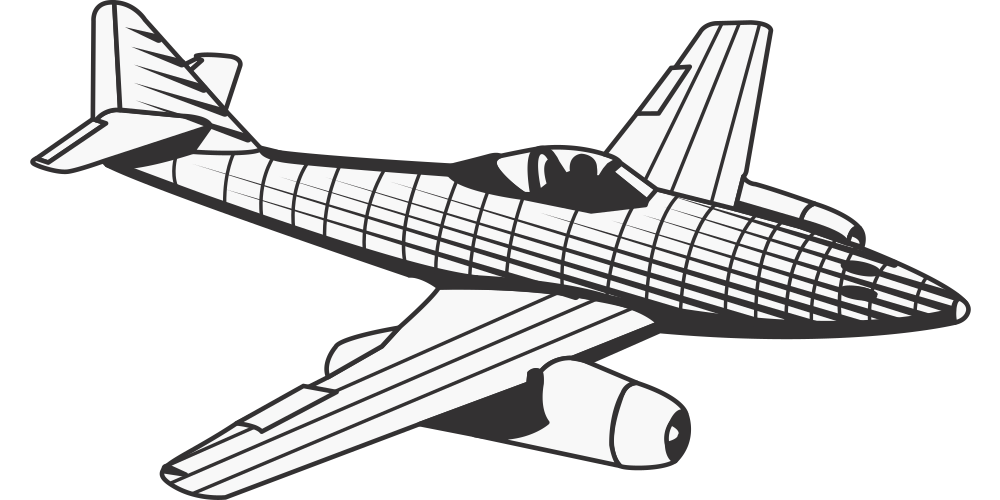
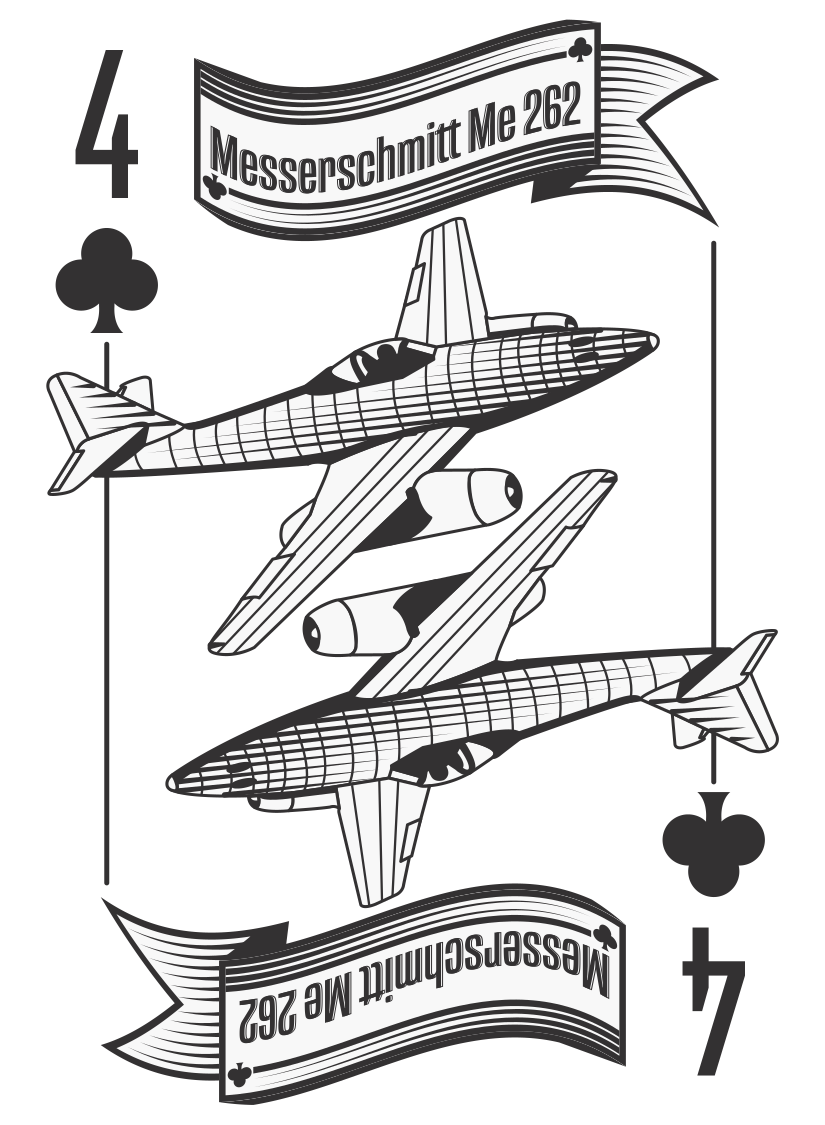
Messerschmitt Me 262
The Messerschmitt Me 262 is a German fighter and bomber aircraft that started to be produced before WWII. This plane is notable for being the first jet-powered fighter aircraft ever made. The production of the Me 262 started shortly after the invasion of Poland but wasn’t used in combat until mid 1944. The Me 262 am known for being faster and more heavily armed than any allied fighter, including the British jet-powered Gloster Meteor. The allies countered its effectiveness in the air by attacking the aircraft on the ground and during takeoff and landing. The Me 262 was late to the fight in WWII, and its effectiveness was hampered by engine reliability issues and Allied attacks on German fuel supplies. The plane had a limited production lifespan, too. Yet its speed and maneuverability were unmatched at the time and its design would still be studied and applied to future fighter jet aircraft like the F-86 Sabre. Captured Me 262s were studied and flight tested by the major powers, and ultimately influenced the designs of post-war aircraft such as the North American F-86 Sabre and Boeing B-47 Stratojet. Several aircraft survive on static display in museums, and there are several privately built flying reproductions in use today.


- Born: December 18, 1912
- Death: July 4, 2002
- Military Rank: 4 Star General
Benjamin O. Davis Jr.
Benjamin Oliver Davis Jr. was an American United States Air Force General and Commander of the World War II Tuskegee Airmen. At the age of 13, in the summer of 1926, Davis went for a flight with a barnstorming pilot at Bolling Field in Washington, D.C. The experience led to his determination to become a pilot himself. After attending the University of Chicago, he entered the United States Military Academy at West Point, New York in 1932. He was sponsored by Representative Oscar De Priest (R-IL) of Chicago, at the time, the only black member of Congress. He graduated in 1936, 35th in a class of 276. He was the academy’s fourth black graduate. When he was commissioned as a second lieutenant, the Army had only two black officers – Benjamin O. Davis Sr. and Benjamin O. Davis Jr. After graduation he married Agatha Scott. He later attended the U.S. Army Infantry School at Fort Benning, and then was assigned to teach military tactics at Tuskegee Institute, a historically black college in Tuskegee, Alabama. Captain Davis was assigned to the first training class at Tuskegee Army Air Field and in March 1942 earned his wings as one of five black officers to complete the course. He was the first black officer to solo an Army Air Corps aircraft. During World War II, Davis was commander of the 99th Fighter Squadron and the 332nd Fighter Group, which escorted bombers on air combat missions over Europe. Davis flew sixty missions in P-39, Curtiss P-40, P-47 and P-51 Mustang fighters. In retirement Davis, who had been suffering from Alzheimer’s disease, died at age 89 on July 4, 2002. Red Tail P-51 Mustang, similar to the one he had flown in World War II, flew overhead during his funeral service. Bill Clinton said, “General Davis is here today as proof that a person can overcome adversity and discrimination, achieve great things, turn skeptics into believers; and through example and perseverance, one person can bring truly amazing change”.


- Born: November 21, 1902
- Death: July 17, 1975
- Known For: Early aviation achievements.
Phoebe Omlie
Phoebe Jane Fairgrave Omlie was an American aviation pioneer, particularly noted for her accomplishments as an early female aviator. Fairgrave attended Madison School and Mechanic Arts High School and graduated in 1920. Fairgrave’s interest in aviation was sparked the day before she graduated, when President Woodrow Wilson visited Minneapolis. President Wilson’s visit was commemorated by a flyover and was the first airshow of any kind that Fairgrave had witnessed. She began hanging around airfields near her home and attempted to convince the airport manager to allow one of his flight instructors to take her flying. The manager finally agreed, thinking that he could scare Fairgrave’s interest in aviation out of her by performing various aerobatic maneuvers in an attempt to make her sick. Instead, Fairgrave demanded more flight time and used some of her inheritance to purchase a Curtiss JN-4 biplane after her fourth flight. In 1925, the Omlies moved to Memphis, Tennessee and began offering flying lessons and mechanical services to local residents. A year later, in 1927, Phoebe became the first woman to receive an airplane mechanic’s license, as well as the first licensed female transport pilot. Phoebe began working for the Mono Aircraft Company. Flying the company’s Monocoupe 90 light in 1928, Omlie set a world altitude record for women when she reached 25,400 ft. That same year, Omlie competed in the Edsel Ford Air Tour and became the first woman to cross the Rocky Mountains in a light aircraft. During the 1920s and 1930s, Omlie set several world records in aviation, including the highest altitude parachute jump by a woman. In 1941 she accepted a job as “Senior Private Flying Specialist of the Civil Aeronautics Authority”. In this position Omlie established 66 flight schools in 46 states, including a school in Tuskegee, Alabama that would later train the famous Tuskegee Airmen. She was considered by First Lady Eleanor Roosevelt to be one of “eleven women whose achievements make it safe to say the world is progressing”.
- Role: Strategic bomber / Heavy bomber
- Manufacturer: Boeing
- Designer: Boeing
- First Flight: September 21, 1942
- Produced: 1943 - 1946
- Number Built: 3,970
- Unit Cost: $639,188 (1943)
- Top Speed: 354 mph
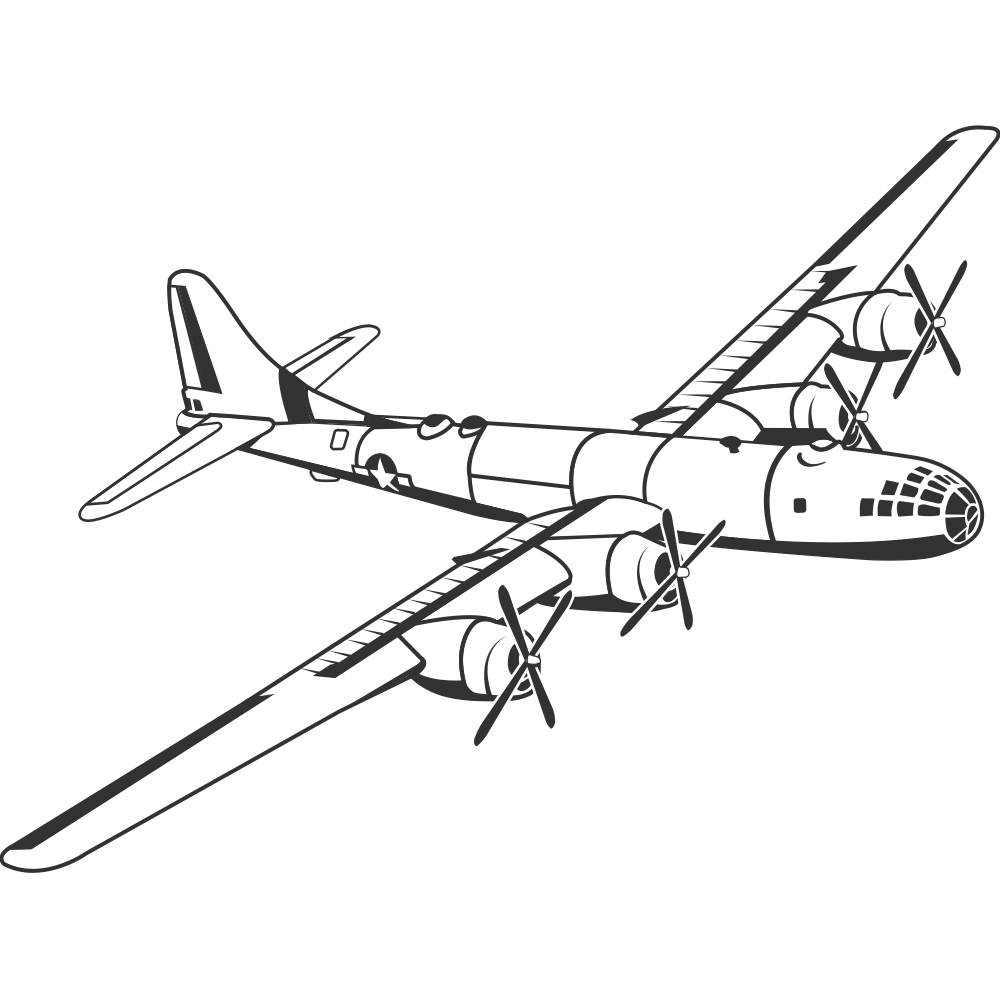
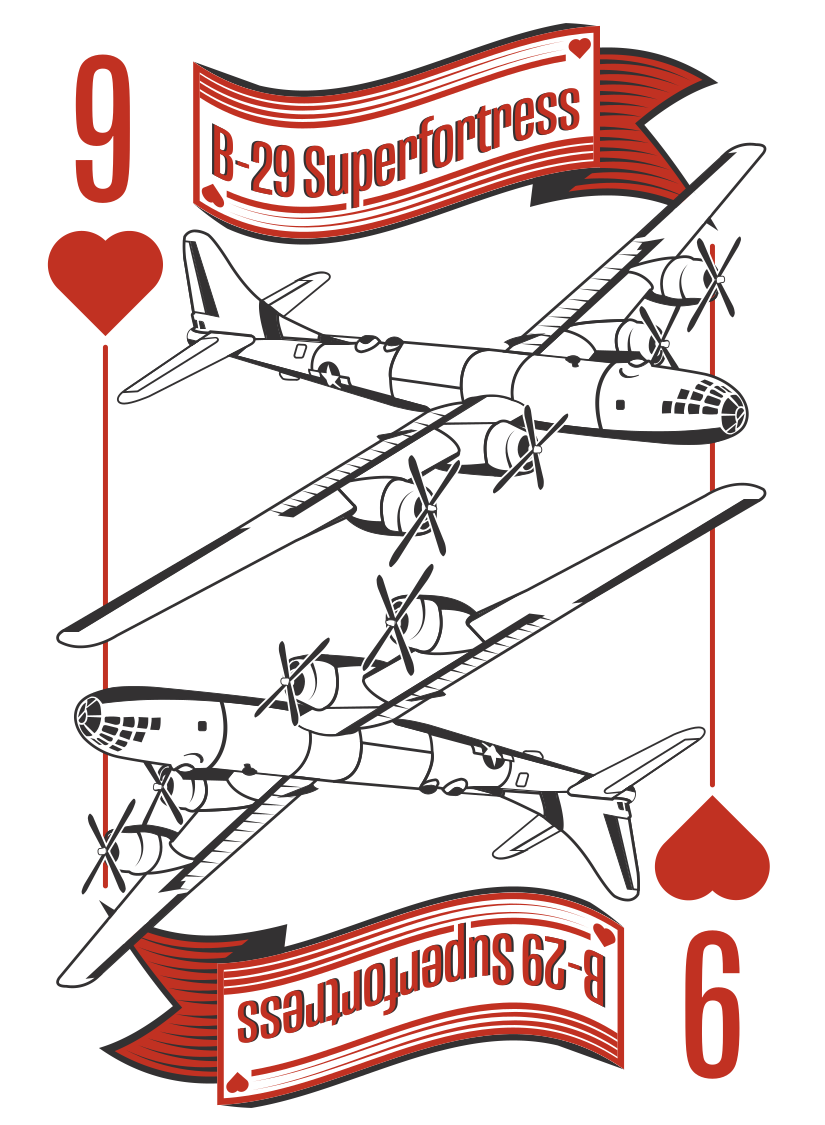
B-29 Superfortress
This World War II bomber plane is a four-engine propeller-driven heavy bomber designed by Boeing. At the request of the United States Army Air Corps, Boeing started to work on creating a pressurized long-range bomber in 1938. Even though the Air Corps didn’t have money to pursue these designs, Boeing pursued the development with their own private funds. Even Charles Lindbergh knew the importance of producing a new bomber to counter the Nazi production when he told general Henry H. Arnold that the U.S. needed to produce one in large numbers. The B-29 became one of the largest aircraft operational during World War II. The design and production of this then state-of-the-art aircraft cost over $3 Billion and was even more expensive than the Manhattan Project that produced the atomic bomb which The Enola Gay a Superfortress, dropped on Hiroshima. The B-29 was capable of flight altitudes up to 31,850; this was its best defense against Japanese fighters that could barely reach that altitude. Following the surrender of Japan B-29s were used for other purposes like supplying Japanese POW camps with food and dropping barrels of rations for them. Because of the advanced design of the B-29 many remained in service long after the war unlike other World War II-era bombers.

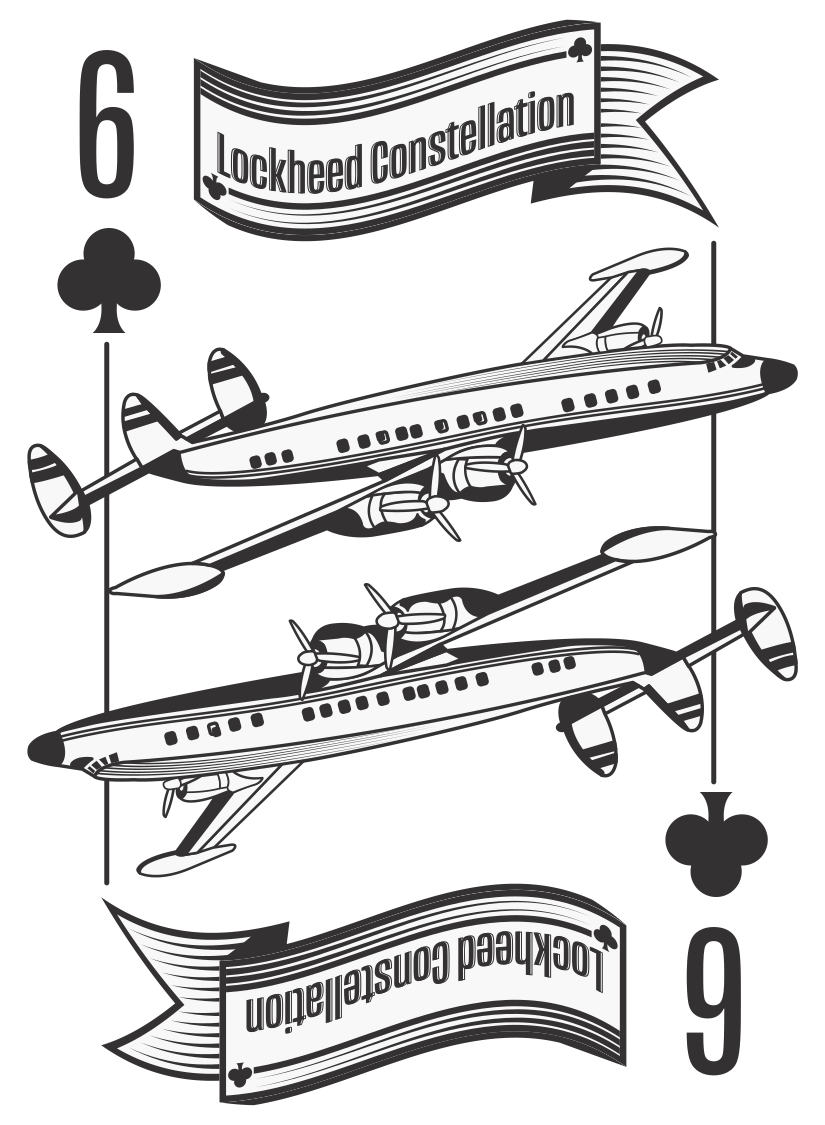
- Role: Airliner and Transport
- Manufacturer: Lockheed
- Designer: Kelly Johnson and Hall Hibbard
- First Flight: January 9, 1943
- Produced: 1943 - 1958
- Number Built: 856
- Unit Cost: $720,000 (1943)
- Top Speed: 377 mph
Lockheed Constellation
The Lockheed Constellation or Connie for short, is a propeller-driven, four-engine airliner built by Lockheed Corporation between 1943 and 1958. The Constellation is credited with ushering in an era of affordable and comfortable air travel. Lockheed built 856 in numerous models, all with the same triple-tail design and dolphin shaped fuselage. The Constellation became the first pressurized-cabin civil airliner series go into widespread use. The pressurized cabin enabled large numbers of commercial passengers to fly well above most bad weather for the first time. Lockheed included new technologies like hydraulically boosted flight control systems. Its iconic form, ultimately led to its obsolescence. The continuously fluid shape meant that no two bulkheads were the same. While this made for a beautiful plane, it made construction expensive. On April 17, 1944, the second production C-69, piloted by Howard Hughes and TWA president Jack Frye, flew from Burbank, California, to Washington, D.C., in 6 hours and 57 minutes at an average 331mph. On the return trip, the aircraft stopped at Wright field to give Orville Wright his last flight, more than 40 years after his historic first flight. He commented that the Constellation’s wingspan was longer than the distance of his first flight.


- Role: Jet Fighter
- Manufacturer: Lockheed Corporation
- Designer: Clarence “Kelly” Johnson
- First Flight: January 8, 1944
- Produced: 1943
- Number Built: 1,715
- Unit Cost: $110,000 (1945)
- Top Speed: 600 mph
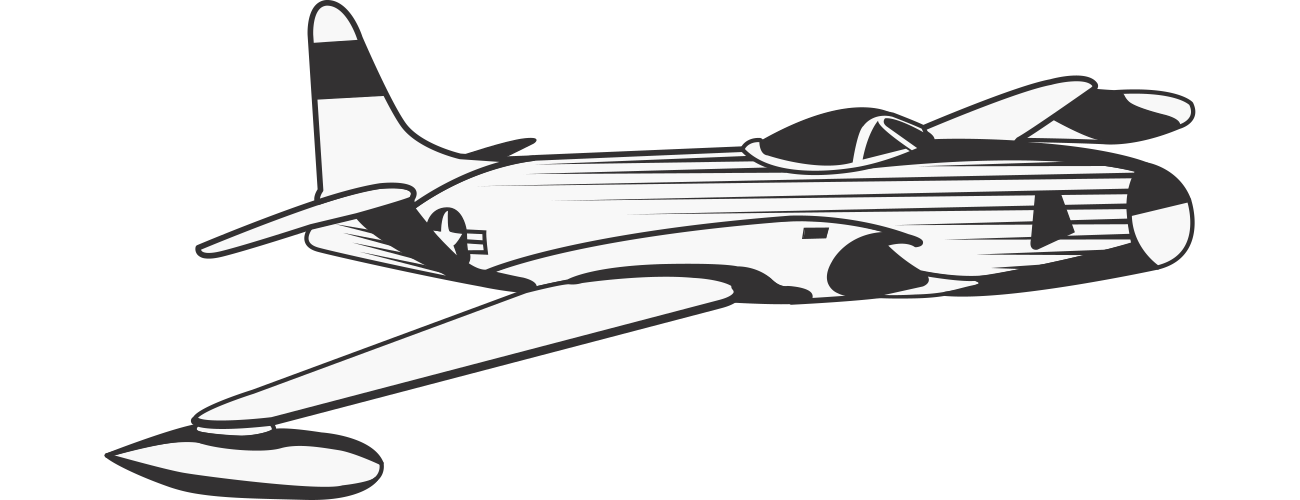
P-80 Shooting Star
The P-80 Shooting star was the first jet fighter used operationally by the United States Air Force. This aircraft was designed and built by Lockheed in 1943 and delivered just a mere 143 days after the start of the design process. The design team was led by the legendary engineer Clarence L. “Kelly” Johnson. Some say this was an early product of Lockheed’s Skunk Works division. The project was so secret that only five of the more 130 people working on it knew they were developing a jet aircraft. Some production models of the P-80 saw limited service in Italy before the end of World War II. Shooting stars first saw combat service in the Korean War, where they saw roles in photo-reconnaissance and air-to-air combat. Despite its very dangerous development period, which killed two top aces and broke the back of another test pilot, the United States’ first turbo-jet powered combat aircraft helped to bring about the jet age. Beginning its service at the close of World War II, the aircraft was used extensively during operations in the Korean War. But its straight wing design was no match for the swept-wing transonic MiG-15. The jet fighter went on to perform ground attack missions and serve as an advance trainer until it was replaced by the swept-wing F-86 Sabre.

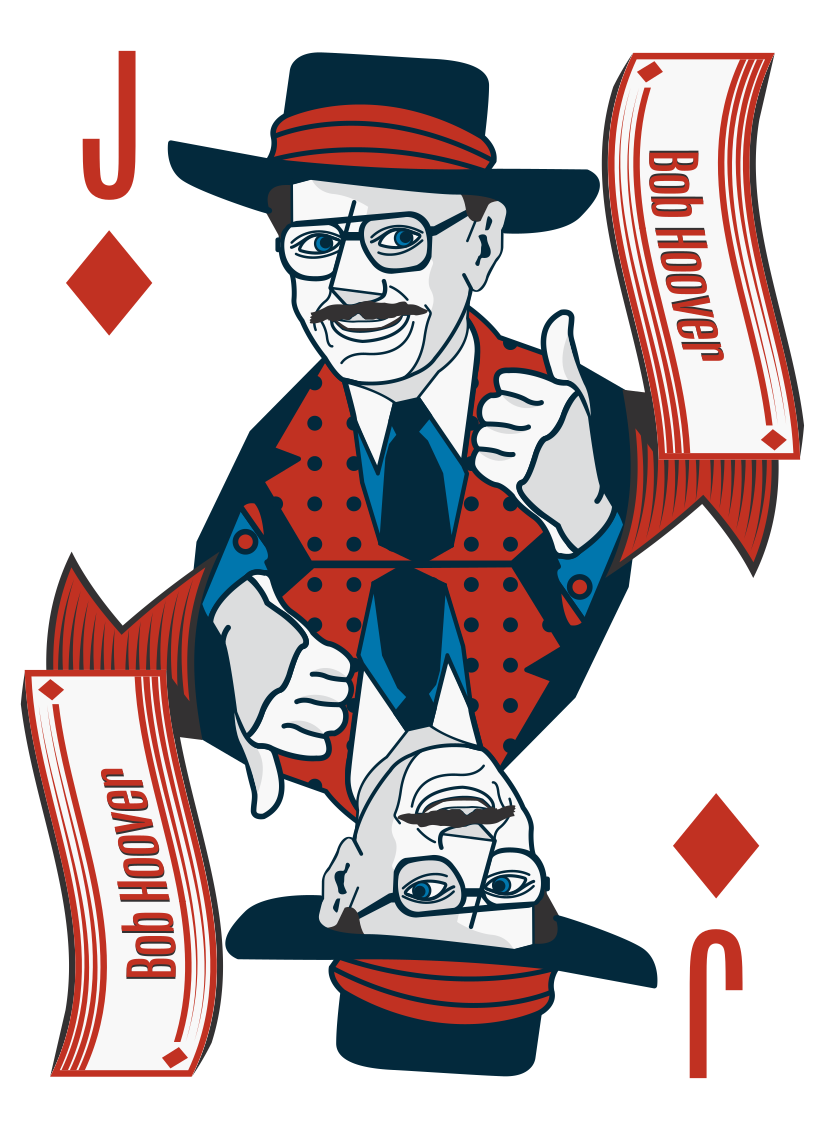
- Born: January 24, 1922
- Death: October 25, 2016
- Records: Transcontinental, time-to-climb, and speed records
Bob Hoover
Robert Anderson “Bob” Hoover was a United States Army Air Forces fighter pilot, USAF civilian test pilot, flight instructor, air show pilot and aviation record-setter. Hoover learned to fly at Nashville’s Berry Field while working at a local grocery store to pay for the flight training. He enlisted in the Tennessee National Guard and was sent for piloting training with the Army. During World War II on his 59th mission he was shot down and imprisoned at a German prison camp in Barth, Germany. After a staged fight covered his escape from the prison camp, Hoover managed to steal an Fw 190, the only flyable plane being kept in the surrounding area and fly to safety in the Netherlands. After the war he was assigned to flight-test duty at Wilbur Wright Field. There he impressed and befriended Chuck Yeager and later helped Yeager on the Bell X-1 program. Hover left the Air Force in 1948 to pursue civilian jobs, for a brief time he worked as a test/demonstration pilot with North American Aviation. During the Korean War he taught pilots how to dive-bomb and during his six weeks in Korea, Hoover flew many combat bombing missions over enemy territory but was denied permission to engage in air-to-air combat flights. During the 1950’s, Hoover visited many active-duty, reserve and Air National Guard units to demonstrate planes’ capabilities to their pilots. Finally in the 1960’s and on Hoover began flying his famous Ole Yeller P-51 Mustang at air shows around the world. Hoover was best known for his civil air show career. He was also known for creating the stunt of successfully pouring a cup of tea while preforming a 1G barrel roll. Hoover was considered one of the founding fathers of modern aerobatics and was known as the “pilot’s pilot”. General Jimmy Doolittle described him as “the greatest stick-and-rudder man who ever lived”. In the Centennial of Flight edition of Air & Space he was named the third greatest aviator in history.


- Born: December 14, 1896
- Death: September 27, 1993
- Years of service: 1917 - 1959
Jimmy Doolittle
James Harold Doolittle was an American Aviation Pioneer. A Reserve officer in the United States Army Air Corps, Doolittle was recalled to active duty during World War II. In October 1917 Doolittle enlisted in the Signal Corps Reserve as a flying cadet; he ground trained at the School of Military on the campus of the University of California, and flight-trained at Rockwell Field, California. Doolittle received his Reserve Military Aviator rating and was commissioned a first lieutenant in the Signal Officers Reserve Corps of the U.S. Army on March 11, 1918. During World War I Doolittle stayed in the United States as a flight instructor. Doolittle was one of the most famous pilots during the inter-war period. In September 1922, he made the first of many pioneering flights, flying a de Havilland DH-4 – which was equipped with early navigational instruments – in the first cross-country flight, from Pablo Beach Florida, to Rockwell Field, San Diego, California, in 21 hours and 19 minutes, making only one refueling stop at Kelly Field. The U.S. Army awarded him the Distinguished Flying Cross. Doolittle’s most important contribution to aeronautical technology was the development of instrument flying. He was the first to recognize that true operational freedom in the air could not be achieved unless pilots developed the ability to control and navigate aircraft in flight, from takeoff run to landing rollout. Doolittle was the first to envision that a pilot could be trained to use instruments to fly through fog, clouds and precipitation of all forms, darkness, or any other impediment to visibility. He helped develop, and was then the first to test, the now universally used artificial horizon and directional gyroscope. During Doolittle’s time serving in World War I he was awarded the Medal of Honor for personal valor and leadership as commander of the Doolittle Raid, a bold long-range retaliatory air raid on the Japanese main islands, on April 18, 1942. The attack was a major morale booster for the United States, and Doolittle was celebrated as a hero. Doolittle was promoted to general years after retirement. Jimmy Doolittle would later die at the age of 96.


- Born: February 13, 1923
- Death: (age 95 years)
- Years of service: 1941 - 1975
Chuck Yeager
Charles Elwood Yeager is a former United States Air Force officer, flying ace and record-setting test pilot. Yeager’s career began in World War II as a private in the United States Army Air Forces. After serving as an aircraft mechanic, in September 1942 he entered enlisted pilot training and upon graduation was promoted to the rank of flight officer and became a P-51 fighter pilot. After the war, Yeager became a test pilot of many types of aircraft, including experimental rocket-powered aircraft. As the first human to officially break the sound barrier, on October 14, 1947, he flew the experimental Bell X-1 at Mach 1 at an altitude of 45,000 ft. for which he won both the Collier and Mackay trophies in 1948. He then went on to break several other speed and altitude records. The X-1 he flew that day was later put on permanent display at the Smithsonian Institution’s National Air and Space Museum. During the latter half of 1953, Yeager was involved with the USAF team that was working on the X-1A, an aircraft designed to surpass Mach 2 in level flight. That year, he flew a chase aircraft for the civilian pilot Jackie Cochran as she became the first woman to fly faster than sound. Yeager later commanded fighter squadrons and wings in Germany, and in Southeast Asia during the Vietnam War, and in recognition of the outstanding performance ratings of those units he was promoted to brigadier general. Yeager, who never attended college and was often modest about his background, is considered by many, including Flying Magazine, National Aviation Hall of Fame, a few U.S. presidents, and the United States Army Air Force, to be one of the greatest pilots of all time. In 1973, Yeager was inducted into the National Aviation Hall of Fame, arguably aviation’s highest honor. In December 1975, the U.S. Congress awarded Yeager a silver medal “equivalent to a noncombat Medal of Honor , for contributing immeasurably to aerospace science by risking his life in piloting the X-1 research airplane faster than the speed of sound on October 14, 1947.” President Gerald Ford presented the medal to Yeager in a ceremony at the White House on December 8, 1976.
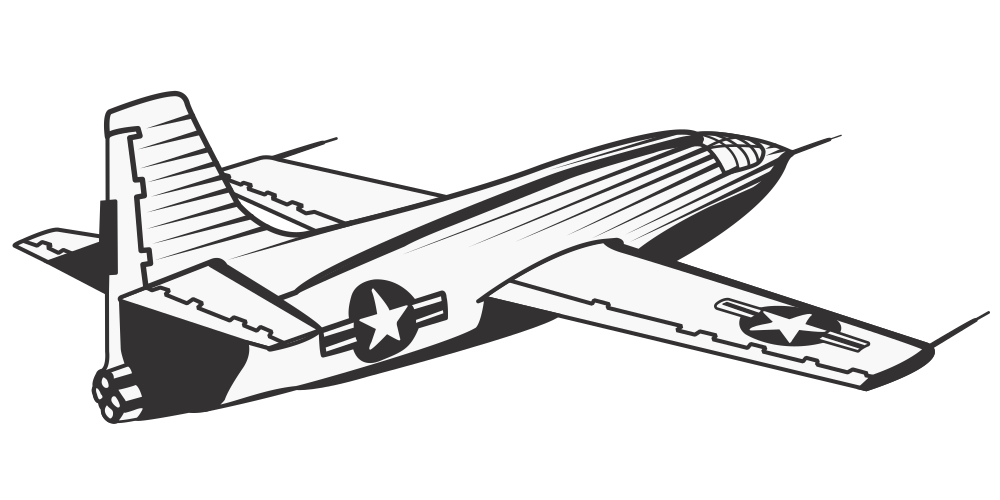

- Role: Experimental Rocket Plane
- Manufacturer: Bell Aircraft
- Designer: Robert J. Woods
- First Flight: January 19, 1946
- Produced: 1944 - 1945
- Number Built: 7
- Unit Cost: N/A
- Top Speed: 958 mph
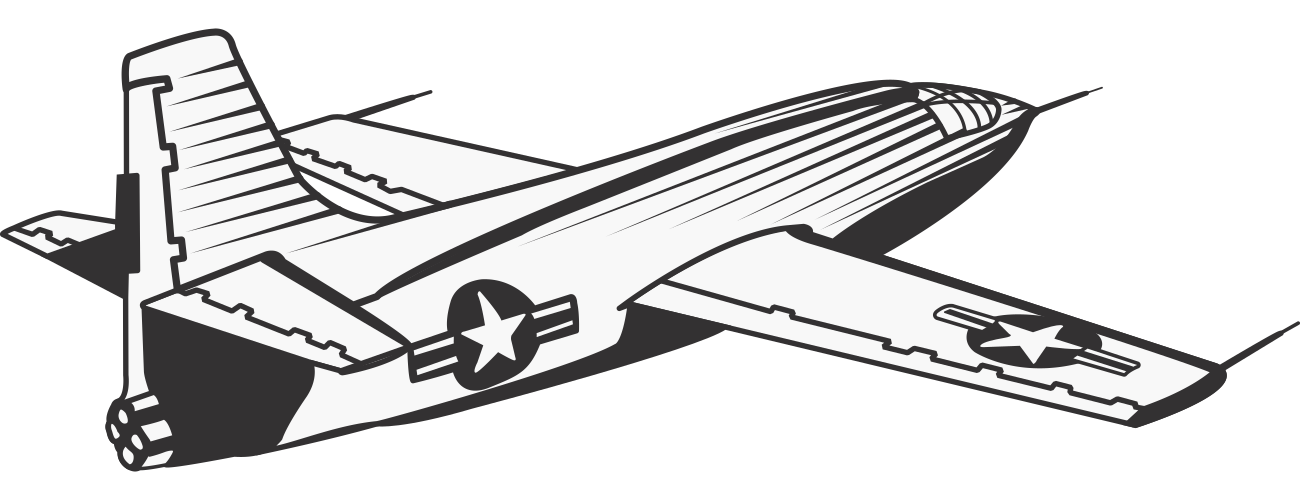
Bell X-1
The Bell X-1, an experimental rocket plane is a rocket engine-powered aircraft that was built by Bell Aircraft as a supersonic research project for the U.S. Military. This Aircraft was conceived during 1944 and designed as well as built in 1945. Its first iteration was capable of achieving nearly 1,000 mph, and then in 1954 an improved version of the X-1 piloted by Chuck Yeager became the first airplane to exceed the speed of sound and reach speeds of 1,600 mph. Before breaking the sound barrier the X-1 was famous for the first manned supersonic flight, which occurred on 14th October 1947, which Chuck Yeager also piloted. His plane nicknamed Glamorous Glennis, which had a beautiful orange color and was named after his wife reached the speed of Mach 1.06 or 700 mph that day. The X-1 program however was a secret program kept under wraps by the U.S. Air Force. Despite their best efforts the story of Yeager’s flight was leaked to the press and the world soon knew of his revolutionary achievement. The research techniques used for the X-1 program became the pattern for all subsequent X-craft projects. The flight data collected by the NACA from the X-1 tests then proved invaluable to further US fighter design throughout the latter half of the 20th century.
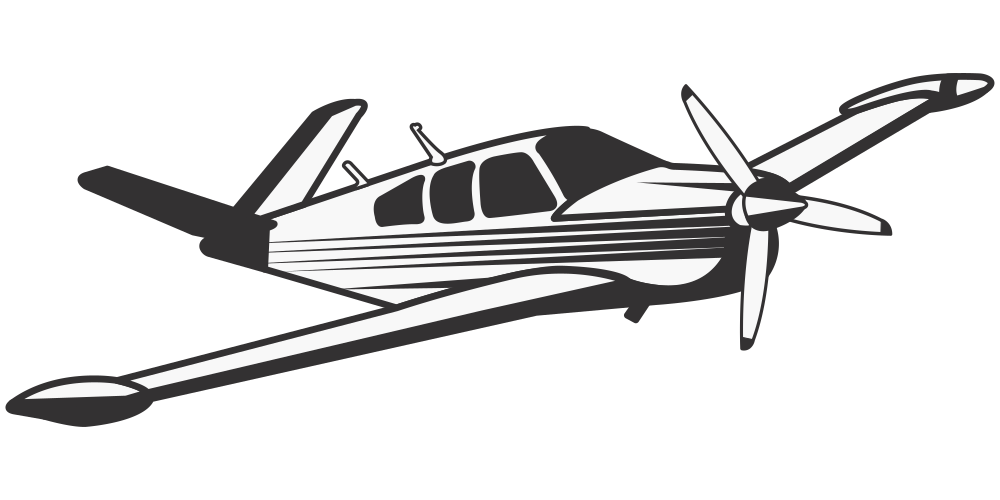

- Role: Civil Utility Aircraft
- Manufacturer: Beechcraft
- Designer: Ralph Harmon
- First Flight: December 22, 1945
- Produced: 1947 - Present
- Number Built: >17,000
- Unit Cost: $700,000 (2006)
- Top Speed: 326 mph
Beechcraft S35 Bonanza
The Beechcraft is an American General Aviation aircraft introduced in 1947 by Beech Aircraft Corporation of Wichita, Kansas. The six-seat, single-engine aircraft is still being produced by Beechcraft and has been in continuous production longer than any other airplane in history. At the end of World War II, two all-metal light aircrafts emerged, the Model 35 Bonanza and the Cessna 195. The both represented different approaches to the premium end of the postwar civil-aviation market. The Bonanza has a shape similar to the fighters developed during the war, it featured an easy to manage, horizontally opposed, six-cylinder engine and a rakishly streamlined shape. The Model 35 had a signature V-tail, which made it both efficient and the most distinctive private aircraft in the sky. Bonanzas had many noticeable flights, such as the first light aircraft to fly from Honolulu, Hawaii to the continental United States, flown by Captain William Odom. Odom in 1949 also piloted a Bonanza a distance of 5,273, from Honolulu to Teterboro, New Jersey in a nonstop record flight. More than 17,000 Bonanzas of all variants have been built, produced in both distinctive V-tail and conventional tail configurations. Many Bonanzas still fly to this day.
After World War II, commercial aviation grew rapidly, using mostly ex-military aircraft to transport people and cargo. This growth was accelerated by the glut of heavy and super-heavy bomber airframes like the B-29 and Lancaster that could be converted into commercial aircraft. The DC-3 also made for easier and longer commercial flights.
1950

- Role: Military Transport Aircraft
- Manufacturer: Lockheed Corporation
- Designer: Lockheed Martin
- First Flight: August 23, 1954
- Produced: 1954 - Present
- Number Built: 2,500+
- Unit Cost: $30,100,000
- Top Speed: 368 mph
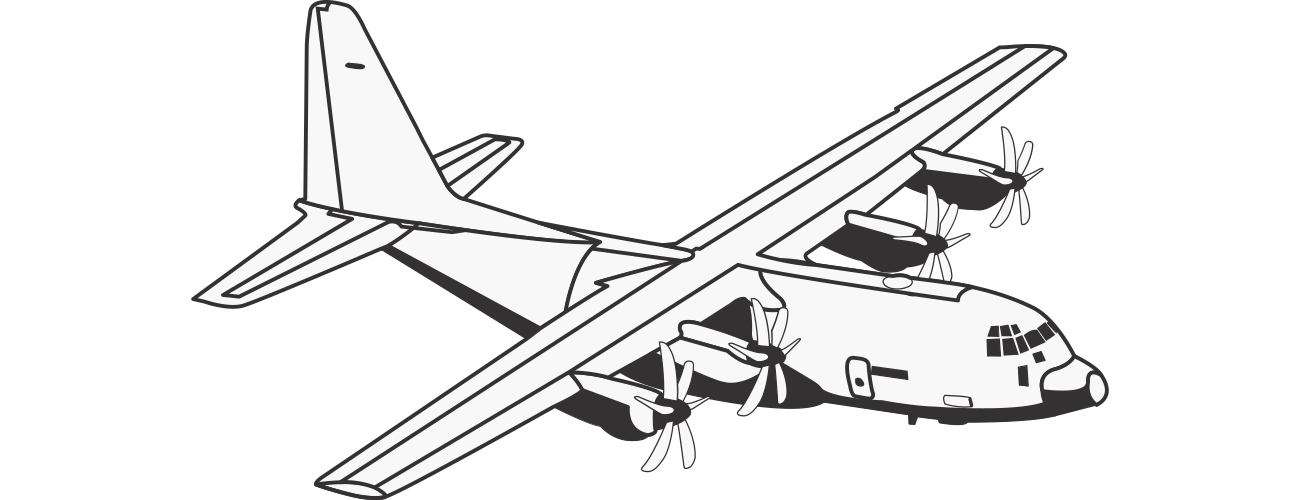
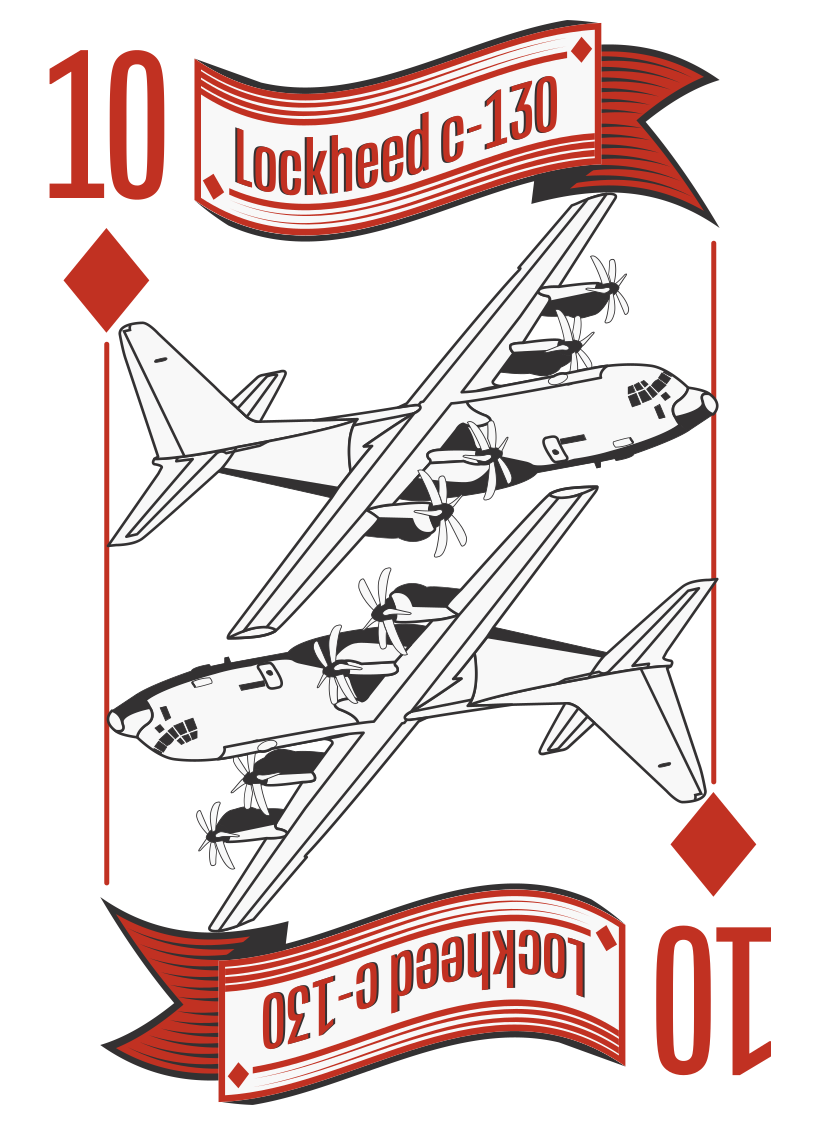
Lockheed C-130
The Lockheed C-130 also known as Hercules is an American four-engine turboprop military transport aircraft designed and built by Lockheed. The United States Air Force recognized that their World War II transport aircrafts were becoming inadequate and issued a GOR to several companies for a newer transport aircraft that could have a capacity of 92 passengers. In 1956 the Air Force’s wish was granted and the C-130 began its military career. The C-130 has multiple military and other roles including gunship, search and rescue, scientific research support, weather reconnaissance, aerial refueling and aerial firefighting. More than 40 variations of the venerable plane have been delivered to more than 70 nations since its first flight in 1954. The C-130 known for its durability became the fifth aircraft in United States Air Force history to mark 50 years of continuous service in 2007. It is also the longest continuously produced military aircraft at over 60 years. The giant cargo plane has a max speed of 366mph and can take off with a max weight of 155,000 lb. In 1963 the C-130 also set a record for largest aircraft to land on an aircraft carrier, it still holds this record.


- Role: Strategic Bomber
- Manufacturer: Avro
- Designer: Avro
- First Flight: May 25, 1960
- Produced: 1956–1965
- Number Built: 136
- Unit Cost: £750,000 (1956)
- Top Speed: 645 mph
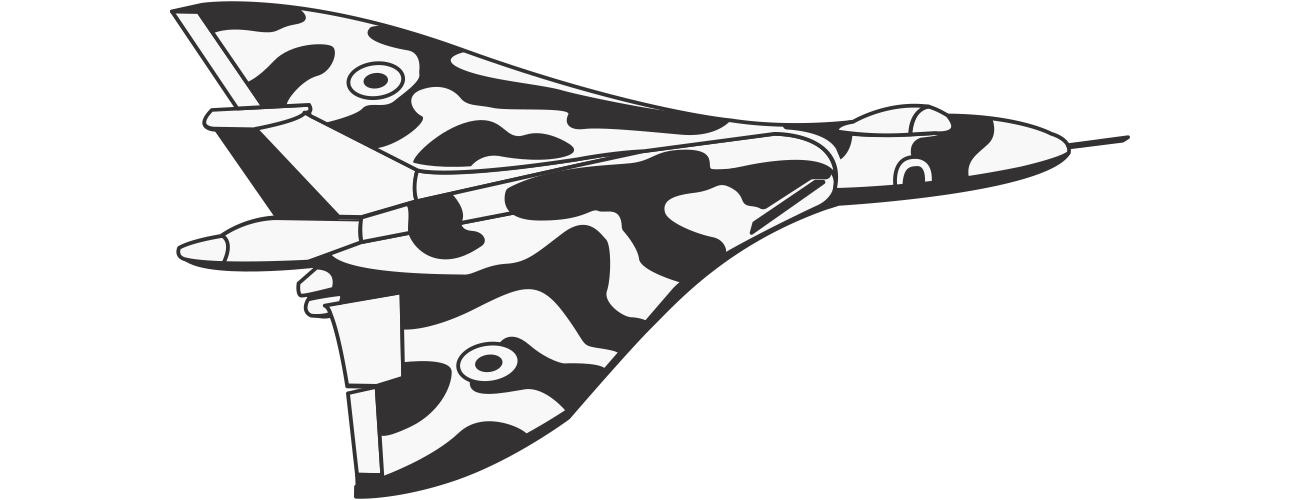
Avro Vulcan
The Avro Vulcan is a jet powered tailless delta wing high-altitude strategic bomber. The Royal Air Force from 1956 until 1984 operated the iconic bomber plane. The Avro Vulcan aircraft is known for relying on its high-speed high-altitude flight to evade interception. Despite its radical and unusual shape, the airframe was built along traditional lines. Except for the most highly stressed parts, the whole structure was manufactured from standard grades of light alloy. The Vulcan is also famous for its white and green camouflage paintjob. The unique bomber operates with a five-man crew, the first pilot, the co-pilot, navigation radar, navigation plotter and air electronics officer. The Vulcan’s only combat missions took place towards the end of the type’s service in 1982. During the Falklands War, the Vulcan was deployed against Argentinian forces, which had occupied the Falkland Islands. This conflict was the only occasion in which any of the V-bombers would participate in conventional warfare. The Vulcan could also carry 21, 1,000-pound conventional bombs. Outside of this the Vulcan also served in reconnaissance and aerial refueling roles. Currently several Avro Vulcans are housed in museums across both the United Kingdom and the United States.


- Born: September 14, 1921
- Death: August 22, 2013
- Known For: Founding EAA
Paul Poberezny
Paul Howard Poberezny was and American aviator, entrepreneur and aircraft designer. He founded the Experimental Aircraft Association (EAA) in 1953 and spent the greater part of his life promoting homebuilt aircrafts. He was introduced to aviation in 1936 at the age of 16 with the gift of a donated damaged WACO Primary Glider that he rebuilt and taught himself to fly. A high school teacher owned the glider and offered to pay Poberezny to repair it. He hauled it to his father’s garage, borrowed books on building/repairing airplanes, and completed the restoration soon after a year later; Poberezny soloed at age 17 in a 1935 Porterfield and soon co-owned an American Eagle biplane. In 1955, Poberezny wrote a series of articles for the publication Mechanix Illustrated, where he described how an individual could buy a set of plans and build his or her own airplane at home. In the magazine were also photos of himself fabricating the Baby Ace, an amateur-built aircraft that he bought the rights to for US $200 a few years prior. The articles became extremely popular and gave the concept of homebuilding worldwide acclaim. Poberezny founded the Experimental Aircraft Association out of his Hales Corners, Wisconsin home in 1953. It started as predominately a homebuilding organization in his basement, but later went on to capture all aspects of general aviation internationally. As of 2014, the organization had approximately 180,000 members in more than 100 countries. EAA’s annual convention and fly-in Oshkosh, Wisconsin attracts a total attendance in excess of 500,000 people, 10,000 aircraft and 1,000 different forums & workshops annually, making it the largest of its kind in the world. He designed, modified and built several home-built aircraft, and had more than 30,000 hours of flight time in his career. Poberezny is widely considered as the first person to have universalized the tradition of aircraft homebuilding. Through his work founding EAA and the organization’s annual convention, he had the reputation of helping inspire millions of people to get involved in grassroots aviation.


- Role: Civil Utility Aircraft
- Manufacturer: Cessna Aircraft
- Designer: Cessna Aircraft
- First Flight: June 12, 1955
- Produced: 1956–86, 1998–present
- Number Built: 44,000+
- Unit Cost: $364,000 (2014)
- Top Speed: 188 mph
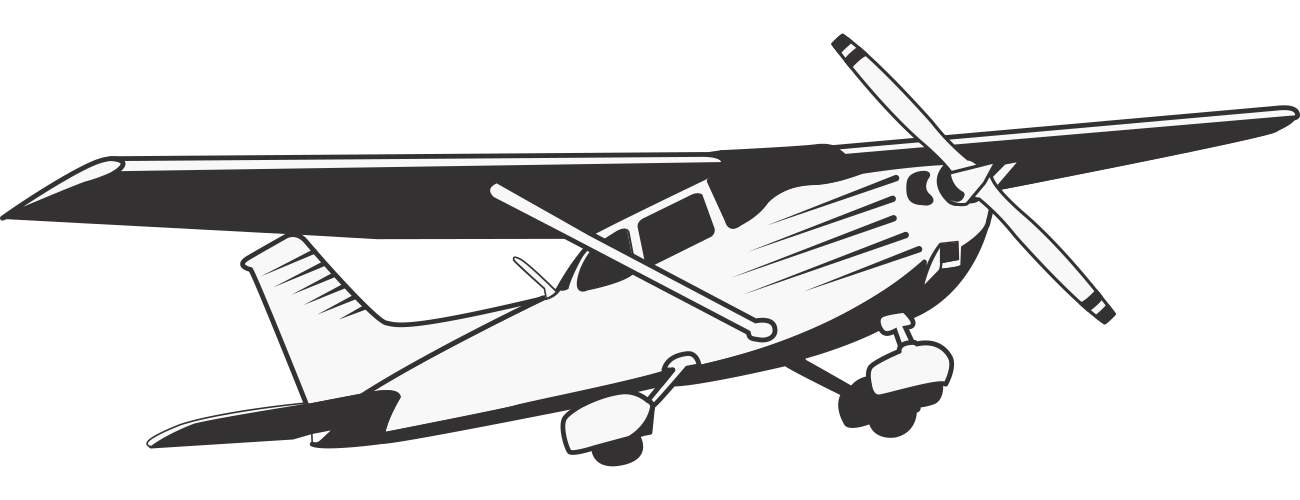
Cessna 172
The Cessna 172 is an American four-seat, single engine, high wing, fixed wing aircraft made by the Cessna Aircraft Company. One of the most popular aircrafts ever made, more 172s have been built than any other aircraft ever. Not only is it popular it also has extreme longevity on its side. Since its first production in 1956, as of 2015 more than 44,000 Cessna 172s have been produced. Reliable, affordable, and stable, the 172 are the staple plane of flight training schools everywhere. Its modest performance and longevity creates the ideal mode of transportation for private pilots across the globe. The Cessna 172’s success drove the Cessna Aircraft Company to domination in the light aircraft market. A Cessna 172 was also used in 1958 to set the world record for flight endurance, which is the longest time an aircraft spent in flight with out landing. This record set by Robert Timm and John Cook of 64 days in the air still stands to this day. (yes you read that right, 64 days.)
- Role: Business Aircraft
- Manufacturer: Grumman
- Designer: Grumman
- First Flight: August 14, 1958
- Produced: 1959 – 1969
- Number Built: 200
- Unit Cost: $1,000,000 (2015)
- Top Speed: 350 mph
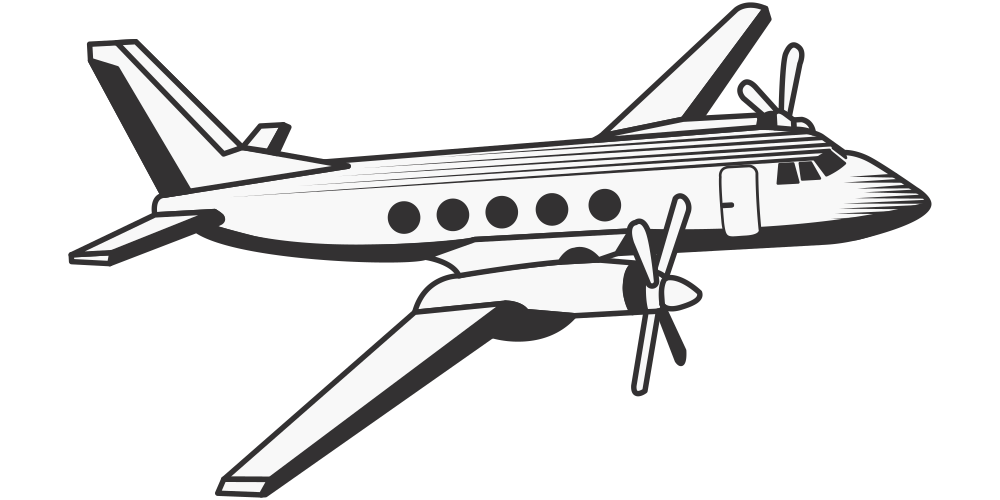
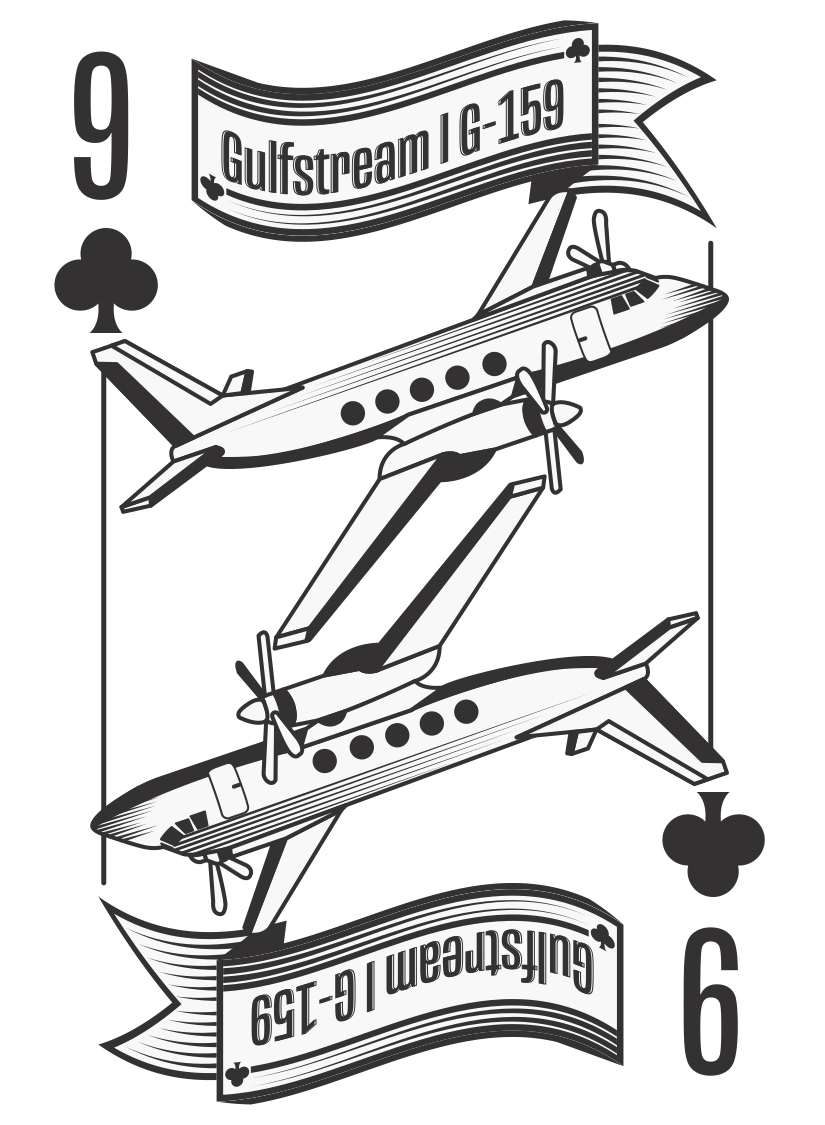
Gulfstream I G-159
The Grumman Gulfstream I, designated G-159 by Grumman, is a twin-turboprop business aircraft. The Grumman Aircraft Engineering Corporation came up with the brilliant idea to turn its robust line of warplanes into a fleet of scaled-down airliners to accommodate the post-war economic boom and so the business jet was born. The G-159 is a low-wing cantilever monoplane with a semi-monocoque aluminum alloy fuselage structure. Two Rolls-Royce Dart turboprops power the aircraft with Rotol four-bladed constant speed propellers. The cabin is designed to take up to twenty-four passengers in a high-density arrangement or only eight in an executive layout. An auxiliary power unit was another design feature contributing to the aircraft’s success. Air conditioning and other systems could be powered prior to engine start. This also allowed the plane to operate at small airfields with limited facilities. The large fuel tanks gave the GI extended range. All of these facts were appealing to a budding business industry that desired a more private and flexible means of travel. As of August 2006, a total of 44 Grumman Gulfstream G-159 remained in service throughout the world.
1960
In 1969 Neil Armstrong and Buzz Aldrin set foot on the moon, the same year Boeing unveiled the Boeing 747 and the Aérospatiale-BAC Concorde supersonic passenger airliner had its maiden flight. The Boeing 747 was the largest commercial passenger aircraft ever to fly, and still carries millions of passengers each year, though it has been superseded by the Airbus A380, which is capable of carrying up to 853 passengers. A few years earlier the SR-71 Blackbird had set the record for crossing the Atlantic in under 2 hours, and Concorde followed in its footsteps. In 1979 the Gossamer Albatross became the first human powered aircraft to cross the English Channel. This achievement finally saw the realization of centuries of dreams of human flight.
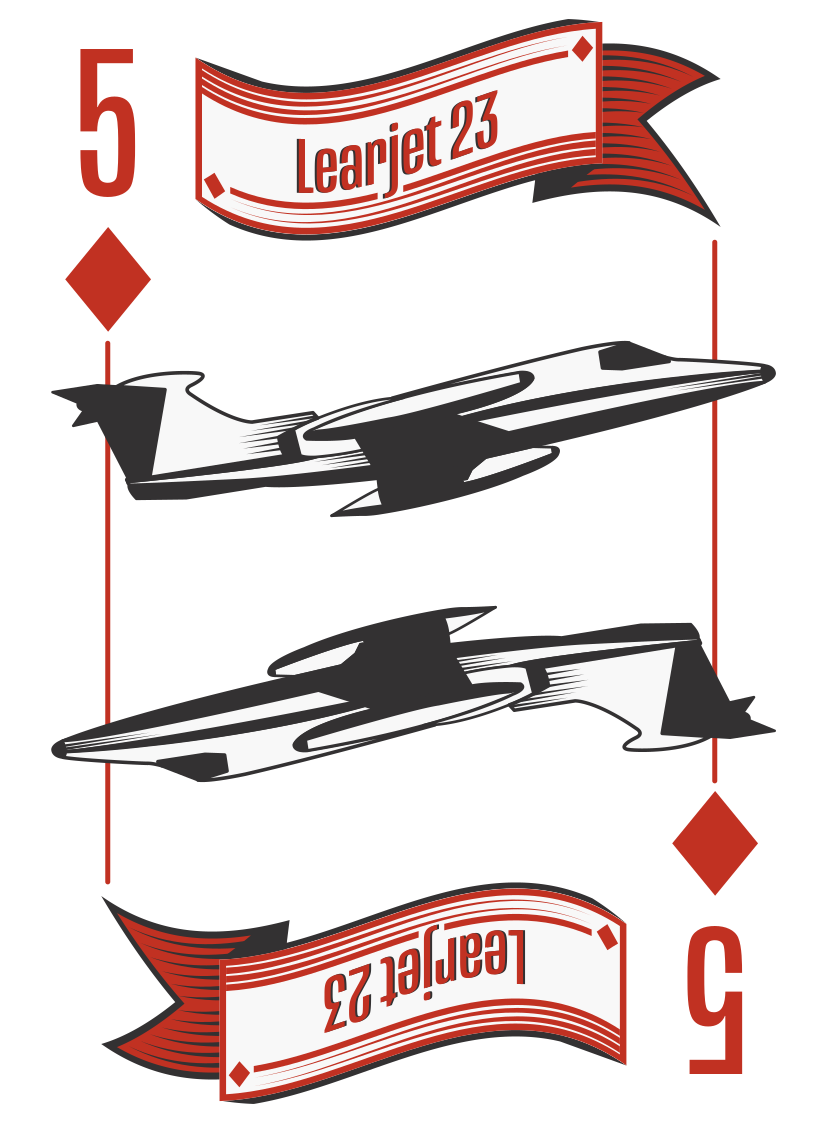
- Role: Business Jet
- Manufacturer: Learjet
- Designer: William Powell Lear
- First Flight: October 7, 1963
- Produced: 1964 - 1966
- Number Built: 101
- Unit Cost: $13,209,000 (2012)
- Top Speed: 561 mph
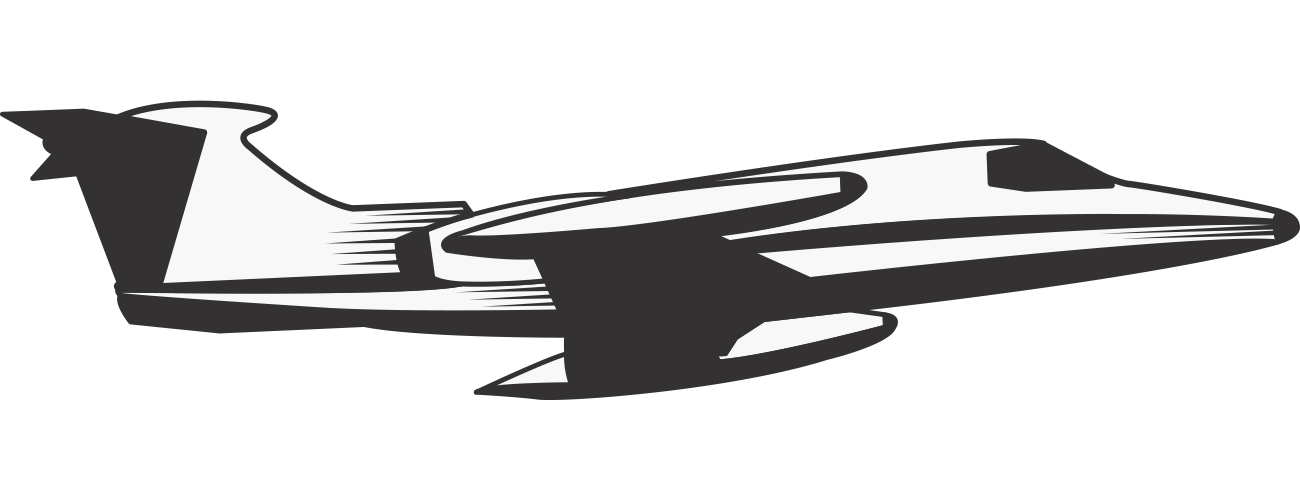
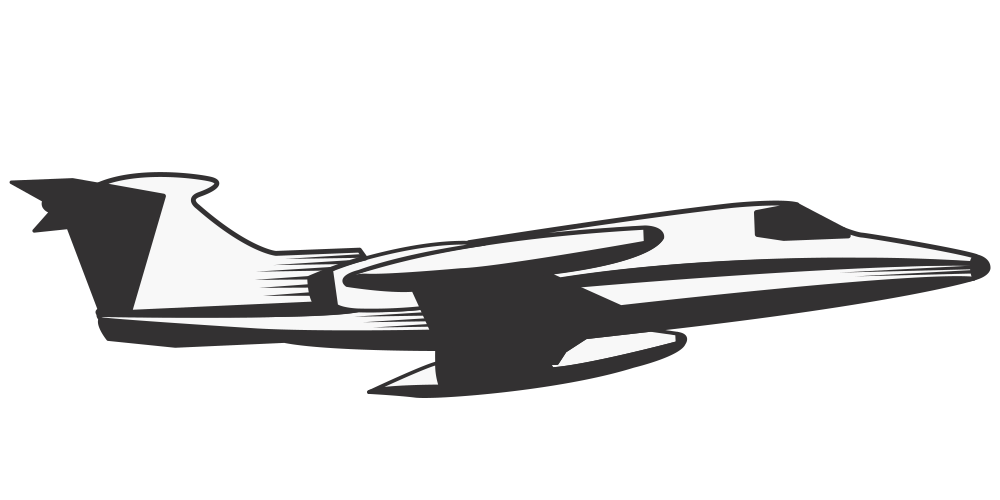
Learjet 23
William Powell Lear moved to Switzerland to California in 1960 to form the Swiss American Aviation Corporation intending to redesign a group of fighter aircrafts and executive jets. However these attempts failed and Lear moved back to the U.S. to produce his own executive version. Lear had a great insight that a market was emerging for executive business travel. This led to the development of the Learjet 23. The Learjet 23 is an American built six-to-eight twinjet, high-speed business jet. It has room for two crewmembers and four to six passengers. Production ended in 1966 after one hundred and one aircraft had been delivered. After this brief but impactful production time the term Learjet became synonymous with the idea of business jets. In 1998, thirty-nine Model 23s were estimated to remain in use. Twenty-seven are known to have been lost or damaged beyond repair through accidents, the most recent being in 2008. Nonetheless Learjet has become the standard for private jets.
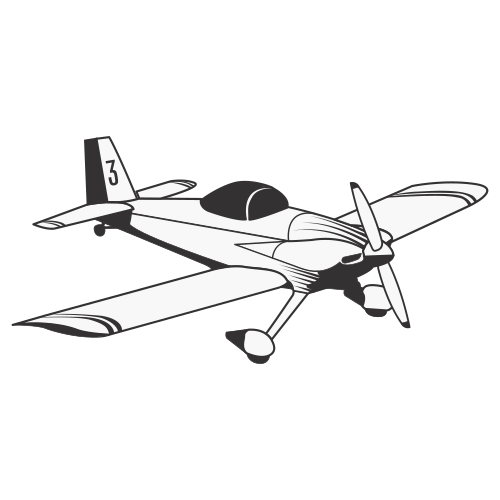

- Role: Kit Aircraft
- Manufacturer: Van's Aircraft
- Designer: Richard VanGrunsven
- First Flight: 1971
- Produced: 1967 - 1997
- Number Built: 281
- Unit Cost: $35,000 – $63,000 (2014)
- Top Speed: 207 mph
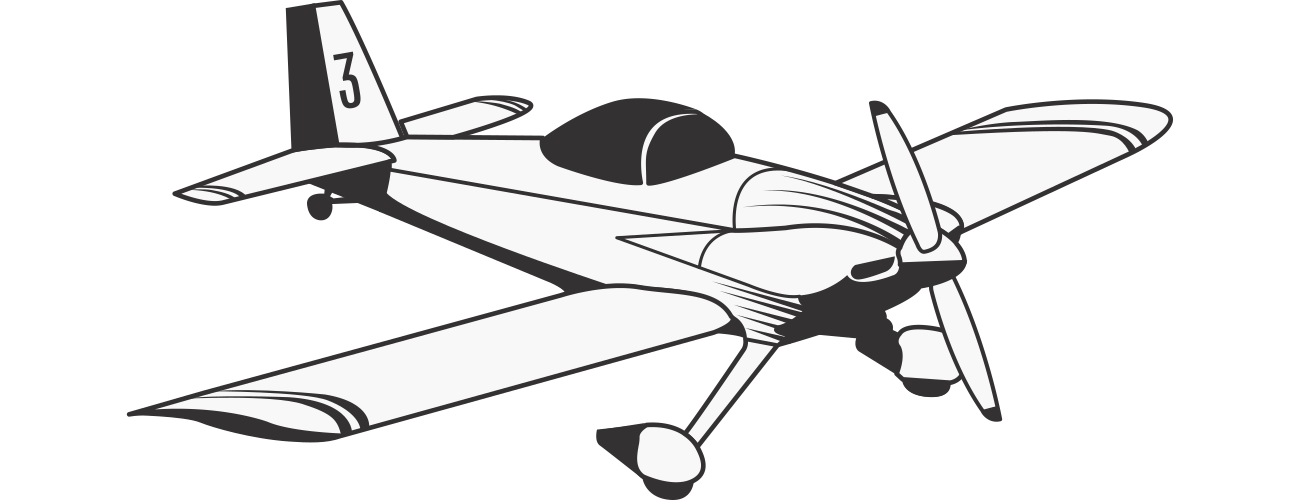
RV-3
The Van’s RV-3 is a single-seat, single-engine, low-wing kit aircraft sold by Van’s Aircraft. Richard VanGrunsven, the architect of the line of Van’s aircraft designed the RV-3 in the late 1960’s after flying the Stits Playboy amateur-built aircraft. He quit his day job to build all of his attempts leading to the RV-3, an airplane of his own design in the garage behind his house. The RV-3 became an attempt to improve the Playboy in anyway possible. The RV-3 was designed to have light handling, aerobatic capabilities and fast cruise speeds. It was also designed with travel in mind; it can carry 30 US gallons giving it a range of about 600 miles. The very first RV-3 built by VanGrunsven won “Best Aerodynamic Detailing” at the 1972 EAA Oshkosh Convention. VanGrunsven continued to build a line of successful kit aircraft based on this original RV-3 for four decades, and the business eventually outgrew two facilities. Now, each year the numbers of aircraft built that were designed by VanGrunsven outnumbers the combined production of all commercial general aviation companies. More than 8,500 DIYers have completed and flown their RVs.


- Born: February 10, 1927
- Death: December 21, 1990
- Known For: Series of important aircraft designs.
Clarence “Kelly” Johnson
Clarence Leonard “Kelly” Johnson was an American aeronautical and engineer. At the University of Michigan, Johnson conducted wind tunnel tests of Lockheed’s proposed Model 10 airliner. He found the aircraft did not have adequate directional stability. Upon completing his master’s degree in 1933, Johnson joined Lockheed as a tool designer on a salary of $83 a month. Shortly after starting, Johnson convinced Hall Hibbard, the chief engineer, the Model 10 was unstable. Hibbard sent Johnson back to Michigan to conduct more tests. This brought Johnson to the attention of company management, and he was promoted to aeronautical engineer. Johnson became Vice President of Advanced Development Projects in 1958. The first ADP offices were nearly uninhabitable; the stench from a nearby plastic factory was so vile. Lockheed ordered it changed to “Skunk Works”. Johnson led or contributed to the development of a number of aircraft. A few examples illustrate the influence of his work. In the late 1930s, Johnson helped lead the team that developed the P-38 Lightning. Eventually, almost 10,000 of these fighters were built. They played a significant role in World War II. In 1943, responding to United States Army Air Forces’ concerns about Nazi Germany’s development of high performance jet fighters. The result, the P-80 Shooting Star, was completed on time and became America’s first operational jet fighter. Johnson also led the development of the SR-71 Blackbird family of aircraft. Through a number of significant innovations, Johnson’s team was able to create an aircraft that flew so high and fast that it could neither be intercepted nor shot down. As a member and first team leader of the Lockheed Skunk Works, Johnson worked for more than four decades and is said to have been an “organizing genius”. He played a leading role in the design of over forty aircraft, including several honored with the prestigious Collier Trophy, acquiring a reputation as one of the most talented and prolific aircraft design engineers in the history of aviation.
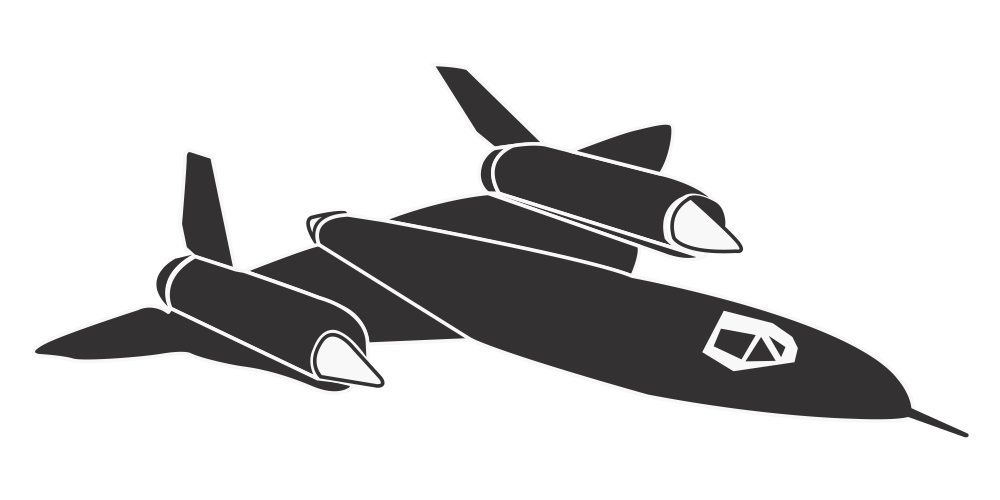

- Role: Strategic reconnaissance aircraft
- Manufacturer: Lockheed, Skunk Works division
- Designer: Clarence “Kelly” Johnson
- First Flight: December 22, 1964
- Produced: 1961 - 1999
- Number Built: 32
- Unit Cost: $33,000,000 (1966)
- Top Speed: 2,200 mph
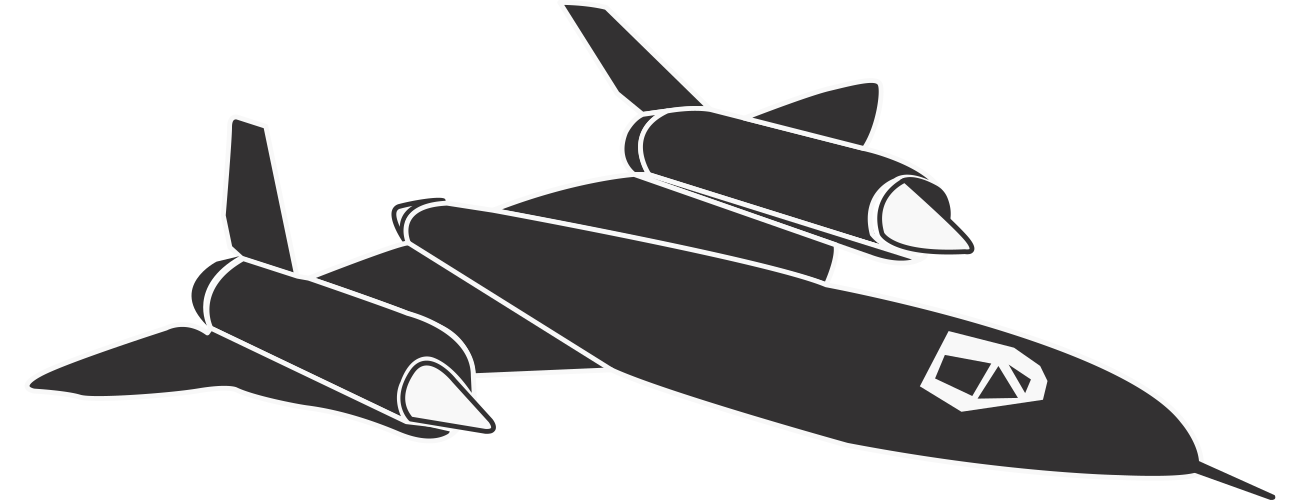
SR-71 Blackbird
The Lockheed SR-71 “Blackbird” is a long range, Mach 3+ Strategic reconnaissance aircraft that was operated by the United States Air Force. The Blackbird had a secret development in the 1960s as a black project under the Skunk Works division of Lockheed. American aerospace engineer Clarence “Kelly” Johnson was responsible for many of the design’s innovative concepts. The Sr-71 was one of the first operational aircrafts developed around stealth. The design included special radar-absorbing materials to reduce the aircrafts radar cross-section. The greatest achievement of the Blackbird was its speed however, if the plane were ever engaged by a surface-to-air missile, standard protocol was to accelerate and outrace the threat. The SR-71 also operated at extreme altitudes like 80,000 feet. Because of this crewmembers could not use standard masks, which couldn’t provide enough oxygen above 43,000 feet. Specialized protective pressurized suits were produced for crewmembers that had a resemblance to space suits. The SR-71 served with the U.S. Air Force from 1964 to 1998. A total of 32 aircraft were built: 12 were lost in accidents, but none were lost to enemy action. Since 1976, it has held the record for fastest air-breathing manned aircraft.


- Role: Narrow-Body Jet Airliner
- Manufacturer: Airbus
- Designer: Airbus
- First Flight: February 22, 1987
- Produced: 1986-Present
- Number Built: 8,140
- Unit Cost: $88,000,000 (2011)
- Top Speed: 903km/h
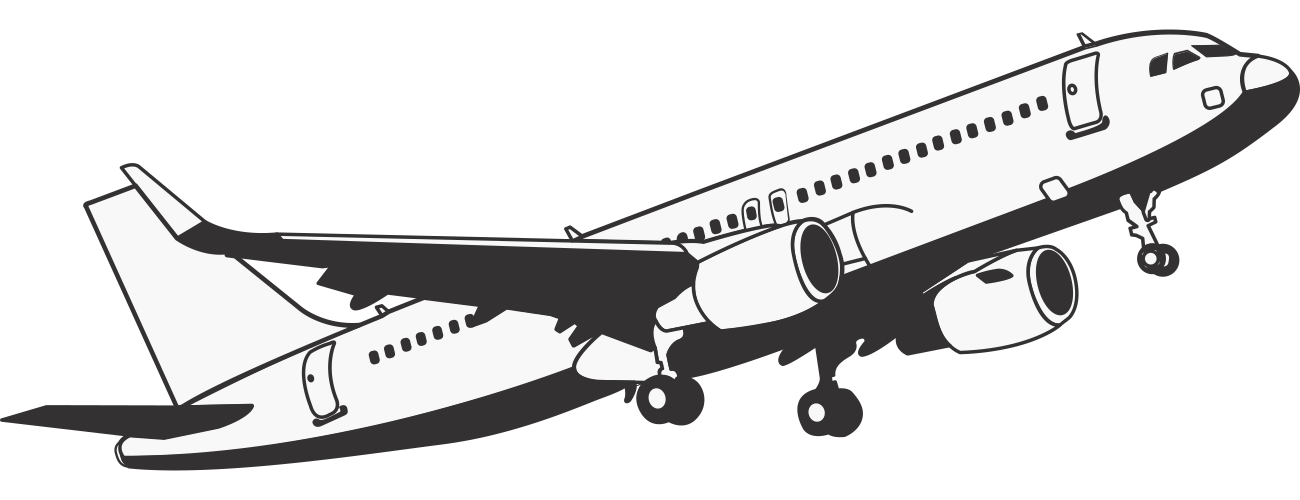
Airbus A320
The Airbus A320 comes from a large family of related aircrafts developed by Airbus in the late 1980’s. The Family came as an effort to catch up to Boeing its biggest competitor. The family consists of short-to medium-range, narrow-body, commercial passenger twin-engine jet airliners. The first member of the family the Airbus A320 was launched in 1984 and delivered to the first customer Air France in 1988. As of late 2018, a total of 8,441 Airbus A320-family aircrafts have been delivered. American Airlines is the world’s largest airline operator of the A320 family of aircraft with 392 aircraft in active service as of September 2017. Airbus took a technological leap forward when they implemented the use of fly-by-wire flight controls and implementing side sticks for improved ergonomics for the flight crew. This results in less arm fatigue by the pilots and more precise control inputs that allow the crew to sit closer to larger integrated flight control instrumentation. The A320 became one of the best-selling airliners of all time. The fly-by-wire technology went on to be included in Airbus’s complete range of products, including the double-decker wide-body A380 and the next-generation A350 XWB.
1970

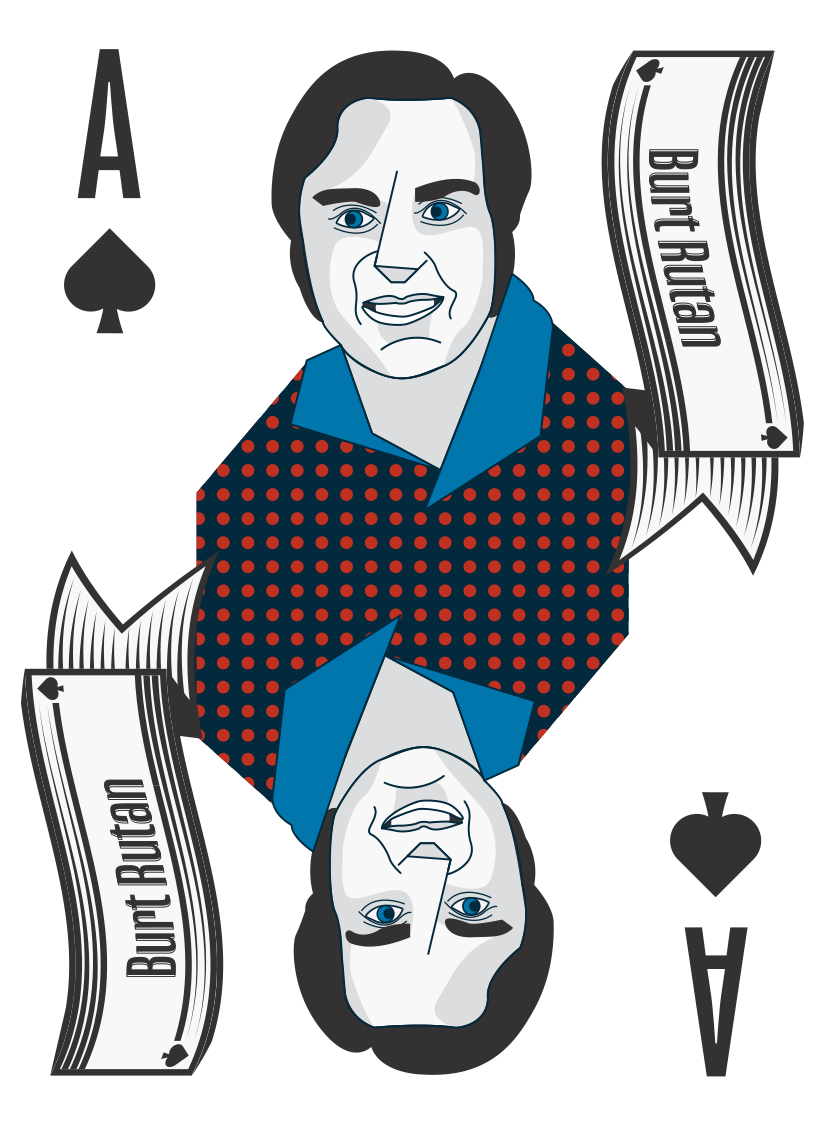
- Born: June 17, 1943
- Death: (age 75)
- Known For: Unique aircraft designs
Burt Rutan
Elbert Leander “Burt” Rutan is a retired American aerospace engineer noted for his originality in designing light, strong, unusual-looking, energy-efficient aircrafts. Burt Rutan displayed an early interest in aircraft design. By the time he was eight years old he was designing and building model aircraft. His first solo flight piloting an airplane was in an Aeronca Champ in 1959. In 1965 he graduated third in his class from the California Polytechnic State University with a BS degree in aeronautical engineering. From 1965 to 1972 Rutan was a civilian flight test project engineer for the U.S. Air Force at Edwards Air Force Base. He left to become Director of Development of the BD-5 aircraft for Bede Aircraft in Newton, Kansas, a position he held until 1974. In June 1974, Rutan returned to California to establish the Rutan Aircraft Factory. In this business he designed and developed prototypes for several aircraft, mostly intended for amateur builders. His first design, executed while he was still at Bede, was the VariViggen, a two-seat pushersingle-engine craft of canard configuration. The canard would become a feature of many Rutan designs, notably the very popular VariEze and Long-EZ. In April 1982, Rutan founded Scaled Composites, LLC, which has become one of the world’s pre-eminent aircraft design and prototyping facilities. Scaled Composites is headquartered in Mojave, California, at the Mojave Air & Space Port. He designed the record-breaking Voyager, which in 1986 was the first plane to fly around the world without stopping or refueling, and the sub-orbital spaceplane SpaceShipOne, which won the Ansari X-Prize in 2004 for becoming the first privately funded spacecraft to enter the realm of space twice within a two-week period. With his VariEze and Long-EZ designs, Rutan is responsible for helping popularize both the canard configuration and the use of moldless composite construction in the homebuilt aircraft industry. He has designed 46 aircraft throughout his career, been the co-recipient of the Collier Trophy and has won over 100 different awards for aerospace design and development.


- Role: Homebuilt Aircraft
- Manufacturer: Rutan Aircraft Factory
- Designer: Burt Rutan
- First Flight: May 21, 1975
- Produced: 1975 - Present
- Number Built: 400+
- Unit Cost: N/A
- Top Speed: 195 mph
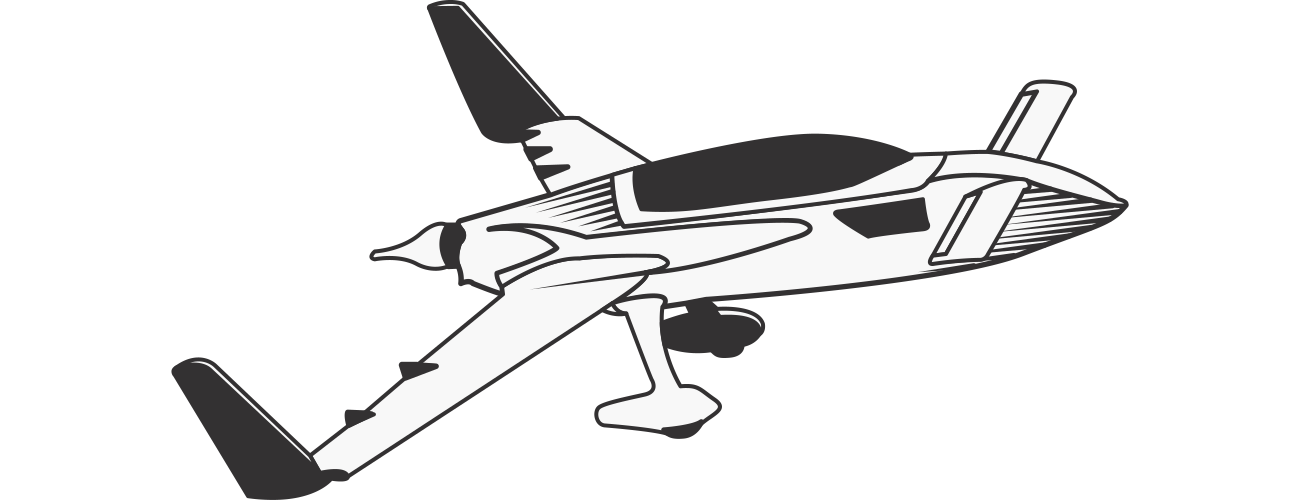
Rutan VariEze
This iconic homebuilt aircraft is a composite, canard aircraft designed by Burt Rutan. Hundreds of these high-performance homebuilt aircrafts have been made. The VariEze is credited with popularizing the canard configuration and composite construction for homebuilt aircraft. The VariEze design grew from Rutan’s experience designing and building the VariViggen, which began in 1974. After four months of construction the first model flew on May 21, 1975. In a departure from the traditional vertical and horizontal tail configuration similar to the tail feathers of an arrow, the VariEze received a Rutan hallmark: a smaller forewing or canard and large winglets at the tips of the larger main rear wing. The VariEze grew in popularity when Dick Rutan flew the plane at a popular air show, Oshkosh. After Oshkosh, Rutan redesigned the plane so that it could be sold as a set of plans. The plans went up for sale and approximately 2,00 aircrafts were under construction in 1980. This quickly became the most built kit plane of all time. The success of this aircraft launched Rutan’s career, resulting in the construction of dozens of aircraft, five of which reside in the Smithsonian National Air And Space Museum.


- Role: Multirole Fighter / Air Superiority Fighter
- Manufacturer: Lockheed Martin, General Dynamics
- Designer: Lockheed Martin, General Dynamics
- First Flight: January 20, 1974
- Produced: 1973 - Present
- Number Built: 4,588
- Unit Cost: $18,800,000 (1998)
- Top Speed: 1500 mph
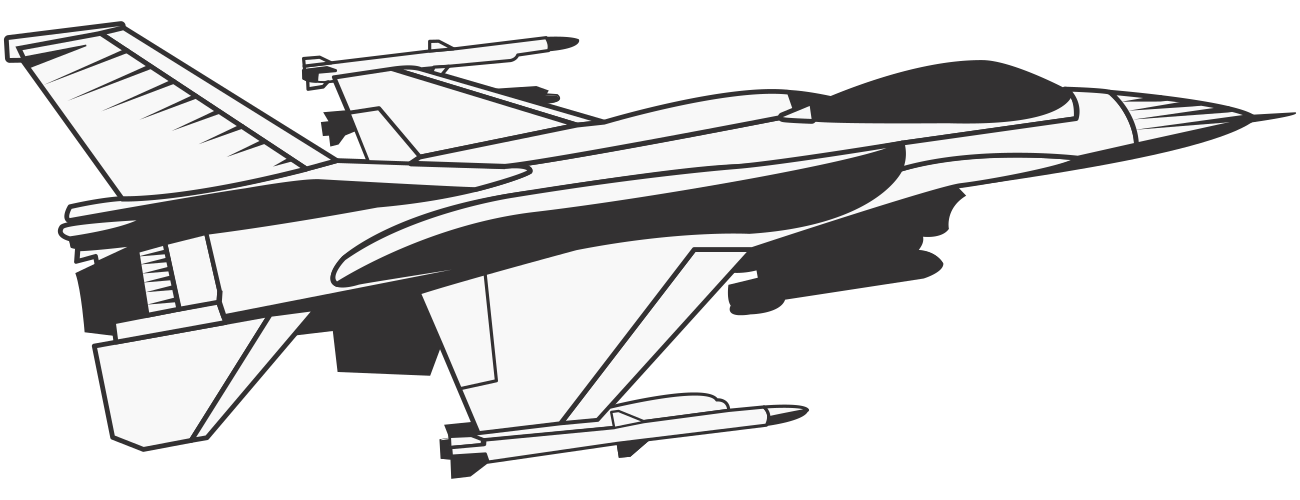
F-16 Fighting Falcon
The F-16 Fighting Falcon is a single-engine supersonic multirole fighter aircraft. It was originally developed by General Dynamics in 1973 and was later produced by Lockheed Martin after a merger in 1995. This led to the continued production for the United States Air Force. The F-16 was designed as an air superiority day fighter and quickly evolved into a successful all-weather multirole aircraft. Since production was approved in 1976, over 4,500 F-16s have been built. It is much smaller and lighter than predecessors, but uses advanced aerodynamics and avionics, including the first use of a relaxed static stability/fly-by-wire flight control system, to achieve enhanced maneuver performance. Also unlike earlier generations of fighter planes the F-16 was designed to be relatively inexpensive to build and more simple to maintain. The Fighting Falcon can reach a maximum speed over Mach 2, a speed twice as fast as the speed of sound. Other important innovations found in this aircraft are its frameless bubble canopy that gives pilots greater, unrestricted visibility. The F-16 was also designed to be aerodynamically unstable, which gives the aircraft more maneuverability but decreases the controllability. Today the F-16 is in the military fleets of more than 25 nations across the globe.

- Role: Multirole Fighter
- Manufacturer: McDonnell Douglas
- Designer: McDonnell Douglas
- First Flight: November 18, 1978
- Produced: 1974 - Present
- Number Built: 1,480
- Unit Cost: $29,000,000–$57,000,000
- Top Speed: 1,190 mph
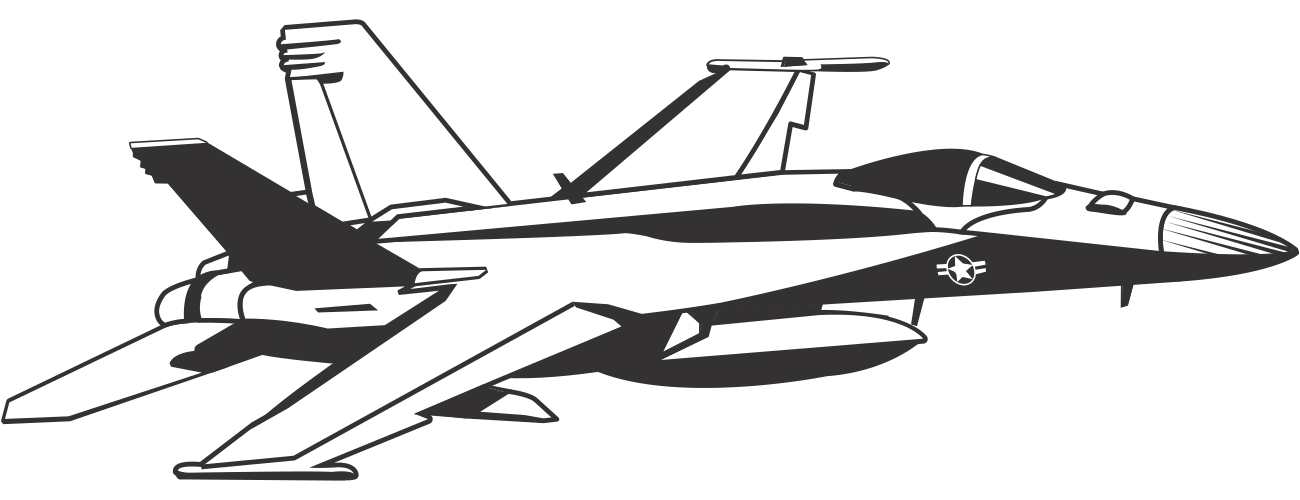
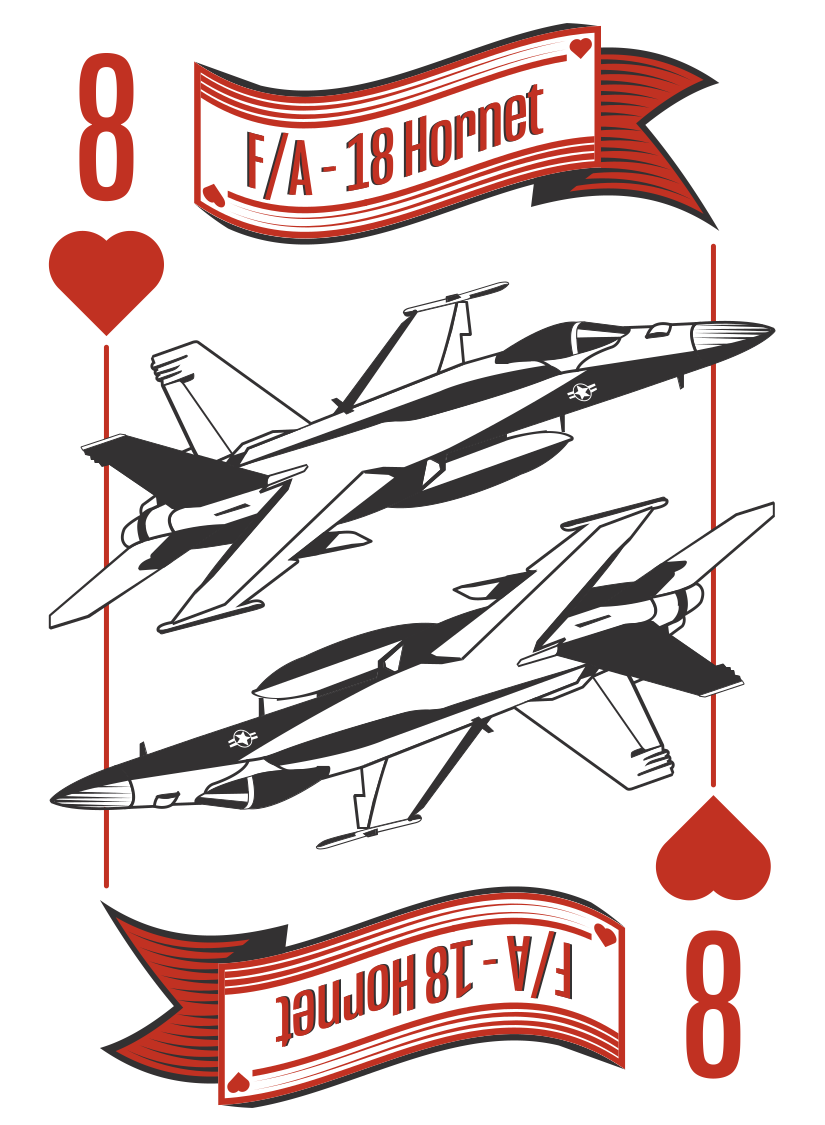
F/A - 18 Hornet
This twin-engine, supersonic, all-weather, carrier-capable, multirole combat jet can bring the pain. The F/A (fighter and attack aircraft) 18 Hornet was designed by McDonnell Douglas, now Boeing and Northrop. The F/A-18 design was based off of the YF-17 aircraft and intended to replace other multirole jets in the U.S. Navy and Marine Corps. The first F/A-18 flew on November 18th 1978 with Navy colors on one side and Marine colors on the other. It first saw military combat action in the Gulf and Iraq War. This beast of an aircraft has a top speed of Mach 1.8 or for the layman, 1,190 mph. The F-18 is a mid-wing, multi-mission tactical aircraft that can carry a wide array of bombs and missiles. It also has air-to-air and air-to-ground supplements. Its good thrust-to-weight ratio allows the Hornet to be extremely maneuverable and controllable at high angles of attack. The high angles of attack are achievable because of the distinguished canted vertical stabilizers found in the design of the F/A-18. Another notable design feature is the emphasis to design to reduce maintenance. This has resulted in far less downtime than its heavier counterparts. This cost efficiency allows the planes to still be active and in service.

- Role: Experimental Aircraft
- Manufacturer: AeroVironment
- Designer: Paul MacCready
- First Flight: 1979
- Produced: 1977 - 1979
- Number Built: 2
- Unit Cost: $200,000 (2016)
- Top Speed: 18 mph
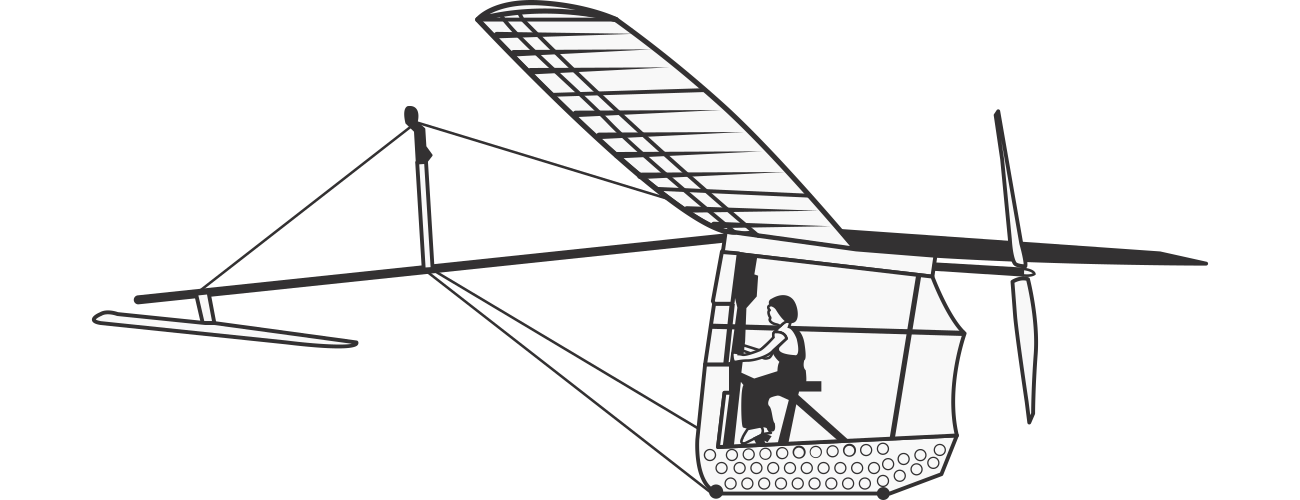
Gossamer Albatross
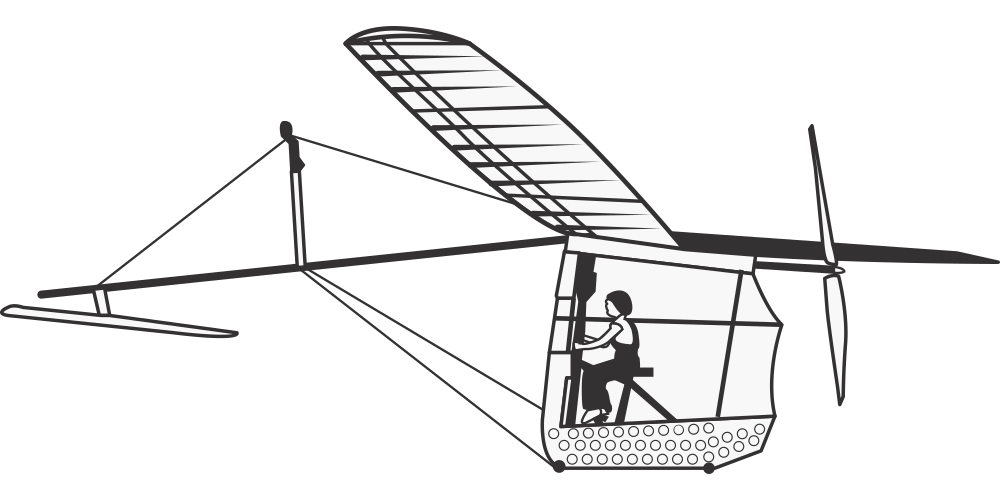
The Gossamer Albatross is a human-powered aircraft built by American Aeronautical engineer Dr. Paul B. MacCready’s company AeroVironment. The Gossamer Albatross is famous for successfully crossing the English Channel to win the second Kremer prize. The aircraft was designed and built by a team led by Paul B. MacCready, who won the first Kremer prize with his design of the Gossamer Condor. The second challenge was then announced in 1977 as a flight across the English Channel, recalling Louis Blériot’s crossing in 1909. The Albatross is of canard configuration, using a large horizontal stabilizer forward of the wing similar to the Wright brothers’ successful Wright Flyer aircraft and powered by suing pedals to drive a large, two-bladed propeller. The aircraft was constructed using a carbon fiber frame with long tapered wings wrapped in a thin plastic Mylar. The Albatross weighed in at a mere 71 lbs. On June 12, 1979 amateur cyclist and pilot Bryan Allen powered the Albatross across the English Channel in 2 hours and 49 minutes and achieved a top speed of 18mph. Today the Gossamer Albatross II is currently on display at the Museum of Flight in Seattle.
1980
The last quarter of the 20th century saw a change of emphasis. No longer was revolutionary progress made in flight speeds, distances and materials technology. This part of the century instead saw the spreading of the digital revolution both in flight avionics and in aircraft design and manufacturing techniques. In 1986 Dick Rutan and Jeana Yeager flew an aircraft, the Rutan Voyager, around the world unrefueled, and without landing.


- Born: July 1, 1938
- Death: (age 80 years)
- Known For: First non-stop flight around the globe with Jeana Yeager.
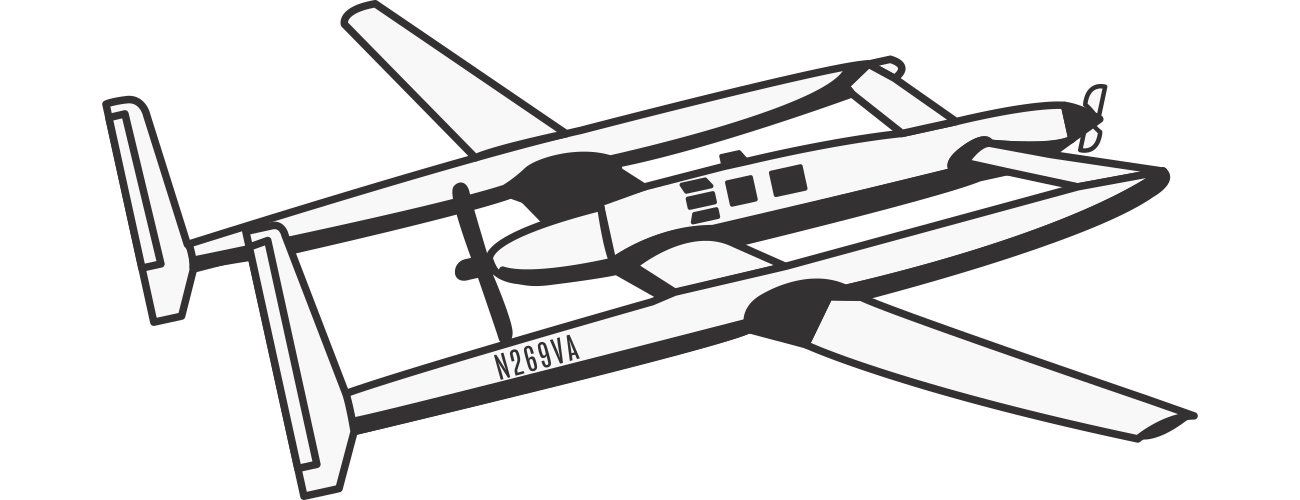
Dick Rutan
Richard Glenn “Dick” Rutan is a retired United States Air Force pilot and record-breaking aviator. He was born in Loma Linda, California, where he gained an interest in flight at a young age. He is the older brother of aerospace designer Burt Rutan. He began his military career joining the Air Force Aviation Cadet Program at age 19, later becoming an Air Force lieutenant. Rutan served during the Vietnam War as one of the founding members of the “Mistys” of Operation Commando Sabre, pioneering the use of tactical jets as a “FastFAC” (known as forward air control) for the FAC Airborne mission, which searched for and marked targets with white phosphorus rockets ahead of the strike package. He flew 325 missions but had to eject when his “Hun” F-100 Super Sabre aircraft was hit. Later, based at RAF Lakenheath, Rutan had to eject a second time in his Air Force career when his aircraft suffered an engine failure over England. During his career with the Air Force, Rutan was awarded the Silver Star, five Distinguished Flying Crosses, 16 Air Medals, and a Purple Heart. He retired from the Air Force in 1978 with the rank of lieutenant colonel. Rutan also acted as a test pilot throughout his career, flying multiple designs such as the Fairchild T-46 in 1981 and the XCOR EZ-Rocket in 2001. From December 14 to December 23, 1986, Rutan flew with Jeana Yeager on the first unrefueled non-stop flight around the world in the Rutan Voyager, a design by his brother Burt. The flight attracted worldwide media coverage and set multiple records. Rutan and Yeager were awarded the Gold Medal of the Royal Aero Club, UK, the same year. In 1997, Dick Rutan and Mike Melvill flew two Long-Eze aircraft that they built side-by-side around the world. This “around the world in 80 nights” flight was called The Spirit of EAA Friendship World Tour and lasted 80 days, as you may have guessed.


- Born: May 18, 1952
- Death: (age 66)
- Known For: First non-stop flight around the globe with Dick Rutan.
Jeana Yeager
Jeana Lee Yeager is an American aviator. She is not related to Chuck Yeager however. Jeana Lee Yeager was born on May 18, 1952, in Fort Worth, Texas, moving with her family to Garland, Texas; Oxnard, California; and Commerce, Texas. Following graduation from high school she worked as a draftsman and surveyor for a geothermal energy company in Santa Rosa, California. In 1978, she obtained her private pilot’s license while still living in Santa Rosa. Jeana went to work for Robert Truax who was developing a reusable spacecraft. She met Dick Rutan in 1980 and they soon both set distance records in the Rutan VariEze and Long-EZ planes, designed by Dick’s brother Burt Rutan. In early 1982, Jeana set a new women’s speed record for the 2,000-kilometer closed course and in the fall of 1984 using the VariEze, she set the open-distance record of 2,427.1 statute miles. Jeana and Dick Rutan decided to attempt to fly around the world without refueling. They formed Voyager Aircraft, Inc., and Burt Rutan began designing the aircraft. Initially unable to find a commercial sponsor, Jeana started the Voyager Impressive People (VIP) program, which became the major source of money to build, test, and fly the aircraft. By mid-1986, Voyager was ready for the flight. She flew as copilot on the 216-hour flight and set a world absolute distance record. This was the first time a woman had been listed in an absolute category. She co-piloted, along with Dick Rutan, the first non-stop, non-refueled flight around the world in the Rutan Voyager aircraft from December 14 to 23, 1986. The flight took 9 days, 3 minutes, and 44 seconds and covered 24,986 miles more than doubling the old distance record set by a Boeing B-52 bomber in 1962. In recognition of the Voyager flight, she received the Harmon Trophy, the FAI De la Vaulx Medal, the Presidential Citizens Medal from President Ronald Reagan and the Collier Trophy, its first female recipient —receiving along with Dick and Burt Rutan.


- Role: Record Plane
- Manufacturer: Rutan Aircraft Factory
- Designer: Burt Rutan
- First Flight: June 22, 1984
- Produced: 1981 - 1984
- Number Built: 1
- Unit Cost: $2,000,000 (1984)
- Top Speed: 122 mph
Rutan Voyager
The Rutan Voyager is a record setting aircraft famous for being the first aircraft to fly around the world without stopping or refueling. The Voyager was piloted by Dick Rutan and Jenna Yeager and took off on December 14, 1986 at Edwards Air Force Base and landed in the same spot 9 days later. Jenna Yeager, Dick Rutan and Dick’s Brother Burt Rutan first imagined the aircraft when they were at lunch in 1981. Like all great ideas the concept for the Voyager was sketched on a napkin at this lunch. The Voyager was built by a group of volunteers over a five-year period in Mojave, California. The frame of the Airplane was largely made of fiberglass, carbon fiber and Kevlar and weighed only 939 pounds when empty. However when it took off for its historic flight it weighed 9,694.5 pounds. The Voyager was powered by one forward and one rear-facing propeller attached to separate engines, the aircraft would average an altitude of 11,000 feet and a speed of 116 mph during its nine-day non-stop journey. In front of 55,000 spectators and a large press contingent, including 23 live feeds breaking into scheduled broadcasting across Europe and North America, the plane safely came back to earth, touching down at 8:06 a.m. at the same airfield 9 days later.
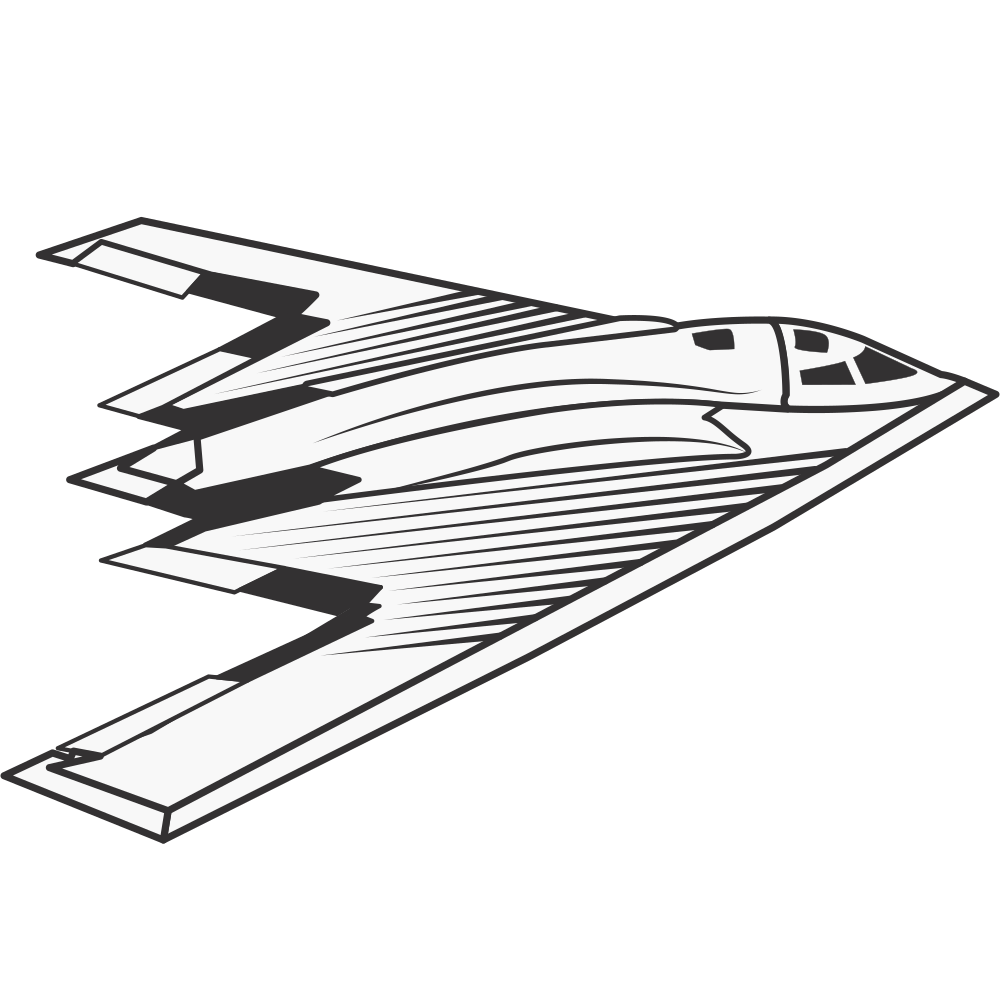
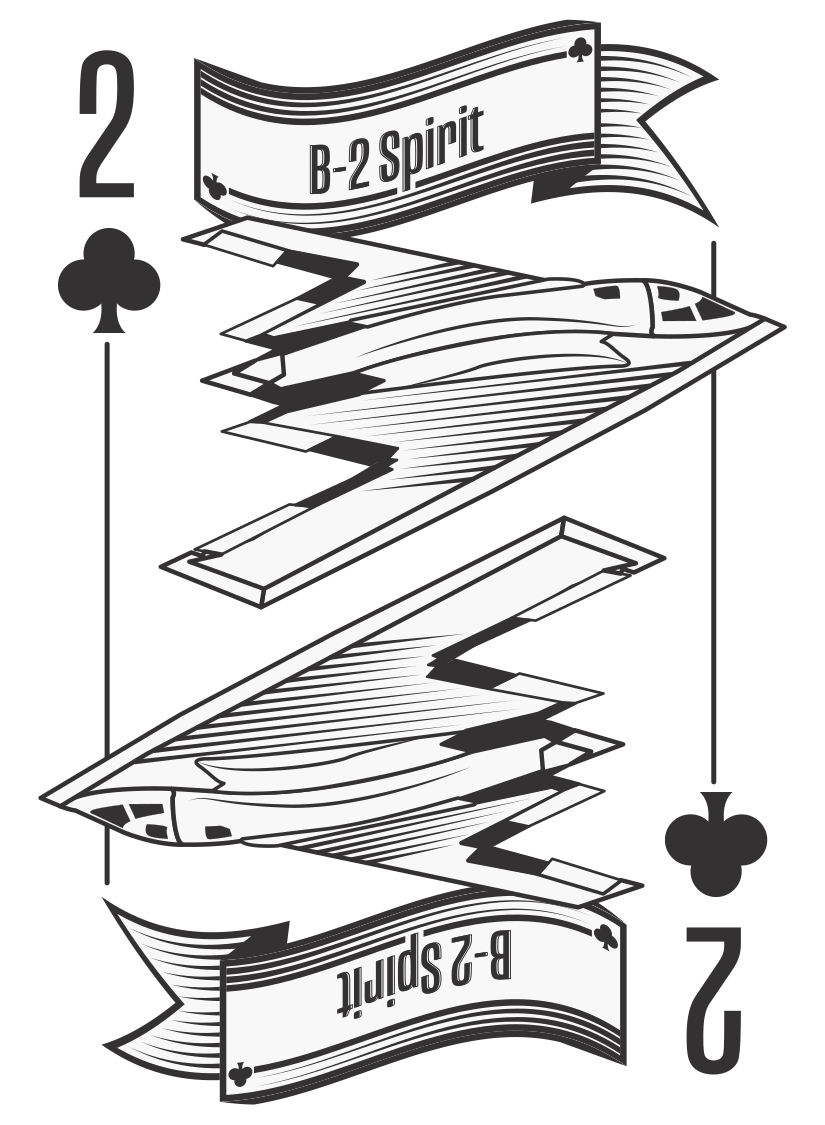
- Role: Stealth strategic heavy bomber
- Manufacturer: Northrop Corporation
- Designer: Northrop Grumman
- First Flight: July 17, 1989
- Produced: 1987 - 2000
- Number Built: 21
- Unit Cost: $737,000,000 (1997)
- Top Speed: 628 mph
B-2 Spirit
The Northrop Grumman B-2 Spirit, also known as the Stealth Bomber, is an American heavy penetration strategic bomber. The bomber had a secret design and development, it was considered a gray project and two people involved in the project tried selling classified information about the design to foreign countries. Both of the people served lengthy prison sentences. To manufacture the bombers, a former Ford assembly plant in California, was acquired and rebuilt. Even the plants employees were sworn to complete secrecy regarding their work and staff members were routinely subjected to polygraph examinations. The B-2 was first publicly displayed in November of 1988 and even the viewing was heavily restricted. The bombers first combat debut was in 1999, during the Kosovo War where it was responsible for destroying 33% of selected targets in the first eight weeks of U.S. involvement in the War. The B-2 is capable of all-altitude missions up to 50,000 feet, with a range of more than 6,900 miles. The stealth of this bomber comes from a combination of reduced acoustic, infrared, visual and radar signatures to evade the various detection systems. Today there are 20 B-2s in the United States Air Force, which plans to keep them in operation until 2032. Which means they would have been in service for over 40 years.


- Role: V/STOL Military Transport Aircraft
- Manufacturer: Bell Helicopter, Boeing Defense
- Designer: Bell Helicopter, Boeing Defense
- First Flight: March 19, 1989
- Produced: 1988 - Present
- Number Built: 200+
- Unit Cost: $71,300,000 (2005)
- Top Speed: 351 mph
V-22 Osprey
The Bell Boeing V-22 Osprey is an American Multi-mission, tiltrotor military aircraft with both vertical takeoff and landing also known as VTOL. Bell Helicopter and Boeing Helicopters created the Osprey in a joint effort for the United States Department of Defense. The need for a new long-range, high-speed, vertical-takeoff aircraft was brought to the attention of the U.S. Department of Defense because of the failure of Operation Eagle Claw during the Iran hostage crisis in 1980. The Osprey is the world’s first production tiltrotor aircraft, with one three-bladed proprotor, turboprop engine and transmission nacelle mounted on each wingtip. Once airborne, the nacelles rotate forward 90 degrees in as little as 12 seconds for horizontal flight, converting the V-22 to a more fuel-efficient, higher speed turboprop aircraft. When the V-22 needs to be stored the rotors fold in 90 seconds and its wings rotate to align front-to-back, with the fuselage. Despite controversy about cost overruns and allegations that the V-22 was unsafe and inadequate for the mission, the Osprey survived and even flourished in active service with both the U.S. Marine Corps and the U.S. Air Force while deployed in transportation and medevac operations.

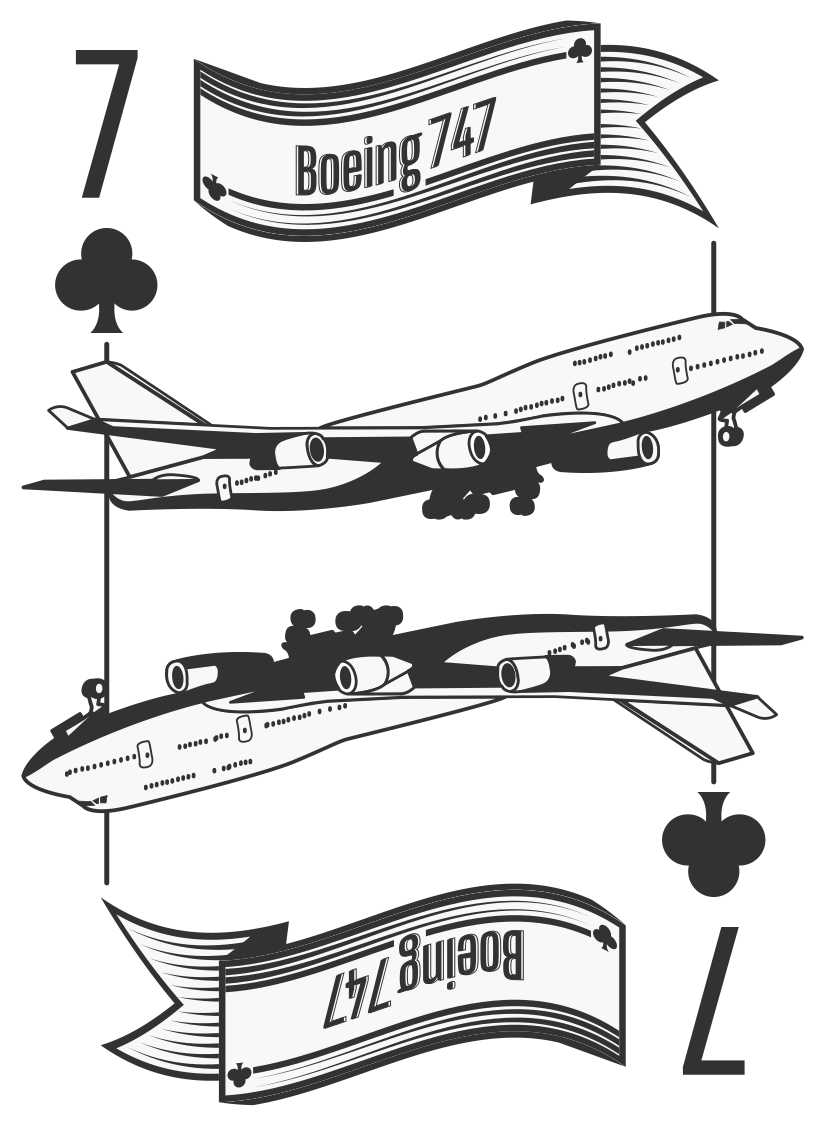
- Role: Wide-body Jet Airliner
- Manufacturer: Boeing Commercial Airplanes
- Designer: Boeing Commercial Airplanes
- First Flight: February 9, 1969
- Produced: 1968 - Present
- Number Built: 1,548
- Unit Cost: $83,000,000 (1982)
- Top Speed: 614 mph
Boeing 747
The Boeing 747 or “Jumbo Jet” is an American wide-body commercial jet airliner and cargo aircraft. The 747s have a distinctive hump upper deck along the forward part of the aircraft that has made it one of the most recognizable aircraft. The 747 is the first wide-body airplane manufactured. Boeing’s Commercial Airplane unit located in United States created the 747, which held the passenger capacity record for 37 years. The 747 could hold up to 660 passengers in a high-density one-class configuration. The 747 are more than twice the size of any existing airliner of the day. Back before computer-aided design, engineers’ hand-sketched 75,000 technical drawings and built a full-scale plywood mockup to ensure the pieces would fit. The 747 has four wing-mounted engines and its wings have a high sweep angle of 37.5 degrees for a fast, efficient cruise. The sweep also reduces the size of the wingspan of the massive plane allowing it to be stored in pre-existing hangars. To date, 1,500 have been sold and many more are on order. The 747s have moved more than 3.5 billion people—the equivalent of half the world’s population. Its jobs have included transporting the President of the United States and ferrying the Space Shuttle piggyback-style.
1990
Unfortunately none of the Illustrations found in this deck are from the 1990s. Does this mean aviation ceased to exist in the 90s? Of course not! In 1999 Bertrand Piccard became the first person to circle the earth in a balloon. Other achievements included the digital fly-by-wire system that allows an aircraft to be designed with relaxed static stability. Initially used to increase the maneuverability of military aircraft such as the General Dynamics F-16 Fighting Falcon, this is now being used to reduce drag on commercial airliners. 21st century aviation has seen increasing interest in fuel savings and fuel diversification, as well as low cost airlines and facilities. Additionally, much of the developing world that did not have good access to air transport has been steadily adding aircraft and facilities, though severe congestion remains a problem in many up and coming nations. About 20,000 city pairs are served by commercial aviation, up from less than 10,000 as recently as 1996.
2000

- Role: Intercontinental Business Jet
- Manufacturer: Dassault Aviation
- Designer: Richard Petri
- First Flight: May 5, 2005
- Produced: 2005 - Present
- Number Built: 260+
- Unit Cost: $52,300,000 (2008)
- Top Speed: 592 mph
Dassault Falcon 7X
The Dassault Falcon 7X is the largest business jet manufactured by Dassault Aviation. This classy French-built aircraft is a three-engine cantilever monoplane with a low-positioned, highly swept wing. The Falcon 7X features the three rear-mounted Pratt & Whitney PW307A turbo fan engines two on the side of the fuselage and another in a center position. This jet has room for 20 passengers and 2 crewmembers. The Falcon 7X has a notable origin, it’s considered to be the first aircraft to be designed entirely on a virtual platform. It was designed on the platform Dassault Systems developed, Computer Aided Three-Dimensional Interactive Application or CATIA. The same software was also used by Boeing to design the Boeing 777 and 787. The plane was first debuted at the 2001 Paris Air Show and had its first flight in 2005. Also of note, due to the special engine mounts and cabin isolators the cabin is very silent. If you can believe it, this plane’s $35 million price tag was $10 million cheaper than it’s nearest long-range, large-cabin market competitor. More than 260 Falcon7X have been delivered to clients spanning the globe. This aircraft also comes with a shower!
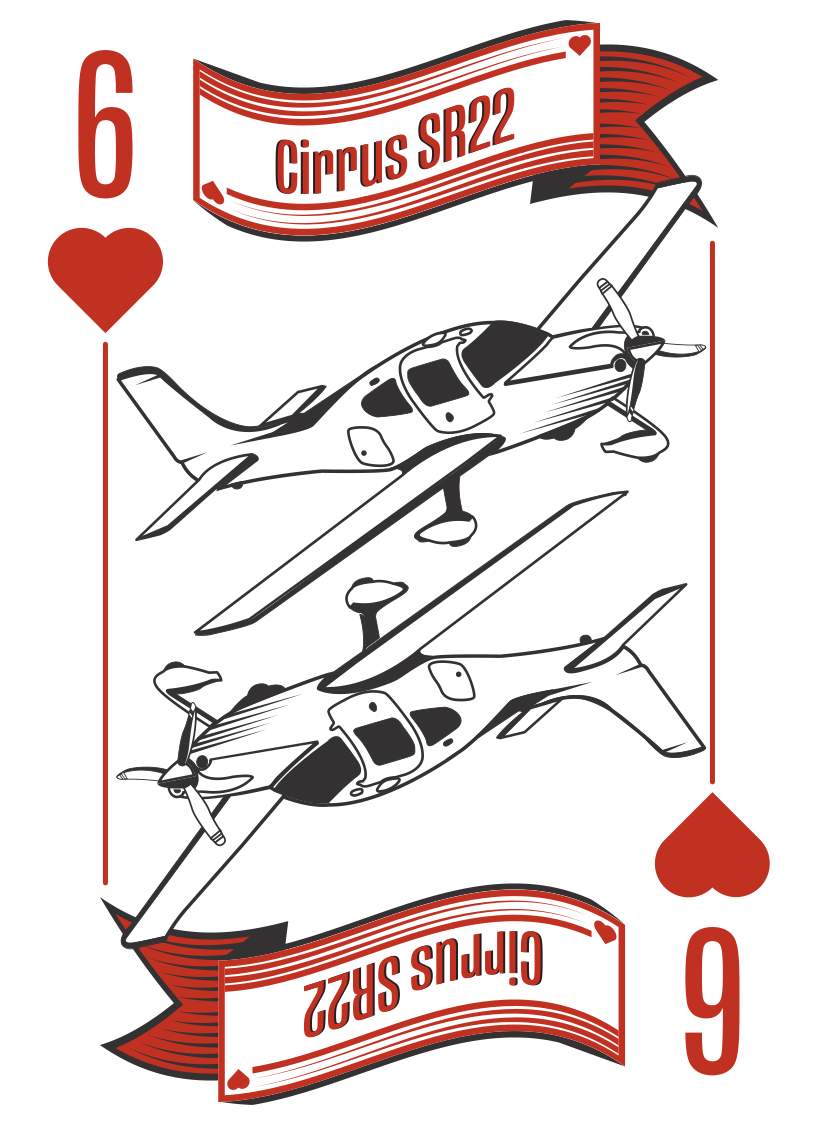
- Role: Civil Utility Aircraft
- Manufacturer: Cirrus Aircraft
- Designer: Cirrus Aircraft
- First Flight: November 2000
- Produced: 2001 - Present
- Number Built: 5,194
- Unit Cost: $540,000 (2017)
- Top Speed: 234 mph
Cirrus SR22
The Cirrus SR22 is an iconic civil utility aircraft. Built for the first time in 2001 by Cirrus Aircraft of Duluth Minnesota, this composite aircraft can seat four or five and has a single engine. The SR22 is generally touted as the best selling general aviation airplane every year since 2003. Over 5,194 units have been delivered from 2001 – 2017. The SR22 features a low wing cantilever monoplane of composite construction. Its fitted with fixed tricycle landing gear and is powered by a nose-mounted 310 hp Continental IO-550-N piston engine. This plane separates itself from the competition with its whole-plane emergency recovery parachute system, the Cirrus Airframe Parachute System or CAPS. This unique feature has contributed to its market success and birthed the nickname “Plane with the parachute.” Because of this its been credited with saving over 150 lives. The SR22 was even used to set a record; Ryan Campbell used an SR22 to become the youngest pilot to fly solo around the world, at the age of nineteen. He modified his SR22 by removing three seats and adding a 160 U.S. Gallon fuselage to create a total tank of 250 gallons. Unfortunately he only held this record for less than a year. Nonetheless the Cirrus SR22 remains one of the best general aviation aircrafts ever made.
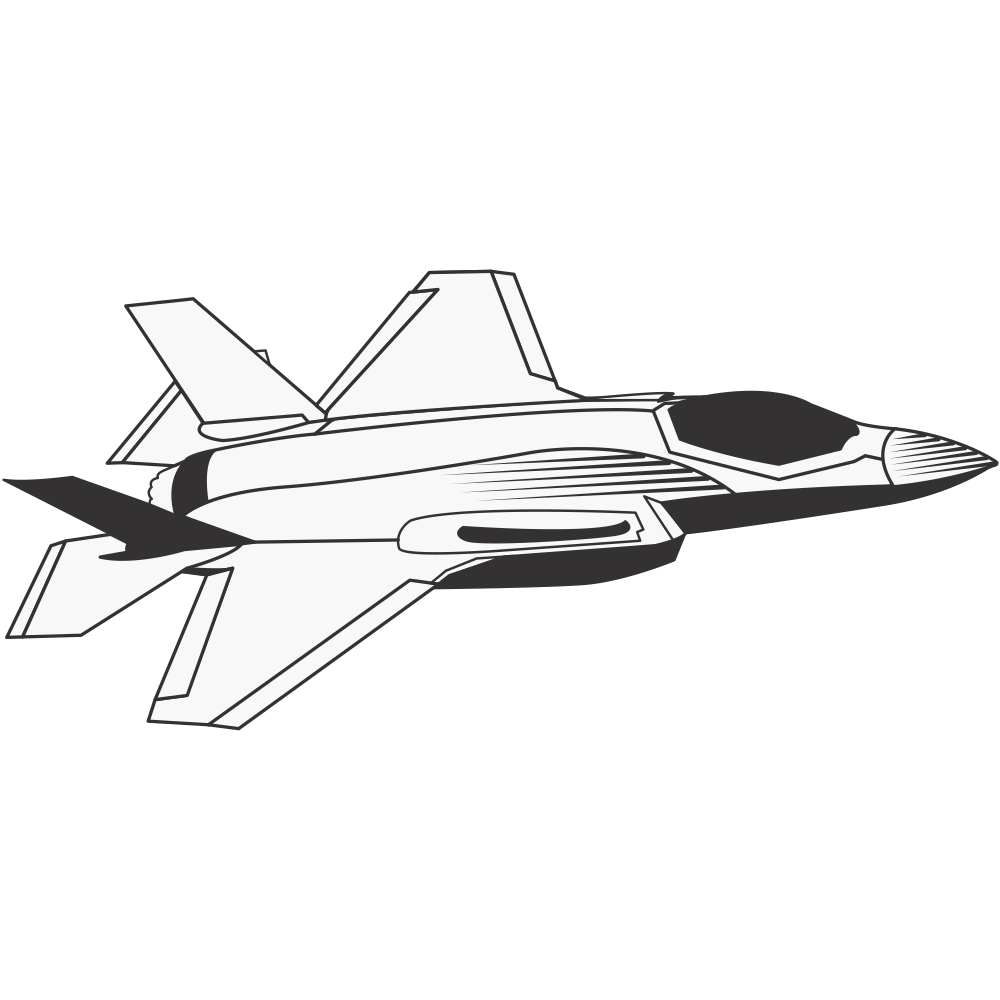
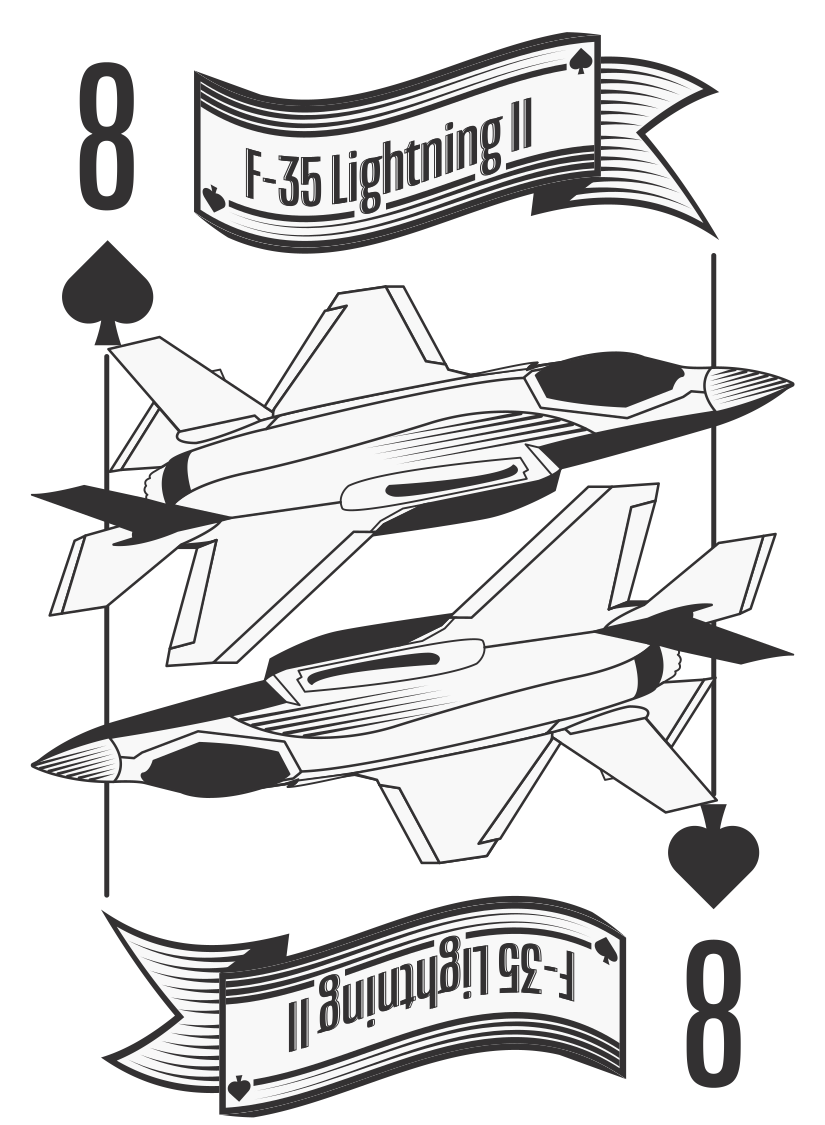
- Role: Stealth Multirole Fighter
- Manufacturer: Lockheed Martin Aeronautics
- Designer: Lockheed Martin Aeronautics
- First Flight: December 15, 2006
- Produced: 2006 - Present
- Number Built: 320+
- Unit Cost: $85,000,000 (2013)
- Top Speed: 1,200 mph
F-35 Lightning II
The Lockheed Martin F-35 Lightning II is a single-seat, single engine, all-weather stealth multirole fighter. It is among the fifth-generation combat aircrafts and is designed to perform ground-attack and air-superiority missions. The F-35 first flew in 2006 and is now seen as the upcoming workhorse of the U.S. military. The F-35 series has a projected service life of up to 2070. The F-35 program has become the most expensive military program but has an important role as the replacements for the U.S. military’s aging fleet of F-16s and F/A-18s. At nearly $400 billion for 2,457 aircraft, the price has doubled the original estimates and delays to the development program have surpassed three years. There are many improvements over current-generation fighter aircrafts such as durable, low-maintenance stealth technology and integrated avionics and sensor fusion that combine information from off and on-board sensors to increase the pilot’s awareness. The F-35 also features a modern and updated flight simulator, which may be used for a greater fraction of pilot training in order to reduce the costly light hours of the actual aircraft. The F-35 has been designed with stealth in mind; it has a low radar cross-section due to the shape of the aircraft and some of the fiber-mat material used in its construction.
- Role: Homebuilt Aircraft
- Designers: Charles Roloff, Carl Unger and Bob Liposky
- First Flight: April 28, 1927
- Produced: 1964 - Present
- Number Built: About 1,000
- Unit Cost: $3,065 (1971)
- Top Speed: 133 mph
The Breezy & Arnie Zimmerman
The Jokers in this deck are dedicated to my grandpa Arnie Zimmerman and the plane he used to bring joy to so many. The RLU-1 Breezy is a homebuilt aircraft known for its “no cockpit” high wing pusher configuration. It is designed to seat the pilot and passenger with a maximum unobstructed view. Designed and built by Charles Roloff, Robert Liposky and Carl Unger, the original Breezy used a modified set of Piper PA-12 wings. At the 2014 EAA AirVenture Oshkosh there was a series of special events to celebrate the 50th anniversary of the design, including a fly-in of Breezys. Arnie Zimmerman, of Downers Grove, built his Breezy, an open-air contraption of metal tubing and poly fiber, in 1998. He uses it to give hundreds of rides a year to stoke aviation enthusiasm among young people. Arnie’s value within the aviation community was most aptly summed up in 2010 by an inscription made in granite, and paved into a commemorative walkway under the Brown Arch at EAA’s convention grounds in Oshkosh. It reads, “Arnie Zimmerman... You have touched the lives of thousands, young and old, by giving them the simple but precious gift of an airplane ride. Thank you for sharing the magic of flight here at Oshkosh in your homebuilt ‘Breezy.’ I’m proud to say that he has definitely stoked aviation enthusiasm in myself.
- Role: Commercial Airliner
- Manufacturer: Boeing Commercial Airlines
- Designer: Boeing Commercial Airlines
- First Flight: December 15, 2009
- Produced: 2007 - Present
- Number Built: 742
- Unit Cost: $239,000,000
- Top Speed: 593 mph
Boeing 787
The Boeing 787 is an American long haul, mid-size wide-body, twin-engine jet airliner made by Boeing Commercial Airplanes. The 787 program cost Boeing $32 Billion and in 2013 the 787 Program was expected to be profitable after 1,100 aircrafts have been sold. The aircraft is 80% composite by volume; aluminum has been used throughout the wing and tail leading edges. External features include a smooth nose contour, raked wingtips and engine nacelles with noise-reducing serrated edges. The longest-range 787 variant can fly 8,000-8,500 nautical miles, which is enough to go from New York City to Hong Kong. The 787’s are designed to typically seat 234 passengers in a three-class setup. A fly-by-wire flight system replaces traditional hydraulic/bleed air power systems in favor of electric servos to manipulate control surfaces. Major aerodynamic improvements combined with all new engines resulted in a 20 percent increase in fuel efficiency over the Boeing 767 that the 787’s are replacing. There are currently 675 Boeing 787 aircrafts in airline service as of July 2018.

- Role: Business Jet
- Manufacturer: Gulfstream Aerospace
- Designer: Gulfstream Aerospace
- First Flight: May 18, 2015
- Produced: 2014 - Present
- Number Built: 5
- Unit Cost: $42,000,000 (2010)
- Top Speed: 585 mph
Gulfstream G500
The Gulfstream G500 is a twin-engine business jet designed and manufactured by Gulfstream Aerospace. This aircraft was unveiled on October 14, 2014 and during the second quarter of 2017 80% of Gulfstream orders were for the G500. The new Gulfstream jet features fly-by-wire active side-stick that provides visual and tactile feedback for the flight crew—technology previously available only for military aircraft. This feedback through the flight control stick allows both the pilot and copilot to track and feel the controls of each other and the autopilot. Flight instruments are brilliantly displayed by Honeywell’s Symmetry flight deck. There are 10 touchscreen controllers providing pilots with a tremendous amount of flight information. The integrated touchscreens will give crew access to system controls, flight management, communications, checklists, and monitoring weather and flight information. The G500 made its maiden flight earlier in 2015 demonstrating an unprecedented level of technology by delivering a more fuel efficient, fast aircraft but improvements in safety as well.
Hopefully this site has shed some light on the wondrous topic of aviation. With every product we create we aim to faithfully describe and explore a subject. As this book illustrates both literally and metaphorically, aviation is something that has drastically influenced all of our lives. Since Wilbur and Orville Wright first took flight in 1903 we as a society have made tremendous strides to make the world smaller through aviation. In aviation’s just over century long life it has already mad a profound impact on our way of life. Planes deliver all things, from people and packages to bombs and troops. In a plane we went faster than the speed of sound. In a plane we can ride to visit our relatives and loved ones. It is the planes that gave us an evolved perspective of our world. It was the technology found in aviation that got us to the moon and birthed the realistic idea of space travel. Hopefully this book illustrates that like humans, planes come in all different shapes, and sizes and all have different purposes. As we grow as a species so to does our desire for exploration and innovation, aviation has fueled this desire. We must remember that aviation has been a tool used to bring joy and wonder to civilization.
 ☰
☰